achyutktelang blogspot

  • Subscribe to our RSS feed.
  • Twitter
  • StumbleUpon
  • Reddit
  • Facebook
  • Digg

четвер, 23 травня 2013 р.

Pharmageddon: JOHN DIES AT THE END (2012) and fuzzy horror

Posted on 13:58 by jackichain

As John Carpenter ages into his RED LINE 7000 phase, a horror genius named Don Coscarelli has quietly stolen the title of the new Hawksian Drive-in fuzzy horror guru. What is fuzzy horror? I can only tell you it encompasses all of Coscarelli's films, the early Sam Raimi, some Cronenberg, John Carpenter til he started doing cable TV, Quentin Tarantino if he ever made a horror movie. It's a loosey goosey termite art digging and goofing around - simultaneously mind-expanding and brain-addling. It never has to rely on vicious sexual violence, it understands normal healthy adult sex is the creepiest most uncanny thing ever, once you can finally see it clearly for what it is, stripped of all its alluring-in-the-heat-of-the-moment bark.

Who loves fuzzy horror? Any one who suddenly found themselves cheering watching BIG TROUBLE IN LITTLE CHINA just because it happened to be the 80s and never looked back, and has seen both THINGs more than a dozen times each. Why is it Hawksian? Because it's still scary even though it tends towards humor. It transcends genre and is based on character interaction, a droll shared language, the gallow's wit of RIO BRAVO, ONLY ANGELS HAVE WINGS, THE THING, THE BIG SLEEP, and TO HAVE AND HAVE NOT. And having interesting things to say and do because there's so much less pointless twisting and random acts of shock designed solely to get bad (better than no) publicity and it understands the two bros being cool language of deadpan calm and running jokes. Why fuzzy? Because it can get pretty sloppy, best to watch late at night, feeling good. Fuzzy horror rewards fuzzy viewing... and the films only get better with each new fuzzy view, cuz the earlier fuzzy has made you forget most of it anyway.


I won't go too much into JOHN DIES plot - you can just mosey over to Netflix streaming and watch it, and then come back to this scintillating post. But let's just say this - that dude up in that picture with the sunglasses and mysterious device? He played the infantry trainer ("Medic!") in STARSHIP TROOPERS, another fuzzy horror masterpiece.

I will say also that time looping is involved but I liked this film way way better than LOOPER. And I believe in time travel, if only via one's third eye, and when a movie makes the third eye hallucinations real instead of as dreams it works, because it's a movie and so exists totally on the hallucinatory level. Unfuzzy directors feel compelled to separate the two - what is just a dream and what is real - like we'll upend the apple cart if not brought safely back to the rut. An example of this unfuzziness is AMERICAN WEREWOLF IN LONDON, wherein the wolf must come out of David through grand physical agony or it won't be 'believable' --and the welcome eruption of Nazi werewolves with machine guns is revealed to be a dream. If John Landis made the dream the real and focused on those Nazi werewolves for the whole film, than hot damn, that would be hardcore fuzzy, and also a bit like the opening of THE SONG REMAINS THE SAME.


What mainstream science still can't quite admit, but which leading edge scientists are realizing to their amazement, is that the universe is totally subjective. If we can move past notions of size, perspective, relation, and spatial relativity, then space/time travel is possible regardless of the distances between solar systems. As humans with limited ESP ability (or, as with most scientists, none at all) we can't imagine space travel any other way except by carting our bodies from point A to point B, in a vessel relative to own size, but that doesn't mean we all won't one day be long past that limited conception of ourselves. If space itself is a vacuum, the idea of needing to travel a certain amount of miles to get there is foolishly short-sighted. Why not just collapse the vacuum? Why not merely shrink the space?

The closest we have to ESP as a legitimate science today is the cell phone and wireless router, but we take those things for granted the way in the 70s we took ESP for granted and would have laughed at the idea of cell phones being universal. Now we take for granted the sound waves that beam all over the globe constantly, billions of voices soaring up and down like ping pong balls between humans and satellite paddles, and yet we scoff at alien abductions. Is an alien abduction so different? How can anyone be so stupid?

Perhaps this is why what was absurd fiction a mere century ago is taken for granted today and yet no one dares broach the subject of dimensional travel's validity as a scientific fact! It is! And it's because the subjective experience of hardcore psychedelic drug trippers would then be valuable and science fears this. Fiction is truer than reality! Lovecraft was tapping into some really groovy shit, man. He knew the tentacles from the fifth dimensional rift were ever pulling that gate open between thought waves, sound waves, and the spontaneous materialization of physical matter.

All of which serves as a flawed introduction to my praise of Don Coscarelli, a man who I've written of in the past as being suspiciously like myself in extrasensory speculation, to the point that one of my pet intervention metaphors, self-performed eye surgery. Check out this exchange in the film after Dave calls a priest because John seems possessed.

Dave: What do you think it's like, Father?
Father Shellnut: What's what like?
Dave: Being crazy, mentally ill.
Father Shellnut: Well, they never know they're ill, do they? I mean, you can't diagnose yourself with the same organ that has the disease, just like you can't see your own eyeball. I suppose you just feel regular, and the rest of the world seems to go crazy around you.

Now check this from an old post of mine in the C-Influence:
Eyewitness testimony can be considered “fact” in a court of law but means nothing to science, which cripples itself through its dismissal of everything “subjective” as if there was something that wasn’t (...) Our collective disbelief about things beyond our comprehension is itself beyond comprehension, revealing the fundamental impossibility of trying to think about nature objectively from inside an organic brain (sort of like trying to perform eye surgery on yourself without a mirror) (5/27/11)
I have no choice, therefore--considering the film's avalanche of uncanny coincidence-- to believe the film was written by me in the future. 


I mean this as no disrespect to JOHN DIES' creators, Coscarelli and author James Wong (a pseudonym so they say), and of course all three of us are clearly inspired by Lovecraft, William S. (and Edgar Rice) Burroughs, Alan Moore, and Hunter S. Thompson, so who knows who I really am? I always hoped Lovecraft might read my work one day in a time travel loop and be inspired to write the Cthulu mythos based on my own August Derleth-based fiction. That's probably not in our immediate 'future' as I haven't written any but two things I do know, I once meant to, and if time is elastic and we are all one, then we are all one right now, connected through an elastic time tentacle, everyone of us, back and forth through time in order to play not just many parts ala Shakespeare but every part, right down to Vishnu, Indra and the former Indra ants in the Brahmavaivarta Purana. In other words, if you weren't me before, you are now, or will be. This is how we become our own great-grandmothers, and why Ramboona never fails.


Such weird collapse-of-time distortions in JOHN DIES AT THE END are only one of the great side effects of a black ooze-style drug dubbed 'soy sauce,' a mix of the black ooze from the X-FILES and the black centipede meat of the NAKED LUNCH, and the Black Sheep Dip from my own unpublished novel... and of course, probably, some real naturally amazing drugs like psilocybe mushrooms and Salvia Divinorum. Aside from time dilation, this soy sauce allows one a Zen-like calm as well as the ability to read minds and to astral travel, which includes visiting an interzone-style alternate reality to invest in biotech that was a literal fusion of biological material into technology, to have computers and Lovecraftian mutli-tentacled horrors fused into one entity that sucks and intellect and experience of the entire world through its crab-claw-tentacles, ala Corman's ATTACK OF THE CRAB MONSTERS (or David Cross in FUTURAMA: BEAST WITH A MILLION BACKS - see my 08 post, and More Tentacles from the 5th dimensional Rift). Or if SKYNET was a giant octopus. That's not even forgetting the tiny nanobyte brainputating spores that take over bodies ala THE THING (1982), GHOSTS OF MARS (2001), and the ones that just dissolve humans from the inside out, like those pinpricks in THE FLESH EATERS (1968), all super fuzzy.


And of course we can't not mention Don's own previous films, including the definitive fuzzy, the PHANTASM series, which depicts post-death Archon soul harvesting procedures, and the zany melancholy of BUBBA HO TEP, wherein the real Elvis and the Ossie Davis as a wheelchair bound JFK battle a mummy from the old west. 


There's great metextuality and in-joke humor in all Coscarelli's films, but JOHN DIES is particuarly clever: the 3-D glasses Fabianne Therese wears is a nice touch, she has phantom limb syndrome and the ghost of her hand turns a magic key in a secret door in the abandoned mall, which is one of my more memorable dreams (in my version Marsha Brady was waiting in a hospital bed through the door, to hold my hand and confess her love and ask me to get her a coke - I went to get it and never found the door again - sorry I know you hate hearing about other people's dreams). Anyway, she can only see her phantom hand with the 3-D glasses! That they would work in a 2-D film, for a 2-D character to see beyond the limits of their known virtual 3-D perceptions, is just one of the stunning choices that puts Don Coscarelli's film way out in front of the cult-contending pack, up past even BUCKAROO BANZAI (1982), which for all its archness never could quite commit to its interstellar overdrive psychotronic roots, and into the zone of timeless fuzzy classics like REPO MAN!


Pay close attention to the banners hanging on either side of the church pulpit in the above still, as I get ready to lay down more of the massive flood of similarities to my own work that will bear out the theory I shall become John Wong in the distant future or have already been in the distant past. Note that the phone Dave uses in the scene depicted on the far left banner is a hot dog, similar to the banana and Marlboro phones in my QUEEN OF DISKS! (2007)

What's that you say? Everyone does the old banana phone gag? Well not when addressing psychedelic transdimensional time slippage! Another similarity is that the 'Mall of the Dead' is similar to my 'Mall of Time' from an old unpublished short story about a guy looking for a special cigarette in the distant past (based on a time when I briefly lived in the head of a Chinese baker) at a conceptual mall. Here's an excerpt:
The mall of time had been designed to appeal to the tactile senses to lure the net-dazed shopper back in. The theme was an evolution of history with spacey gadgets on one end and gradually decades receding as you walked down the aisles until you past the dawn of man and into some weird cannabalistic pagan wordlessness. Eighties clothes and jewelry down to seventies retro, flapper prom tuxedo shops, Cowboy Dan's, and then farther back still… through pre-Columbian dining room sets, a series of moving sidewalk exhibitions with tinsel rain and roaring plastic volcanoes and the voice of Christian Bale narrating your trip through time. The roar of a dinosaur as we reach the kid's robot dinosaur displays, and, if you are a tripper, looking for the special cigarettes, back farther still...
... and as we took the escalators down and down and ran giddy but full of dread along the black tiles, our shoes echoing amid the cacophony of music and the crowd thinning down to only us, and Bale’s voice on the loudspeaker as it discussed the mating habits of the terandadon, that flying dinosaur that was the missing link between birds and reptiles. Down where we were heading the music got quieter and the lights got lower, and the animatronic dinosaurs became lower to the ground, hiding in the shadows and in the coin fountain now bubbling with fake moss and plastic sludge. Blood and mud filled the air, like a slaughterhouse zoo. 
Right? Coscarelli's film is a little different, but the idea of a mall being associated with interdimensional time travel is the same, and and James Wong writes really bizarre, perceptive stuff for Cracked. Am I totally comfortable in saying that Wong is me in the distant future or distant past or in an alternate reality where we come from the same persona-stalk in the blazing fire of souls? Yes. Do I 100% believe it? Well, that can best be described in a line from the film, espoused by the Arkham University-style detective in the film:
Detective Lawrence 'Morgan Freeman' Appleton: I'm an old school Catholic. I believe in hell. I believe it's more than just murderers and rapists down there. I believe in demons and worms, and vile shit in the grease trap of the universe. And the more I think about it, the more I think that it's not just some place down there. Oh no, that it's right here with us. We just can't perceive it. It's kinda like the country music radio station. It's out there in the air, even if you don't tune into it.


So what does that tell you? That, for a fuzzy horror filmmaker, Don Coscarelli is amazingly prescient about the realities of post-death alternate dimensional enslavement, forging a direct link with theories espoused by everything from the Tibetan Book of the Dead, the Egyptian Book of the Dead, the writings of Nigel Kerner, Phillip K. Dick, Nick Redfern, and David Icke. He understands the collapse of reality that comes from opening up past mainstream science and Christianity's tight-ass gates and stretching one's tentacles out into the slimy levels where just entertaining crazy ideas taps one into the mythic.

The heavens and hells of the bibles are all around us; the future, present, and past exists simultaneously. The heaven and hell we create for ourselves is created with each breath and karma is so instant that retribution precedes the crime, and this also explains the lucky in love unlucky at cards truth, and if this time travel is possible than people from the future have already manipulated our past to suit their own ends. The Hassidic Jewish community has mastered this which is why they continue to dress the same as they did before the stock market crash, to as not draw attention to themselves. Do I believe they caused the crash? No. Do I believe they knew about in advance? Not really, yet it was revealed to me by the alien intelligence, with an image of a Hassidic scholar reverse screwing himself into existence out of the pages of a giant, opened book.


Of the two alien intelligences I know of, one is legal and the other should be. One is like a strict Catholic gardening teacher, who skins the visitor alive in a slow, circular orbit, like clockwork de la Kubrick of dragon's teeth. And if you can sufficiently let go (of self, time, duality) and identify with the nature of the universe, with the floor beneath your meditation cushion, then you can just let the teeth strip away your crappy egoic shell and 'pop' you are suddenly free in awash of one love no sense of time or space --the bright yellow cosmos, where any question the remainder of your psyche can think to ask is answered, in a way wherein you remember being told this answer in the distant past. Her name is Sally.

The other is a little younger and less austere -- the cool hippie teacher instead of the stern egocidal gardener, a space jockey who moves in like that fun kid from college, who blows through the town of your soul, sweeps the crap off the floor of your life, and sneaks you into all the coolest wildest clubs and teaches you how to see the spirits between the cracks of reality. After awhile he starts to get on your nerves. It takes hours and hours for him pack up his duffel. Each minute passes like hours and you're like it was great having you around but now you're getting on my nerves, bro; and you're still seeing his shadow a week after he's allegedly gone home. By then you miss him, terribly.

So as you can see, these 'poison path' pen pals do take a bite before they go. Your mileage and enlightenment may vary, and only holy fools, madmen, and artists would be insane enough to ever go it alone.


If this rambling 'review' has been more about me than JOHN DIES AT THE END I apologize. All you really need to know is where it exists in the family tree of midnight cult goofball fuzzy: it's to the soft side of THE EVIL DEAD, a more deadpan sci fi TUCKER AND DALE VS. EVIL and REPO MAN up the street from Don's PHANTASMs, and sitting at the same table as NAKED LUNCH, BUCKAROO BANZAI, NIGHT OF THE COMET, and HAUSU. With even maybe a smattering of HELLBOY and CONSTANTINE waiting in the corner. It's ANTS IN YOUR PLANTS OF 1939 meets 80s John Carpenter. That should be enough for you, or indeed any man, woman, Indra, or ant. As long as you're fuzzy.
Read More
Posted in | No comments

субота, 18 травня 2013 р.

Early Hawks: THE CRIMINAL CODE, TIGER SHARK, CEILING ZERO, BARBARY COAST, ROAD TO GLORY

Posted on 11:36 by jackichain

Much as I love Orson Welles, I've never quite forgiven him for his Cahiers du Cinema interview when he was asked to name the three greatest American directors and answered, "John Ford, John Ford, and John Ford." How dare he exclude our greatest director, Howard Hawks? Of course it should be: Howard Hawks, John Ford, and Preston Sturges. Ford was brilliant visually and emotionally but easily mired in his misty-eyed Irish sentiment. He wasn't American -- he was "Irish-American." Sturges is the most American, and Hawks is the most of what makes America great - the knowing the difference between being brave in the face of death and just being an imperialist swine. Of the three when it comes to comedies, only one made The Lady Eve, so earns his spot right there. When Ford tried to do comedy he got lost in children's choirs and rollicking brawls. There's never any religion, or children to get soft over with Hawks. What these men do instead is to face danger on a daily basis, not necessarily externally but internally, so when violence comes their way it's already after they've conquered themselves; and they sing and play music together, and drink and smoke. And when they die, they die like men, or they survive like men, either way without speeches. And if they meet a woman it's ten times faster and more disorienting than a Maginot line charge. There's no chaperone, no parson beaming, no dance, no time for blarney --they have to face that woman alone, and no amount of inner death-defying can prepare them. The whole fabric of the John Ford fort, the small town unity that extends in generations for centuries back, is sublimely pared down to a gummy old cripple, a drunk, and a limping sheriff, holed up in a jail and visited daily by attractive women who seem more modern and free of phony glamor than even Ford's wild Irish tomboys. There's no mutually consenting nonmarital sex in a Ford film, and nothing but nonmarital sex in a Hawks. No weddings, no stern cockblocking elders (only Walter Brennan), no kids (unless they're froggy-voiced old people in kid bodies, like in Gentlemen Prefer Blondes). Ideally, the heroine and hero are dead before they either become or produce either end of the generational spectrum.


Needless to say, John Ford John Ford John Ford has won the history, the legend's been printed; he's got dozens of boxed sets in his name, Hawks none (aside from R2 where he has but one), and part of that may be that Hawks films are still very modern. There are very few misses in his canon but also nothing of superficial (i.e. bourgeois) importance like GRAPES OF WRATH. The closest Hawks gets is maybe his most unHawkslike, SGT. YORK. Usually, instead of emotion, race, and historical accuracy, Hawks' films are fun, archetypal, witty, engaging, resonant more on a Jungian than Freudian level. In some ways it's as if Hawks films take place in the universe that Ford has set up, the same towns and valleys, but then the Hawks characters are never seen in Ford's films because they hide out from all the boring town functions, they'd never dream of going where Fords' camera would be waiting for them. While the Ford characters are off square dancing, speechifying, voting, learning to read and write, and eating big breakfasts, Hawks' characters quietly grab a bottle of whiskey off the table, sneak out back, roll cigarettes and shoot the shit. Fords films are about obeying the rules, worshipping tradition, joining the social order with a deep Catholic devotion, Hawks films are about breaking rules, sidestepping tradition, and letting Dean Martin suffer through the shakes and PTSD brought on by past films enduring Jerry Lewis. "In case you haven't figured it out yet," John Wayne explains to his prisoner; "the minute your brother starts somethin' you're liable to get accidentally shot." The way Wayne says 'shot' is a chilling reminder of death's finality. In some films, guns are just toys and marksmanship is almost irrelevant - the heroes never miss and the villains never hit- but in Hawks it's about being a dead shot even with a pistol fired from the hip, or else staying the hell out of the way of those who are. The rules in most westerns seem very arbitrary and inconsistent: good guys stand around like idiots and bad guys only rarely realize the good guys have been sitting ducks the entire time; in Hawks' films it's always perfectly clear how the sheriff and deputies handle even a walk around town, with hostages and cover fire and every last struck match out of line of fire. It's not that all good guys are great shots, in a Hawks' film, it's that only great shots are welcome. In Ford's, it's that only men good to their saintly old mom are welcome.

In the 30s, though, Hawks was still figuring himself out. He had some great writers, many of whom, like William Faulkner, had served with him in the escadrille signal corps (so had to deal with death daily) or gone hunting with him, BUT Hawks had yet to find his signature action movie style, the male bonding-in-isolation, the querencia mentality, wherein courageous, noble, chivalrous marksmen, pilots, or hunters band together against great odds in an enclosed space. He had some early masterpieces, like SCARFACE, but in some of these early films he's bound by love triangles and other structures odd for Hawks but ubiquitous at the time. Anyway, maybe examining these five early films (in order of release) will help. They're all rather obscure, so I mention how to locate each film, be it available only on VHS, DVD-R, or TCM--which is a crime considering nearly every John Ford movie ever made is remastered out there on disc--and my own ratings.

THE CRIMINAL CODE (1931)
Avail. on VHS and Region 2 DVD
***
Walter Huston is a tough but fair warden who, as DA, sends a naive kid (Phillip Holmes) up the river for ten years. The kid whacked a masher with a bottle in a notorious speakeasy, and the masher died. It's a bad break, but as Huston tersely snaps, "an eye for an eye - that's the foundation of the criminal code!" Waving a black book like a blackjack, Huston has no choice eventually (once he becomes warden) to realize there's a different criminal code, which means don't rat out your fellow inmates. And there's a climax wherein if Holmes rats out a killer of a squealer he'll walk out a free man, but he won't violate the code. He won't! He won't he won't! he won't! Huston gets in some intense acting, grabbing the boy by the lapels and demanding to know who did it. WHO DID IT!??


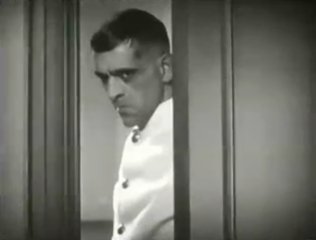
There's some good press room overlapping dialogue introducing the action, but this doesn't feel particularly like a real Hawks film. Once he becomes warden, Huston gets some chances to be super tough, like walking unarmed into a throng of hateful prisoners, or getting a shave from a lifer who cuts another man's throat, and there's a great silent build-up to the whacking of a squealer, with Karloff looming around like a white tunic-sporting Frankenstein, but otherwise characters are trapped in situations clearly contrived for the demonstration of Big Moral Issues, and an air of existential gloom hangs heavy uber alles. There's not much room for Hawksian heroics in such a clamped-down situation (like if the whole of RIO BRAVO was told from the point of view of the imprisoned Joe Burdett).  In TARGETS (discussed here) it's the film Peter Bogdanovich and Karloff watch on TV while getting drunk in Karloff's hotel suite. The VHS I have is pretty solid, made back in the day when they built them to last.

TIGER SHARK (1932)
Occasional TCM airings, Warner Archive DVD
**1/2
When Hawks focuses documentary-style on a tuna fishing off the coast of a Steinbeckain California, going into the heart of tuna schools and pulling them up one after the other, throwing them all into a big trough around the boat, where they flip and flop trying to escape, slicing each other up with their razor fins, you get an idea this was what John Huston was trying for with his mustang hunt in THE MISFITS. When one man fishes for himself, it's the natural order; when a crew fishes for half a state, it's mortifying. The good part here is that man's not strictly the sole apex predator, because where there's fish there's tiger sharks, and they love the spicy tang of a Portuguese-a commercial a-fisherman for-a the nice-a dinner. Edward G. Robinson's jovial capatin loses his hand to one, and so wears a shiny hook (he gets it polished on his wedding day). Another guy loses his legs, dies, and leaves his daughter (Zita Johann) powerless against Eddie's boastful charms. Johann's weird pallor worked in THE MUMMY but she doesn't have the inner fortitude of, say, Greta Garbo's Anna Christie, and so when she falls for Eddie's partner (two-handed hunk Richard Arlen) there's only the sense that he might have access to some benzos that would make the overacting of Robinson's angler bearable. Wrote Andrew Sarris, "Hawks remorselessly applies the laws of nature to sex.The man who is flawed by age, mutilation, or unpleasing appearance to even the slightest degree invariably loses the woman to his flawless rival." There's some good scenes and no bad ones in TIGER SHARK, but Robinson seems miscast. His constant chatter and Portuguese accent seem unduly weak for such a great actor. When he shoots at sharks from the safety of the crow's nest it only makes a sensitive viewer sick, rthough it's when the illicit couple are making out and the bullet fire off camera suddenly stops--that the film's sole moment of 'whoa!' occurs, as how often does a cease fire signal the start of real danger?
 
CEILING ZERO (1936)
VHS
****
Here's the first film where Hawks shows the rapidfireoverlapping dialogue style that would become his trademark. A chronicle of the early days of Newark airport, wherein stray pilots are nursed through heavy fogs by hungover radio operators and ex-daredevil-turned air traffic warden Pat O'Brien deals with overlapping crises via radar and radio while old friends and a snoopy aviation bureau rep (Barton MacLane) try to interfere and/or say hello. We come to admire the way O'Brien can refrain from snapping people's heads off while engaged in life-or-death radio contact and some oblivious person walks in with an oblivious joke and a pat on the back.

Then, enter (tumbling) James Cagney, who served with O'Brien in the Signal Corp (where Howard Hawks served with William Faulkner). It's a bit similar to DAWN PATROL in that O'Brien doesn't fly the planes, and has to send men up in bad conditions (ceiling zero means the fog is so high even the sea gulls are grounded) and he doesn't like it.


A highlight is when they're all trying to help a lost Stu Erwin after his honing beam goes out, and he can't get their radio signal but they can all hear him shouting in panic and rage, him presuming everyone on the ground is off playing poker and they're all shouting into different phone lines all along the flight plan to various listening posts and police stations, and the one girl in the room cries and shouts "Why don't you do something?" and they all bark at once "SHADDUP!!!!" Awesome. We see a slight demerit in Hawks here, not misogynist per se, but his Hawksian woman was still being formed and while the girls are of varying degrees of toughness, they crack up in a crisis, throwing little tantrums when things get terse. There's also some surprising sexual frankness: June Travis offers herself to Cagney for succor after the death of the pilot who took the doomed flight so Cagney could have a date with her -- a shadowy prefiguring of Joe's death in the early section of ONLY ANGELS HAVE WINGS two years later.

The ending is one of those trite bits where everyone's noble self-sacrifice has to constantly trump one another's, but it's almost beside the point; Hawks has found the zippy overlapping dialogue of a bunch of professional men united against the weather, and the (notably Irish blarney-free) velocity of the Pat and Jimmy chemistry is at full manly throttle, setting a benchmark for all the two man hetero bromances to come.

The VHS I got is blurry, not built to last. There is no DVD. It is a crime.

BARBARY COAST (1935)
(DVD)
**1/2
Miriam Hopkins is the first white woman in San Francisco, back in the 19th century gold rush boomtown days, when a pre-Panama Canal ship had to travel all the way around South America to get there and took the better part of a year. Arrivers found a city of unpaved mud roads so nasty they could suck a pedestrian under like quicksand, a dense fog filled with scammers, pickpockets, and ruffians, and inside thenothing but crooked roulette wheels, murderous bouncers, and that pint-sized unlucky-in-love big shot Eddie G. Robinson controlling the works.


There's a few elements that let you know Hawks isn't fully himself here. COAST is one of the films he made as a hired gun of Goldwyn's and he's not particularly enamored with his leading man, Joel McCrea, a foolish poet-type who loses his hard-earned sacks of gold in one turn of Hopkins' fixed roulette wheel, a "cheap price for such an education." This after they fell in love as strangers both seeking shelter from a rainstorm at an old deserted cabin, the period equivalent of running out of gas, myeah. Notes Cinephile:
"There’s little sexual tension, chemistry, or even the vaguest hint of innuendo between the two leads, it would seem a sign attached to one of the gambling tables in Robinson’s casino which reads “No vulgarity allowed at this table” is a rule disappointingly applied to the rest of the film as well. It has little visual identity beyond Ray June’s atmospherically foggy night-time photography (which does some fine work with shadows towards the end) and little of the cynicism or edge which marked out other collaborations with screenwriter Ben Hecht, instead opting for flowery, pretentious dialogue many of the cast clearly struggle with."

Gambling is a hard trick to do right cinematically speaking and Hawks isn't a great one for making money seem important. Lugging sacks of gold through throngs of thieves seems foolhardy, unrealistic, i.e. you can't show a guy getting his pocket picked one second then another one lugging overflowing sacks of gold around by himself and not getting his corpse picked clean insider of six seconds. This inconsistent financial environment takes us as far from the usually clear-cut Hawksian sense of group solidarity and danger pinpointing as you can get. As Old Atrocity, Walter Brennan alone seems to achieve some sort of noble 3-D savagery. His survival in this place, his disheveled, foul-smelling self being welcome even in the glossy casino (where he lures strangers for a cut of the trimmings) makes him one of those rare figures (like C3PO or John Holmes in WONDERLAND) who can wander back and forth between classes, enemy camps, nature and civilization at will.  Add some throw-away lines like "it's hard rowing when I'm so emotional" and it still adds up to a formulaic but well-detailed socio-historic romantic thriller that's no SAN FRANCISCO (1936), nor even--when all is said and done--a TIGER SHARK.

THE ROAD TO GLORY (1936)
(Portugese DVD - Region 1)
***1/4
William Faulkner co-wrote this name-only remake of one of Hawks' silent films. It's hard to imagine it was made a year after BARBARY COAST as it looks straight from 1930, which is a compliment. As as a dreamy WWI Parisian combat nurse with a beautiful black velvet choker-wrapped neck, pale skin, bangs, sexy Red Cross on her cape, and a low-registered speaking voice, Hope Lange has the air of Lauren Bacall on the cover of the March 1943 Harper's Bazaar --which first won Hawks' notice.  You can see the same prematurely world-weary petulance in Lang's face, her moment of self-reflexion (thinking about a dead soldier lover?) a prelude to walking through selfless sacrifice's vampiric portal.


The plot to ROAD is an uneasy mixture of inter-generational jealousy and the same old love triangle and how both are bad for victory: new officer Frederic March meets Lang when they take shelter together from a bombing raid in a blasted-out basement saloon. He plays some tunes on the dusty piano, and puts his coat over her as the rafters rattle. Next day he's bothering her at the hospital while she tries to bandage the wounded, unaware she's the mistress of shaky drunk Warner Baxter, his new C.O. Once Baxter finds out, of course, it's suicide mission time for March, a bit like the situation in Kubrick's PATHS OF GLORY or Von Sternberg's MOROCCO, or any of a dozen other films (or FRIENDS AND LOVERS, reviewed a few posts ago). Adding to the trouble is Baxter's father (Lionel Barrymore) wanting to get into the young man's game of soldiering to prove his worth. He ends up hogging screen time before grenading his own team, Lionel-style. March puts up with it all stoically, and there's never a guess how it ends, DAWN PATROL-style.


A memorable segment of the film involves Germans digging underneath the allied lines while the allies can do nothing but wait it out, rolling cigarettes with their shaky hands as the Germans scrape away below, knowing that as soon as the scraping stops the bombs are likely to go off. That's where the true courage is tested, that painful, prolonged waiting... and smoking. There's a rousing charge across no-man's land and a sneaky night time flank maneuver, but there's still the same auld love triangle, sermons on the ignominy of war, the sense of being pawns in the grip of a writer with a theme and message rather than a director with the guts to let that highlighter pen fall to the floor and trust his own shoot-from-the-gut sense of comedy, overlapping dialogue, cigarettes, whiskey, coffee, and one damned good looking girl.

See also, the 1932 Hawks film THE CROWD ROARS, which I capsuled earlier. 
Read More
Posted in Boris Karloff, Frederic March, hope lange, Howard Hawks, James Cagney, joel mccrea, Lauren Bacall, Lionel Barrymore, Miriam Hopkins, red cross, walter barrymore | No comments

неділя, 12 травня 2013 р.

"In the words of my father... Oxnard." - Ghoulardi

Posted on 18:44 by jackichain

For the average auteurist critic, deconstructing an opaque work like Paul Thomas Anderson's THE MASTER (2012) tends to involve making connections to the topographical 'conscious' of the artists' life, while the geological 'unconscious' -- the subtextual kernel to which the artist himself is usually blind by definition -- tends to be ignored. And yet it's this exact lower strata where underpinnings are made clear, a strata linked inextricably not to the artist but to his parents. In other words, to understand THE MASTER don't look at at Paul Thomas Anderson, look at his father, Ghoulardi.

I just re-watched THE MASTER (2012) today, and while the first time it mainly left me irritable (too stuffy in the theater), this time, on the safety of my own couch, paying only marginal attention, I thought of my own late father, Jim Kuersten, and of Paul Thomas Anderson's late father, Ernie Anderson, aka Ghoulardi, a Cleveland horror movie host of some legendary renown from the mid-60s. I knew the name, but figured he was just a Vaudeville schtick-jiving Mockula ala mein own Dr. Shock (with daughter Bubbles, below) on Channel 17, my favorite as a child in Wilmington, Philadelphia.


But as I researched Ghoulardi on Wiki, my eyes started widening and the pieces of the MASTER plan puzzle popped into place. He was beyond any mere horror-host pigeonholing, apparently. Ghoulardi was a maniacal anarchist, blowing up models and toys the kids sent in, live on air. He used a lot of free-associative beatnik slang of his own invention, like 'stay sick!'  He played his own surf rock intros (he was a direct inspiration for the look and sound of The Cramps), and ranted against suburban towns like Parma (Par-ma) with its polka music fetish. He had a pet raven named Oxnard. He smoked on air. He aroused the ire of the higher-ups. It was all broadcast live, and he said whatever the hell popped into his head. Not a lot of it survives. But the T-shirts live on. 


Watching THE MASTER this second time I could see some of Ghoulardi in the Satanic twists of Freddie Quell's forehead and in the cult-building improv 'making it up as he goes along' prowess of Lancaster Dodd. Anderson's cult might have been of young, crazy Cleveland mid-60s proto-punks rather than serious-minded adult proto-Scientologists, but it was a cult nonetheless. As Cleveland.com remembers: "Ghoulardi came before all the things we identify with the 1960s: the Kennedy assassination, the Beatles, Vietnam, civil unrest... Ghoulardi was the last Beatnik from the '50s and had this wisecracking irreverent attitude..." Check out this, one of the few surviving clips of the great Ghoulardi in action:


Listen to that deep, resonant Charles Middleton-ish voice! Do you hear a touch of Lancaster Dodd's deep croak? Most interesting is the knowledge that he had trouble memorizing his lines so just made it all up as he went, live on air, which is how Dodd's son describes his dad's methodology. And Ghoulardi was a chronic challenger to authority, standing up to the big wigs at his local TV station, and regularly doing crazy things like driving a motorcycle through the offices.


 Here's what Paul Thomas Anderson said about his dad in an interview, as reported in WIKI
"He was in the Navy stationed mainly in Guam. I don't think he did any fighting. I think he was trying - he was fixing airplanes and knew just where the beer was stashed and played the saxophone in bands and stuff like that. You know, every picture I have of him [shows] a beer in his hand. Every single picture from the war he's got - so he was pretty good about probably finding ways to get out of fighting. But again, you know, we never really talked that much about it."

In other words, Ernie Anderson was a wild man, a ballsy, deep-voiced iconoclast, a trickster, the father as wild man. He later became the announcer for most of ABC's programming and promos. And some of that fine work can be heard here. 


I know it's weird to write about a father on mother's day, but I was just on the phone with my mom to wish her a happy one, with THE MASTER paused on the first big 'session' between Dodd and Freddie. My own dad died of cancer a year and a half ago, and I never got to visit him in the hospital; he never would have wanted me to, either. He despised soap operatics. Our true good-bye was watching and rhapsodizing over Lumet's LONG DAY'S JOURNEY INTO NIGHT (1962), the highballs making him merry and open, and both of us enraptured by the pure ballsy artistry of every aspect of the film. I'm sure I'll think of him whenever I next see it again, which I hope is soon. I don't have any recordings of my dad, but he lives on in whispered pro-golf announcers, and old horror movies for me, which we used to make fun of together in a ritual of wit-honing.


My dad was fierce, tall and with a booming Wellesian voice, a drinker. He was larger than life, and he drank right up until the end, like a superstar. The doctors were amazed his metastasized cancer hadn't killed him years earlier, they theorized the booze was keeping him alive.  He fell and broke his ankle mixing a drink and had to be hospitalized, since his bones were shot because of chemo. And of course being in the hospital meant no booze. He was dead in a matter of days. I've hated doctors ever since, worse than Kate Hepburn's character does in LONG DAY'S JOURNEY.  I still smoke, because fuck living forever like my 107 year-old granny, and when I feel my big Wellesian dad's archetypal energy alive in a film I tend to love that film as if it were my father's ghost. I want to avenge it against the Claudius critics and shout it from this blog's parapets. 


Ernie Anderson died of cancer in 1997, the year BOOGIE NIGHTS came out, the year I was first struggling to get sober. Paul Thomas was there for it all, sitting beside his dad's bed ala Phillip Seymour Hoffman in his 1999 film MAGNOLIA (see here for an analysis of this in context with Edward G. Robinson's death scene in SOYLENT GREEN).  Anderson wasn't around for his dad's Ghoulardi phase, as it was over by the time he was born. He did get to see it on the VHS tapes that are around in circulation and pieces of which are on youtube (and above): "What I do and what he did is so different, but he hated authority and he wanted to stir things up. And I hope my work always has that kind of spirit."

It does. Tell your parents to turn blue, he'd say. "Stay sick and turn blue." That must be a weird thing for PT to hear on a tape made by his own late father, but it's a weirdness the same late father left him equipped to handle. As a result PTA's films fly past the maudlin sand traps and safety-first water hazards of most films about flawed or dying fathers, and straight into the hole of modern myth. There's no stern moral or tsk-tsking in a PTA film. No matter how vile some figures are (such as the incestuous talk show host in MAGNOLIA), Paul just shows them forgiveness, because he respects wild men. It's pretty clear in studying the Ernie Anderson story just where PT's love of wild man Screamin' Jay Hawkins-esque energy comes from.


There's also the sense Ernie was a partier, like my own dad, like me, like Jason Robards and his dad in LONG DAY'S, and of course Freddie Quell, who always has a drink in his navy hand, and knows alcohol for what it is, the last true line of defense against the void, as well as the void itself, the mirror through which the artist may behold the Medusa Muse of Mortality without turning to stone. If, in the end, it stones you just the same, at least you get to pick your frozen pose. 

---
One last coincidence: my dad always joked he was going to retire... to Oxnard. I forget why. He loved that name. It wasn't related to Ghoulardi's use of it, to my knowledge. We never lived anywhere near Cleveland, but he too loved its crazy name. Oxnard. He joked he wanted to retire there, and I needed to make money to pay for it. "You gotta earn a lot of money so I can retire in Oxnard," he'd say. I didn't. Oxnard exists now only in my memory.

(See also Great Dads of the 70s: Burt Reynolds in Boogie Nights)

(and my initial post on The Master - Butler of Orbs 
and the The Master's Questions Answered by the I Ching)
Read More
Posted in Ghoulardi, Paul Thomas Anderson | No comments

субота, 4 травня 2013 р.

High Society Matrons of Frank

Posted on 17:19 by jackichain
From top: Betty Garrett, Celeste Holm, Vivian Blaine
The enduring image of Mr. Frank Sinatra today is from the early 60s, the a ring-a-ding-dingin' wiseguy crooning, chairman-of-the-board for the Rat Pack, shtupping a plethora of broads from the casino and Hollywood. But did you know that during WW2 he used to be called 'Frankie' and in the late 40's was but a humble and naive wingman to blustery Gene Kelly in MGM musicals? The women he wound up with were often bigger than he was, even a bit matronly. "the mother instinct" was the reason they pursued him and this Brooklyn beanpole never put up more than token resistance. If she had a good pitching arm, a car, her own apartment, a money-making job, and a refusal to take no for an answer, what could he do? Ring-a-ding-done! So what was the deal for this unusual romantic strategy? 

It all began during the Second World War, wherein Sinatra's quiet storm radio broadcasts won a massive following of stateside sweethearts, which might have made the soldiers listening on Armed Forces Radio jealous. So they played up the mother instinct aspect. Frank was just a skinny kid with a golden voice and women could love him and not be unfaithful because they just wanted to cook and to care for him. He was no threat to a red-blooded serviceman and he was a good sport about being mistaken for a broom or carried off by strong winds when he guested on Bob Hope or The Jack Benny Show. 

But after the war he found it a persona to shake. When the war was over, morals changed, soldiers were home, but not all of them and war widows were abundant. Now their mother instincts were more intense than ever, but they could do something about it, if they wanted to make a move. And these ladies perhaps found their model in Betty Garrett. 


In Take Me Out to the Ballgame (1949) their relationship was perhaps best summed up by the song "It's Fate, Baby it's Fate," a duet wherein Garrett makes her passes and Frankie tries to argue his way out as she chases him around the empty ballpark: 
 Betty: Too late, baby, too late,
So accept your destiny,
It's fate, baby, that you were meant to fall into love with me.
(break)
I'm gonna start it out on my astrology, and phrenology

Frank: It does not matter that you are Aquarius, or Sagittarius

Or Gemini or Scorpio or Taurus the Bull, Capriconicus or Pisces the fish.
Betty: Winter, summer, spring or fall,
As long as you were born at all,
Mister, you're my dish.

It's fate baby, it's fate.

Frank: Can't I even put up a fuss?
Betty: It's fate, baby, the stars have written that you and me is Us.

In On the Town (released the same year) she's a NYC cabbie who sings "Come up to My Place," and--in a move very bold for the 1949--convinces Frank's sailor to abandon planned sightseeing. Their horny quicke / nooner hook-up vibe gets so intense that the clueless cockblocking of her sniffling roommate is almost not funny. We feel the heat and want Garrett to get her man planted. Finally Garrett packs the roomie off to the movies so she and her mother love object can presumably have some of the most forthrightly implied casual afternoon sex since Dorothy Malone closed up the bookstore in The Big Sleep (1946).  (See more about my love for the Garrett / Sinatra dynamic in my 2006 piece, "The She Wolf Gets Her Man").


Garrett was a blast in both roles and was a tough act to follow. She wound up blacklisted--a commie!--and Frank had troubles of his own. He finally lost the 'ie' at the end of his name when he landed a major role in From Here to Eternity (1953) but he still made musicals, of course, contending with the bossy broad Adelaide (Vivian Blaine, above) in 1955's Guys and Dolls, but it wasn't until 1956 that his musical persona began a transitional phase. He made two films that year-- The Tender Trap and High Society. The staid, supportive, witty, and patient Celeste Holm took over the matron role. She was no cabbie, but a photographer in one and a concert violinist in the other. She was high class, a lady of substance rather than a brassy girl from the neighborhood like Garrett. Frankie was making the grade but there was no spark with Holm. She was his launch pad, boosting his courage and catching him if and when he ever fell.


In High Society, Holm is in the place usually reserved for Joan Blondell or post-code Jean Harlow, the patient, long-suffering girl friday. It's Grace Kelly of course that Frank really sparks with. She's supposed to be Bing's true love but as soon as Sinatra gets behind the bar, pours some drinks, and sings to her of course, a curious magical thing happens: the swinger Frank is born. The bar is clearly Frank's place of power, his voice is the sonic equivalent of the giddy warm flush in your cheeks when the first drink lights up your soul like a beam of cocktail hour setting sun. Frank's set to 'smolder' and Grace lights him up. Together they leaves Bing looking almost anemic, hungover and outgunned, ready for Celeste to lead him out to pasture.


This moment wasn't just a Hoboken son getting lucky with a future princess but a career-turning revelation. A deep, poetic, sincere romanticism that Sinatra could only really convey in his best recordings comes out onto screen finally, and the last shred of the old innocent 'Frankie' disappears forever. The booze, the bar, the saloon song, the intimacy of two people alone at a bar, this--it was clear--was Frank's place of power, and the world's knees was shaking.

But he still had to go back to Holm in the end, because he would never be able to go all the way into high society. He was meant for the quiet hideaway bar rather than the ritzy soirees. And Holm, at least in High Society, wins him by default. But her mother instinct had just gone obsolete. She expected her Icarus high-flyin' swinger would plummet back into her arms once his wings melted into the morning's hangover and the bar was closed but there was a city where the bars never closed, the crooning, drinking, and seducing could go on 24/7. There was no need for Holm in... Las Vegas.


In Frank and Holm's other 1956 film, The Tender Trap, he plays a swinging New York City talent agent with a constant stream of dames, allegedly, but he only seems to be seen with Holm, whose classy carriage (she's an orchestra violinist) and Broadway wit anchor his confidence. She will puts up with his tomcatting and sticks by him because she's got nothing better going on, for now, and so the years pass. Easy sex keeps him dependent, but there's no kick. When the pair are out at a restaurant and meet marriage-minded virginal singer Debbie Reynolds (one of producer Frank's new clients), they grill her on her life goals (she wants three kids and a home in the country within five years, or bust), and she's so naive she doesn't even recognize they're kidding her. Holm gets to seem cosmopolitan here but then the censor steps in, presumably, and it's revealed Holm is just a plain old-fashioned girl, too.

Ugh.

At least she's fun before then but Reynolds' character is bossy and controlling and frowns at any kind of non-Better Homes and Gardens-style party planning. Still, Frank's womanizing attitude buckles like arctic summer ice when he finally falls into her arms, and its beautiful to see, despite the icky subtexts.


Frank was now drawing the A-list stars, but nothing could prepare him for the Shirley MacLaine experience. Her 'party girl' make-up and a solid range of acting chops didn't preclude her playing the doormat, adopting some Vivian Blaine-shrillness as the girl who won't stop chasing Sinatra even into his hometown (where he goes for a frigid English teacher instead) in the non-musical Some Came Running (1958). As he almost did with Holm in Trap, Sinatra marries Shirley for the wrong reason and she runs into her pimp's bullet mere hours afterwards, to save Frank's life and open him up for more reciprocal relationships. Were any of them coming? Or just some more mothering easy Brooklyn-type broads (whom he considered himself too good for) and slumming college-grad good girl virgins (vice versa)?


Pal Joey (1957) was another musical, another Sinatra stepping persona stone. Here he's a self-aggrandizing but small-time crooner / strip club emcee, 'mothered' by "mice." A new form of Sinatra film was cohering wherein the songs 'functioned' within a dramatic context, and the babes competing for him were both hot and aggressive. With his method of seduction stated as: "treat a tramp like a lady and a lady like a tramp," it's natural he would get one of each: Kim Novak is a small town innocent in the chorus and Rita Hayworth is a rich widow / ex-stripper. A bunch of showgirls do his laundry, serve him bagels, and so forth but since none of them get jealous we wonder if they just feel that old devil mother instinct. If so they don't do a good job as Frank looks very, very thin, wan, undernourished, especially compared with Novak, a big girl more suited to a big man, like Bill Holden with his shirt open in Picnic. 

But Frank was finding his inner fire, and it gave off a heat of booze, artistic aspirations (he did after all pioneer a whole new style of microphone recording) and that old black magic. He can knock your socks off in his "Lady is a Tramp" rendition, performed for Hayworth in the empty club, or when he starts to walk away from her at the end in his iconic white raincoat and hat you can feel an earned gravitas in his step, walking way from Hayworth's yacht and off into the fog, with a dog and Novak at his side. Bogey had that same walk and a similar raincoat in Casablanca, and we all know Bogey ran the original Rat Pack, which Frank had been in, as an admiring young pup. It paid off.


A mark of his maturity was his willingness to look foolish. In one of the Joey songs, "My Funny Valentine," Novak sings of his less-than-Greek figure and unsmart dialogue. For "Bewitched, Bothered, and Bewildered," Hayworth refers to him a "half-pint imitation." Each song is a smoldering high in the film, each asking the eternal Frank question: why this half-pint imitation-- skinny, arrogant, class climbing so-and-so still delivers the sexual goods. It's a testament to all three performers that we can feel their rapture so keenly. As Stephanie Zacharek recently wrote about Baz Lurhman's Gatsby, there's a difference between a faker and a phony. And Frank is so authentic he can submit his faker persona to enough withering epiphanies and humiliations to kill ten ordinary Gatsbys, and not even flinch.


By 1960, due no doubt to all this good bad behavior, his mother instinct stigma had receded even farther, to the occasional needy ex-one night stand cum-stalker, while in the foreground the McLaine broad types, the slumming socialite types, and the homey types were coalescing into one perfect package, such as Angie Dickinson in 1960's Ocean's Eleven. An ironic mention of the old mother instinct is found in a snatch of dialogue between Dean Martin and Dickinson upon their meeting up:
DM - What made you come back? I've come to the conclusion it must be love. Mother love
AG: I'll consider many things: mistress, plaything, toy for a night, but I refuse to be a mother, that's out.
DM - Don't get me wrong, I'm the mother....

Then there was one final mother: Janet Leigh i The Manchurian Candidate (1962). This one comes in like a relapse, understandable since Frank's character is in the process of becoming unglued as a result of nightmares and PTSD. Janet Leigh, hardly a matron or a broad, follows him out of the bar car. He's shaking and glazed with sweat, unable to make eye contact. She gives him a cigarette because his hands are too shaky to light his own, gives him her address and phone number, presuming a man in his DT-esque condition will effortlessly remember both. He calls her to pick him up from jail, and in the cab home she announces she's already broken off her engagement before even getting the call, because sweaty, shaky, twitchy, imprisoned Frank is such a catch. In the car she says she's an orphan, a reincarnated Chinese laborer (an eerie prefiguring of Mrs. Iselin's Asian connections). Is she a spy, or is the mothering instinct here gone so rogue it's gone red, found its way into the cold nether regions of political intrigue in a bizarre mirror of Lansbury? Leigh's character is sexy and smart, but her love is so total and so unearned its unnerving. At least, by the end of the film, Frank looks great, sober, secure. The sweat glean is gone, the uniform is pressed, and he's not skinny anymore. He looks ready to evolve even higher.

Then, JFK, a personal friend of Frank's, died. It traumatized him, the nation, the world, and brought an immediate end to all innocence. Mother instincts were out, for keeps.


Do I have a purpose here, in following this 'mother instinct' thread through Sinatra (whom I adore so don't think I'm criticizing him). It's just that as an ex-boozer, an ex-rock band member, an ex-husband, a struggling writer whose work is littered with typos, a burn-out, I've had my own troubles with mothering co-dependent women. I've been fought over and plowed under, ignored and suffocated, I've stared out hotel windows at dawn with a bourbon in my hand and Steinbeck on the bed in the wee wee hours.... not even trying to be legendary, just trying to not shake. Have I suffered for Frank's sins? Is the whole mother instinct thing and Frank's efforts to be rid of it responsible for the glamorizing of boozy misogyny that coursed through Sinatra's Rat Pack schtick, and which in turn infected generations of men like me?


Frank would know--he was always more intellectual and caring than he let on--but he's gone, flown off to the next marquee. Hopefully in the next life he won't have to spend another film career escaping and then submitting to the tender trap, and then maybe those of us who follow after him (avidly, avidly) won't confuse maturity and womanizing, won't end up settling for the one apron string that ties us up faster than the rest, so we can spend the rest our stage time escaping, bemoaning the leash like the courageous dog whose a coward off it. It's not fate, baby, it's just men trying to figure out how the hell they wound up where they are. Once they figure it out, they're gone. They'll call you, baby. Don't crowd them.

Read More
Posted in | No comments

субота, 27 квітня 2013 р.

Pre-Code Capsules - SCARLET EMPRESS, LADIES THEY TALK ABOUT, THE BARBARIAN, FRIENDS AND LOVERS, THE RICH ARE ALWAYS WITH US

Posted on 12:31 by jackichain

SCARLET EMPRESS, THE
1934 - ****
Von Sternberg was a genius but one could argue he never quite entered the sound era, preferring the language of symbols, small gestures, posed tableaux, and intertitles -all of which nearly suffocates the first half of SCARLET EMPRESS. Taken from the then still-sizzling diaries of the sexually voracious Catherine II of Russia, the film begins in a flower-encrusted choke-hold as the life of a regimented life of a young Austrian noble (Dietrich, in curls) is contrasted with the DeMille-level lurid tortures of the Proletariat at the hands of the Cossacks. The handsome, brooding, impeccably-uniformed John Lodge suddenly materializes like a tall shadow person with sable highlights in the stuffy Prussian parlor of Catherine's mother, and things start looking up, but the pompously over-orchestrated Russian melodies and airless claustrophobia is a long time going. One unbearable matriarch after another pokes and prods Dietrich like a piece of meat at the butcher's until your feminist blood is curdling, and it's only after Lodge has whisked her fully off to Moscow that we feel we can start to soak up the glories of the snow and the richly photographed sable wraps. But Moscow is just more poking, at the hands of the reigning queen in Russia, a perennially-cranky 'dowager empress' (Louise Dresser overplaying to near Shelly Winters-ish levels), and her no-good nephew Peter (Sam Jaffe), the half-wit prince and Catherine's betrothed, prefers prowling through the Satanic art-bedecked corridors of the royal palace like Harpo Marx on meth crossed with MESA OF LOST WOMEN's Dr. Leland rather than bedding his young wife. She's fine with that, but the dowager is ranting about needing a male offspring out of her, in a way that makes Bette Davis' mom in Now Voyager seem a model of compassion.


Well, if Peter won't bed her, she better find someone who can, fast, and keep it on the DL. Between all the horses marching tediously along by the hundreds past the camera (JVS digs filming his "1,000 extras"),  intertitles ("Pushed like a brood mare into a marriage with a royal half-wit"), drab nature shots, lockets falling gently down the length of vast trees, interminable liturgies droned in candle-lit churches, endless ringing bells, and strangely modern, rather overwrought Satanic sculptures at ever turn, this may be the most staid, stuffy, boring film that ever included shots of topless women being flogged and branded.

That said, if you're in the right frame of mind (the kind wherein you dig falling asleep to the molasses-slow poetic kink of Jean Rollin) you can forgive Von Sternberg being a little too obsessed with the sadomasochistic double bind of Marlene being forced to brood mare it up, and dig how Peter's drilling holes through his mom's walls so he can spy on any lesbian hanky panky reflects  JVS' own predilection for the peeping camera, and sponge up the aesthetic gloom overkill and be able to just lean back and watch Dietrich age quicker than her character does over the course of the film thanks to (based on what Von Sternberg writes in his Notes from a Chinese Laundry) the cruelty inflicted on his icy star.


LADIES THEY TALK ABOUT
1933 - ***1/2
"Watch out for her. She likes to wrestle," notes convict Lillian Roth of a cigar-smoking lesbian who looks not unlike famed sewing circle ringleader Mercedes De Acosta (lover of Garbo). It's only one quick shot during a long and engaging women's prison tour Roth gives new inmate Barbara Stanwyck and though she never came out of the closet it's interesting to find Babs semi-mocking a (possible) fellow sewing circle sister onscreen. But at least the gay/lesbian reality was represented, at Warner Brothers, where fey tailors and stern masseuses (such as a recently restored scene of one taking Cagney's measurements in PUBLIC ENEMY) were winked at but never bullied, which is at least more than they'd get after the code, when they'd have to just disappear, deep back into the closet.

Mercedes De Acosta - right / Dyke in LADIES - left
The bulk of the film deals with a love affair between gang moll Babs and moral crusader Dan Slade (Preston Foster), the kind where each has to continually top the other in sacrifice and honesty. He gets her off after she's busted as a bank job accessory, so she confesses she was really guilty. He sends her to the joint, so she gets even by tearing up all his pleas to help her. Dan's terminal earnestness is all but mocked openly by WB screenwriters, but they give Stanwyck full license for two-fisted feminine shots at chin of the status quo, the kind of target Sharon Stone aimed for in Basic Instinct but never really shattered like Babs does here. The huge gaggle of female convicts are (a few exceptions aside) all friends, the bull-ettes are nice if you behave; hell, this women's jail seem almost like Vassar except. When Lillian Roth sings "One Hour with You" while mooning over a glossy of Joe E. Brown, you know that hetero-wise, things are pretty desperate.

THE BARBARIAN
1933 - **1/2
It’s one of those films that could only have been made in the pre-code era at MGM, the studio who had the hardest time being truly subversive and often wound up just kinky and deeply racist instead. Egyptian guide Emil (Ramon Navarro) begins the film saying a tearful good-bye to a rich white European tourist lady on the outgoing Cairo train, and afterwards affixes himself to a striking British socialite played by Myrna Loy. Naturally, it being MGM, miscegenation would be out of the question, except that --like all British socialites visiting Egypt who catch the eye of skulking Arabs--she has an Egyptian mother (or rather 'had' - they're always dead before the film starts, saving any alleged social discomfort with the all-white side of the family). In Egypt to visit her indefatigably British fiancee (Reginald Denny) and his unbearably controlling mater, she's blessed with the king of 'harrumph' - C. Aubrey Smith (lower left) as a more understanding pater. Clearly MGM is pointing towards two 1932 hits for its box office hopes ---Universal's THE MUMMY and Columbia's BITTER TEA OF GENERAL YEN. But it's still MGM and therefore falls woefully short of Paramount's surreal charms or Universal's lurid expressionism, even Columbia's humanist handball, even if the pyramids are superbly evoked and the whole scene mad with magic.

 Emil first worms his way into her flower-choked hotel room via offers of service as a guide, enduring the casual cruelties he's subjected to at the hands of the lordly British and then turning the tables. If you imagine what it would be like if MUMMY star Zita Johan went off into the MOROCCO desert to endure SWEPT AWAY-style whipping and dominance head games at the hands of General Yen, well you'll find the erotic Myrna Loy bathing scene to be approximately sexier than Claudette Colbert’s milk bath in SIGN OF THE CROSS, which if these things matter to you, is nowhere near as awesome as Maureen O’Sullivan's nude swimming in TARZAN AND HIS MATE. Frankly I’m ashamed of myself for knowing all this, and so is Ramon Navarro, or will be, once he’s caught by Myrna’s coterie of harrumphing Enlganders.


1931
Erich taunts his wife with Adolphe's love letters
FRIENDS AND LOVERS
1931 - **
British officer Laurence Olivier goes a bit bananas as the other man who loves nymphomaniac Lily Damita in this stuffy, tangled FAREWELL TO ARMS-meets D.H. Lawrence-ish saga set partly in London, partly in Paris, partly in.... India, and always squarely on the MGM stage. The best parts are in the beginning with porcelain collector Erich Von Stroheim (as Damita's aesthete husband) lolling languidly in the surf of Menjou's discomfort as one of his wife's lover caught with a lame alibi. It turns out Erich's habit is to blackmail his errant wife's many lovers, charging Menjou $10,000. because "porcelain is... expensive." We root for Erich all the way, especially since Damita is such a wearying screen presence. She can be charming, but when she's not 'on' she radiates a restless peevishness, like she's been kept waiting all day and is tired of being prodded and mussed by the make-up lady. Nice legs, though. Too bad that fellow Damita-schtupper Olivier later tries to shoot Menjou in a fit of jealous pique (by this time Damita already has another fiancee in the wings).

This all seems to be enough of a climax for MGM and the ending abruptly dumps everyone out on the curb after weekending at beloved old character actor Frederick "Here's to the House of Frankenstein!" Kerr's estate, and though he's cool with underhanded business, eh wot? his shrewish wife boots them out for conformity's sake. It's a lot familiar (for the era) triangle business that adds up to little more than the bros-before-hos credo 'tested' and broken on the rocks of Damita's scattered lips and alleged sex appeal. Better we should have followed Erich von Stroheim's porcelain, to the floor in shards if needed!

THE RICH ARE ALWAYS WITH US
1932 - **1/2
Divorce, scandalous, risque and o-so progressive in and of itself, was still enough of a subject for a films back in 1932, even at the already risque and progressive Warner Brothers, so here's novelist Julian (George Brent) pestering newly-divorced rich socialite Ruth Chatterton into marriage. She wants to have a little fun in Paris first but secretly wants him to come out and pester her, presumably but Brent always presumes that is the case, which is one reason I dislike him. His whole attitude reflects the gateway rationalization of rapists. Meanwhile, as Chatterton talks on the phone from Paris, her kid sister-like college chum Bette Davis tries to steal Julian away, but in a Midge kind of semi-joking manner that never works, until maybe the very end, (unless the man you're stealing is Frank Sinatra).

What's so fascinating this time around is the idea that ex-married couples can still be friends and look out for each other. Ruth's investment broker ex-husband starts losing his clients once he's seen snoozing the night away at ritzy clubs with his new, younger Paris Hilton-esque wife. So Chatterton comes home and throws her weight around to keep him afloat, rather than marrying the sappy and sacharine Brent, who's fond of purring bad lines like, "Will you think I've fallen out of love with you if I light a cigarette?" like it's the cleverest string of words ever uttered.  Davis' dialogue is, on the other hand, pretty smart, and the issues of marriage and divorce are rather adultly presented. Alfred E. Green (BABY FACE) directs with plenty of that old WB pepper but there's only so much you can do with this sort of material. No sooner has the bitchy new young wife announced on the drive home that she's pregnant but doesn't want to have the baby since it would ruin her figure and tie her down to some squawling brat, for example, she's instantly killed in a car wreck. But at least she got to say what everyone's thinking. Julian would be better off with Davis, but that's not to say Chatterton doesn't have great ditzy appeal; she's the living hybrid stop between Carole Lombard and her mother in MY MAN GODFREY (1936), and I mean that as a compliment.


Read More
Posted in Arabs, Barbara Stanwyck, Egypt, Erich von Stroheim, Josef Von Sternberg, Lesbianism, Marlene Dietrich, Mercedes de Acosta, miscegenation, Myrna Loy, Nudity, pre-code, Ruth Chatterton, sadomasochism | No comments
Новіші публікації Старіші публікації Головна сторінка
Підписатися на: Дописи (Atom)

Popular Posts

  • Happy Birthday Cheryl Ladd!
    Today, it's Cheryl Ladd's birthday. Happy birthday to an underrated actress, sparkling beauty, sultry singer, and first-class Angel!...
  • CinemArchetype #25: The Fisher King
    The cinema has done wrounght or rongt for the Fisher King. What are these two odd words? They wrong and right mixed inextricably together --...
  • Taming the Tittering Tourists: 50 SHADES OF GREY, 9 1/2 WEEKS, EXIT TO EDEN, SECRETARY + SHE DEMONS, Franco, Bunuel, Josef von Sternberg, Alain Robbe-Grillet
    Most fans of 50 Shades of Grey-- the kinky BDSM bestseller by E.L. James -- were wincing (and not in a good way) at last week's debut of...
  • 22 Films that prove 1933 was the greatest year for classic movies.
    Everyone cites 1939, year of Oz , Wind , and Grapes, as the best year in the history of movies, but not Acidemic. Here we know the best year...
  • Great Women of Horror: An Acidemic Top Ten
    So many of the top horror film bloggers are women it's not even fair to just say 'it's your month, baby.' Because they rule!...
  • Hex and Taxes
    Emancipation Day and The Income Tax Due Date bracketed this past weekend, making it the right time to rent a ghost story/steampunk Dirty Sou...
  • Are You Lonesome, Automaton: Terminator and Halloween vs. Hugo
    I am a mechanical man And I do the best I can Because I have my Family    -- Charles Manson ("Mechanical Man") Was it chance I saw...
  • Butler of Orbs: THE MASTER (2012)
     "The only performance that truly makes it is the one that achieves madness" - Turner (Mick Jagger) -  PERFORMANCE)  What was true...
  • Best Erich Writing of 2012
    It was a strange year, not least because the apocalypse we were hoping for in our darkest heart of hearts never occurred. So now here we are...
  • Secrets of 2012, or the "The Day of a Million Relapses"
    Sorry to be so late to the party in loving/trashing Roland Emmerich's 2012, but I got so much to say, You HAVE TO LISTEN TO ME! We'r...

Categories

  • . Akim Tamiroff
  • 1930s
  • 1932
  • 1933
  • 1941
  • 1967
  • 1968
  • 1969
  • 1970s
  • 1970s dads
  • 1980s
  • 2001
  • 2012
  • 33.3
  • 70s
  • 70s Dads
  • 9 1/2 weeks
  • 9 monkeys
  • aa
  • Aaron Spelling
  • abbi jacobson
  • ABC
  • Abel Ferrara
  • abortion
  • abstraction
  • abuse
  • acid
  • acting
  • Action
  • actor's studio
  • actresses
  • Adam Roarke
  • Adam Sandler
  • Adam Wingard
  • Addiction
  • Adrian Pasdar
  • Adrienne Barbeau
  • adult
  • Adult Books
  • adultery
  • African
  • African American
  • After school special
  • Ahab
  • AIP
  • air-mail
  • airmen
  • airplanes
  • Akira
  • Akira Kurosawa
  • Al Jolson
  • Al Santos
  • alain robbe-grillet
  • Alan Arkush
  • Alan Ladd
  • albert finney
  • Albert Maysles
  • Alchemy
  • alcohol
  • Alcoholics Anonymous
  • Alcoholism
  • Alec Baldwin
  • Alexander Payne
  • Alexandra Breckenridge
  • Alexandra Hay
  • Alfred Hitchcock
  • Ali Larter
  • Alice in Wonderland
  • Alien
  • alien abduction
  • Alien conspiracy
  • alienation
  • aliens
  • Allegory
  • Allen Jenkins
  • Altamont
  • Amanda Warren
  • Ambiguity
  • America
  • American
  • American Horror Story
  • Amnesia
  • amok
  • amok animals
  • amos poe
  • amy allan
  • Anarchy
  • ancient rome
  • androids
  • Andrzej Zulawski
  • Andy Serkis
  • Angelina Jolie
  • Angelo Rossitto
  • Anima psychosis
  • animals
  • Animus
  • Anita Loos
  • Anita Pallenberg
  • Ann Revere
  • Anna Carlisle
  • Anna Christie
  • anna karina
  • Anna May Wong
  • Anna Paquin
  • Anna Sten
  • Anne Francis
  • Anne Hathaway
  • annet mahendru
  • Antichrist
  • Anton Grot
  • Antonioni
  • anxiety
  • apocalypse
  • April Fools
  • Aquarius
  • Arabs
  • Archetpyal
  • archetypal
  • Archetypal Psychology
  • archetype
  • Argentina
  • Argento
  • Armageddon
  • Arnold Schwarzenegger
  • Arous
  • art
  • art scene
  • Arthur Hunnicutt
  • asa butterfield
  • Asexuality
  • asherah
  • ashley cahill
  • Asia Argento
  • astronaut
  • audio mimesis
  • Aurora
  • Automaton
  • Ava Gardner
  • Avengers
  • aviation
  • awesome horror
  • Ayahuasca
  • ayuhuasca
  • Aziz Anzari
  • Baader-Meinhof
  • Baby Doll
  • Backwoods
  • Bad
  • bad faith
  • balls
  • ballyhoo
  • BAM
  • Barbara Crampton
  • Barbara Hershey
  • Barbara Stanwyck
  • Baroque
  • Barry Shear
  • bars
  • Barton Fink
  • Basil Rathbone
  • basquiat
  • Batman
  • Batman Returns
  • Baudrillard
  • bawdy
  • beaches
  • Beards
  • beatles
  • Beatrice Dalle
  • Beckett
  • Bela Lugosi
  • Bella
  • Ben Hecht
  • Benicio Del Toro
  • bergman
  • Bertolt Brecht
  • Best of decade
  • Bette Davis
  • Betty Blue
  • bi-polar
  • Big Liebowski
  • Big Red One
  • Big Sur
  • Bikers
  • Bill Clinton
  • Bill Gunn
  • billie piper
  • Bing Crosby
  • Biography
  • birth
  • bisexual
  • Black
  • Black Cat
  • black comedy
  • Black Dahlia
  • Black Metal
  • Black Star
  • blackface
  • Blacklist
  • blade runner
  • blank generation
  • blaxploitation
  • Bleeding Skull
  • Blind Dead
  • Bloggers
  • Blondes
  • blood
  • blue meanings
  • Blueberry
  • Bob Geldoff
  • bob guccione
  • Bob Hope
  • Bohemian Grove
  • Bombshell
  • Bon Rafelson
  • bondage
  • Bonnie Brown
  • boondoggle
  • bootleggers
  • bootlegging
  • Boris Karloff
  • bourgeois
  • bowery
  • Brad Pitt
  • Bradley Cooper
  • Brain
  • brain damage
  • brainwashing
  • Bramwell Fletcher
  • Brazil
  • Brecht
  • Breillat
  • Brenda Wiley
  • Bret Easton Ellis
  • Brian Cox
  • Brian De Palma
  • Brian Donlevy
  • Brian Glazer
  • Brian Wilson
  • Bright Lights
  • Brit Marling
  • British
  • broad city
  • Broderick Crawford
  • Brooke Shields
  • Bruce Lee
  • Bruce McCall
  • Bruce Willis
  • Bruno Forzani
  • Bruno Ve Sota
  • Buddha
  • Buddhalution
  • Buddhism
  • Bueno Aires
  • Buenos Aires
  • Bugs Bunny
  • Burl Ives
  • Burma
  • Burns and Allen
  • Burt Lancaster
  • burt reynolds
  • Busby Berkeley
  • Busby Berkley
  • Buster Crabbe
  • Cabin Fever
  • Caligula
  • camille paglia
  • camp
  • Camping
  • Canada
  • Canadian
  • Candace Hilligoss
  • Candice DeLong
  • Cannibalism
  • Cannibals
  • capital crime
  • Capitalism
  • Cappucine
  • Carey Mulligan
  • Carlos
  • Carmen Sternwood
  • Carmilla
  • Carol Channing
  • Carole Lombard
  • Caroll Baker
  • Carrie
  • carrie white burns in hell
  • Carroll Baker
  • Cartoons
  • Cary Grant
  • Casablanca
  • Casey Anthony
  • casinos
  • Cassavettes
  • castavet
  • castration
  • Cat Women
  • Cate Blanchett
  • catherine deneuve
  • Catherine Keener
  • Catherine Mary Stewart
  • Catherine Zeta Jones
  • Catholicism
  • Catholics
  • Cecil B. DeMille
  • Cesca
  • CGI
  • Channing Tatum
  • Charles Bickford
  • Charles Coburn
  • Charles Dickens
  • Charles Farrell
  • Charles Haid
  • Charles Kaufman
  • Charles Laughton
  • Charles MacArthur
  • Charles Manson
  • Charlie Bronson
  • Charlie McCarthy
  • Charlie Sheen
  • Charlies' Angels
  • Charlize Theron
  • Charlotte Gainsbourg
  • Charlotte Rampling
  • Cheap Trick
  • Cheech and Chong
  • Cher
  • Cherie Curie
  • Cheryl Ladd
  • chick flick
  • childhood
  • children
  • Children's Hospital
  • Children's liberation movement
  • Chile
  • Chloe
  • Chloe Grace Moretz
  • Chris Hemsworth
  • Chris Nolan
  • Chrisopher Lloyd
  • Chrisopher Walken
  • Christ
  • Christendom
  • Christian Bale
  • Christianity
  • Christina Rosetti
  • Christmas
  • Christophe Waltz
  • Christopher Jones
  • Christopher Lee
  • Christopher Nolan
  • chronicle
  • chthonic
  • Chuck Norris
  • cia
  • Cibo Matto
  • Cinematography
  • Cinq au sept
  • citizen kane
  • City Gardens
  • Civil War
  • Claire Denis
  • Clara Bow
  • Clarence Brown
  • Clarence Muse
  • Clark Gable
  • classic horror
  • Classism
  • Claude Raines
  • Claude Rains
  • Claudette Colbert
  • Cliff Robertson
  • Clint Eastwood
  • clitorectomy
  • cocaine
  • cockblocking
  • Cocoa Cola
  • Cocteau
  • Coen brothers
  • Coffy
  • Coke Ennyday
  • Cold War
  • Colin Farrell
  • Colin Firth
  • collagen
  • colonialism
  • Colorado
  • Columbia
  • Comedy
  • Comedy horror
  • Communism
  • computer games
  • Conan
  • conan barbarian
  • Confederacy
  • conflict diamonds
  • Conrad Veidt
  • conservativism
  • conspiracy
  • Constance Bennett
  • controversy
  • Coppola
  • Copyright issues
  • Cormac McCarthy
  • Cornell Woolrich
  • Corruption
  • Counterculture
  • Country Joe
  • Cpnspiracy
  • crack
  • Craig Robinson
  • crank
  • crazy
  • Creepshow
  • Crestwood
  • Crime
  • criterion
  • Critics
  • Cryogenics
  • Crypto-fascism
  • crystal skull
  • Cul-de-sac
  • cults
  • cultural theory
  • Curtis Harrington
  • Cyd Charise
  • Czech new wave
  • daimonic reality
  • Dakota Fanning
  • Dan Curtis
  • Dance
  • Dance marathon
  • dancing
  • Daniel Ekeroth
  • Daniel McBride
  • Daniel Plainview
  • Daniel Radcliffe
  • Danny Trejo
  • Dario Argento
  • Darionioni Nuovo
  • Dark Secret of Harvest Home
  • Dark Shadows
  • Darwin
  • Dashiell Hammett
  • Daughter Italian Ripp London Ralph Bates Susan Brodrick
  • Daughter of Horror
  • Dave Chapelle
  • David Brandon
  • David Cronenberg
  • David Cross
  • David Del Valle
  • David Fincher
  • David Hemmings
  • David Icke
  • David Letterman
  • David Lynch
  • David Niven
  • David O Russell
  • Dazed and Confused
  • DC Comics
  • Dead
  • dead files
  • Deadgirl
  • Deadly Women
  • Dean Martin
  • Dean Stockwell
  • death
  • death drive
  • death fetishist
  • Deborah Kerr
  • decadence
  • decapitation
  • Defection
  • Dellamorte Dellamore
  • Delphine Seyrig
  • Dementia
  • Demi Moore
  • Demons
  • denise richards
  • Denmark
  • dennis hopper
  • Depression
  • Desert
  • Detective Magazines
  • Detectives
  • detournement
  • Devil
  • Devil Commands
  • devouring other
  • Diablo Cody
  • Diane Keaton
  • diane selwyn
  • Diane Varsi
  • DIaspora
  • Dick Foran
  • Dick Powell
  • Dinah Shore
  • dinners
  • Dino De Laurentiis
  • Dino De Laurentis
  • dinosaurs
  • disaster
  • disillusionment
  • Disney
  • DMT
  • DNA
  • Dogme 95
  • dogs
  • Dogville
  • Dolores Del Rio
  • Dolores Fuller
  • Dolph Lundgren
  • Domestic violence
  • Dominique Strauss-Kahn
  • Dominique Swain
  • Domino Harvey
  • Don Coscarelli
  • Don Rickles
  • Donal Cammell
  • Donald Pleasance
  • Dopey
  • Dorothy Lamour
  • dostoyevsky
  • Douglas Fairbanks
  • Douglas Fairbanks Jr.
  • downtown
  • Dracula
  • dreams
  • Drew Barrymore
  • drinking
  • drinking games
  • Drug addiction
  • drugs
  • Drunken Monkey
  • Duane Jones
  • duff gardens
  • Duke Ellington
  • Dustin Hoffman
  • Dusting Hoffman
  • DW Griffith
  • dwarfs
  • Dyatlov Pass
  • Dylan
  • Dylan Baker
  • Dylan McDermott
  • dystopia
  • Eagles
  • East Germany
  • ecological horror
  • Ed Dorado
  • ed wood
  • eddie nugent
  • Edgar Allen Poe
  • Edgar Bergen
  • Edgar Ramirez
  • Edgar wright
  • Edmund Goulding
  • Edmund Lowe
  • education
  • Edward Arnold
  • Edward Dmytryk
  • Edward Everett Horton
  • Edwige Fenech
  • Ego
  • Egypt
  • Egyptology
  • eisa gonzalez
  • el rey
  • Eli Wallach
  • Eliza Dushku
  • Elizabeth Hurley
  • Elizabeth Taylor
  • Ellen Burstyn
  • Ellen Page
  • Elliot Gould
  • Elliot Nugent
  • Elm Street
  • Elvis
  • Elvis Presley
  • EMA
  • Emily Blunt
  • Emily Watson
  • Emir Kusturica
  • Emma Roberts
  • emperor
  • Endless Love
  • England
  • Enlightenment
  • Ennio Morricone
  • ennui
  • ensemble
  • environmentalism
  • Eric Jonrosh
  • Eric Romer
  • Erich Kuersten
  • Erich von Stroheim
  • Errol Flynn
  • escorts
  • Espionage
  • Eugene O'Neill
  • Europe
  • European
  • Eva Green
  • Eva Mendes
  • Evan Peters
  • Evil
  • evolution
  • excess
  • Existenitalism
  • existential
  • Existentialism
  • Exorcist
  • exotica
  • Experience
  • experimental
  • Exploitation
  • Eyes of Laura Mars
  • Facebook
  • Fairuza Balk
  • fairy tale
  • fairy tales
  • Fakery
  • family drama
  • family dynamics
  • fantasy
  • Fanu
  • farce
  • Farrah Fawcett
  • fascism
  • Fashion
  • Fassbinder
  • Fate
  • fatherhood
  • Fay Adler
  • Fay Wray
  • Faye Dunaway
  • Female Convict Scorpion
  • feminism
  • Fernando De Leo
  • Ferris Bueller
  • Fight Club
  • Film Critics
  • Film Forum
  • Film Noir
  • film preservation
  • Film Theory
  • films
  • Final Destination
  • first national
  • Five Stairsteps
  • five to seven
  • Florence
  • Florence and the Machines
  • Flower Power
  • Folk
  • folk music
  • fool
  • Ford Beebe
  • Forest
  • France
  • Frances Dee
  • Francis Ford Coppola
  • Franco Nero
  • Franco Zeffirelli
  • Francois Dorleac
  • Frank Morgan
  • Frank Sinatra
  • frankenstein
  • Frankenstenia
  • Franklin Pangborn
  • freaks
  • Fred Ward
  • Freddy Kruger
  • Frederic March
  • free love
  • freebase
  • French
  • french girls
  • French New Wave
  • french revolution
  • freud
  • Freudian
  • Fritz Lang
  • Fritz Lieber
  • frostbite
  • Fulci
  • Fundamentalism Christianity
  • fury
  • Fuzzy Night
  • gaby hoffmann
  • Gale Sondergaard
  • gambling
  • Gang violence
  • gangster
  • Gangsters
  • Gary Cooper
  • Gary Morris
  • Gary Oldman
  • Gaspar Noe
  • Gender
  • gender issues
  • gender reassignment surgery
  • Gene Evans
  • Gene Kelly
  • Gene Tierney
  • George Bernard Shaw
  • George C. Scott
  • George Chakris
  • George Clooney
  • george harrison
  • george lazenby
  • George Peppard
  • George Reed
  • George Romero
  • George Sanders
  • George Zucco
  • Georgina Reilly
  • German Expressionism
  • Germans
  • Germany
  • ghost america
  • ghosts
  • Ghoulardi
  • giallo
  • giant spider
  • Giant Spiders
  • Gig Young
  • gigolo
  • gillian robespierre
  • gin
  • Ginger Rogers
  • ginger snaps
  • giorgio moroder
  • Giovanni Lombardo Radice
  • girl power
  • Girls
  • Glasgow
  • Glenda Farrell
  • Glenda Jackson
  • Globalization
  • Gloria Stuart
  • Go Ask Alice
  • God
  • Godard
  • Godfather
  • Godzilla
  • Golden Turkey
  • Golem
  • Gone With the Wind
  • Gonzo
  • Goodfellas
  • Gore
  • Gore Vidal
  • Gort
  • Goth
  • Gothic
  • Government
  • Graveyard
  • gravity
  • Great Britain
  • great depression
  • greed
  • greenwich village
  • Gregory Peck
  • Gregory Ratoff
  • Greta Garbo
  • greys
  • Grindhouse
  • Grizzly Adams
  • Groucho Marx
  • Guggenheim
  • guide
  • gunfights
  • Guns
  • Guru
  • guy debord
  • Gwenyth Paltrow
  • Gwili Andre
  • H.G. Welles
  • habitat
  • Haight-Ashbury
  • HAL 9000
  • Hal Holbrook
  • Halloween
  • hallucinations
  • Hammer
  • handheld horror
  • Hanging Man
  • Happiness
  • Harlem
  • Harold Robbins
  • Harrison Ford
  • Harry Hamlin
  • Harry Nilsson
  • Harvey Keitel
  • haters
  • haunted house
  • hauntings
  • Hazel Court
  • Heather Graham
  • heaven
  • Heckler
  • Helen Hayes
  • Helena Bonham Carter
  • Helene Cattet
  • Hell
  • Hell's Angels
  • henri clouzot
  • Henry Fonda
  • Henry Hill
  • Herbert Marshall
  • Herk Harvey
  • heroin
  • Herschel Gordon Lewis
  • High School
  • highway safety
  • hillbillies
  • Hills Have Eyes
  • Hinduism
  • hippies
  • Hipster
  • hit girl
  • Hitler
  • holidays
  • Hollywood
  • Hollywood Haunted Babylon
  • hollywood sewing circle
  • Hollywood USA
  • Homophobia
  • homosexuality
  • hope lange
  • horror
  • Horror Demons Monsters Hippies Sex
  • Horror films
  • horror screenwriter
  • Horror terror
  • horses
  • hospitals
  • Howard Hawks
  • Howard Hughes
  • Hubris
  • Hugh Herbert
  • Hugh Jackman
  • Hugo Weang
  • Humphrey Bogart
  • Hundustani
  • Hunger
  • hungry charlie's
  • Hunter S. Thompson
  • Huntsman
  • Hurt Locker
  • Hypnotism
  • Hypocrisy
  • Hysteria
  • Ian McKellen
  • Ice Age
  • IFC
  • ilana glazer
  • Ilsa She-Wolf of the SS
  • imitators
  • immortality
  • imperialism
  • In Bruges
  • incest
  • incompetence
  • indecent
  • Indiana Jones
  • Indie
  • Inept
  • infringement
  • Ingrid Bergman
  • Inishmore
  • initiation
  • Insanity
  • Internet
  • intolerance
  • intoxication
  • Isabelle Adjani
  • Italian
  • Italian-American
  • Italy
  • J. Edgar Hoover
  • jack arnold
  • Jack Benny
  • Jack Hill
  • Jack Nicholson
  • Jack Nitzsche
  • Jack Torrance
  • Jackie Coogan
  • Jackie Earle Haley
  • Jackie Gleason
  • jacobean
  • Jacques Dutronc
  • jake gyllenhaal
  • james bond
  • James Caan
  • James Cagney
  • James Cameron
  • James Coburn
  • James Davidson
  • James Deen
  • James Fox
  • James Franco
  • james huberty
  • James Mason
  • James McHattie
  • James Taylor
  • James Toback
  • James Watkins
  • James Whale
  • jamie dornan
  • Jamie Lee Curtis
  • Jan De Bont
  • Jane Asher
  • Jane Birkin
  • Jane Campion
  • Jane Fonda
  • Janet Leigh
  • Janice Rule
  • janos
  • Japan
  • Japanese
  • Jaqueline MacInnes Wood
  • Jason Patric
  • Jason Reitman
  • Javier Bardem
  • Jay Baruchel
  • Jazz
  • Jean Claude Van Damme
  • Jean Harlow
  • Jean Luc Godard
  • Jean Michel Gondry
  • Jeff Bridges
  • Jeff Goldblum
  • Jeff Morrow
  • Jemima Kirke
  • Jennifer
  • jennifer connelly
  • Jennifer Jones
  • Jennifer Lawrence
  • Jennifer's Body
  • jenny slate
  • Jeremy Renner
  • Jerry Lewis
  • Jess Franco
  • Jesse Eisenberg
  • Jessica Alba
  • Jill Banner
  • Jim Breuer
  • Jim Crow
  • Jimi Hendrix
  • jimi page
  • Jimmy Page
  • Joan Blondell
  • Joan Collins
  • joan crawford
  • Joan Jett
  • Joan of Arc
  • Joanne Woodward
  • Joe Cocker
  • Joe E. Brown
  • Joe Kubert
  • joe massot
  • Joe Pesci
  • joel mccrea
  • Joel Schumacher
  • john agar
  • John Barrymore
  • John Bonham
  • John Carpenter
  • John Carradine
  • John Cusack
  • John Cusak
  • John Ford
  • John Garfield
  • John Gilbert
  • John Goodman
  • John Heard
  • John Huston
  • john lennon
  • john lurie
  • John Malkovich
  • john monk saunders
  • John Parker
  • John Phillip Law
  • John Sebastian
  • John Stahl
  • John Wayne
  • Johnny Depp
  • joint
  • Joker
  • Jon Beller
  • Jon Voight
  • Jonas Cord
  • Josef Von Sternberg
  • Joseph Campbell
  • Joseph McCarthy
  • Josh Brolin
  • josh hartnett
  • Joshn Brolin
  • Jude Law
  • Judi Bowker
  • judi dench
  • Judy Davis
  • Judy Garland
  • Julia Roberts
  • Julian Barett
  • Julianne Moor
  • Julie Bishop
  • Julie Harris
  • Juliette Lewis
  • Jung
  • Jungian
  • jungle
  • junk
  • Juno Temple
  • Jurgen Prochnow
  • Justin Timberlake
  • Juvenile Delnquency
  • kali
  • karate
  • Karen Morely
  • Karina Longworth
  • Karl Malden
  • Karyn Kusama
  • Kate Bosworth
  • Kate Jackson
  • Kate Valk
  • Kate Winslet
  • Kathryn Bigelow
  • katniss
  • Katrina Bowden
  • Kay Francis
  • Keira Knightley
  • Keith Richards
  • Kelli Maroney
  • Ken Russell
  • Kenneth Anger
  • Ketamine
  • Kevin Smith
  • KGB
  • kiefer sutherland
  • Kiele Sanchez
  • Kiera Knightley
  • Killer Whale
  • Kim Morgan
  • Kim Novak
  • Kimberly Linn
  • Kirsten Dunst
  • Klaus Kinski
  • Klute
  • Kristen Stewart
  • Kristen Wiig
  • Kristina Lokken
  • Kubrick
  • Kurt Russell
  • La Cava
  • la nouvelle justine
  • lacan
  • lacanian
  • Lake Bell
  • Lambda
  • Lana del Rey
  • Lana Turner
  • Lance Rock
  • language barriers
  • Lars Von Trier
  • Las Vegas
  • last year at marienbad
  • Laura La Plante
  • Lauren Bacall
  • Laurence Olivier
  • Le Tigre
  • Led Zeppelin
  • Lee Marvin
  • Lee Tracy
  • legalize it
  • Lena Dunham
  • Leni Riefenstahl
  • Leo Carrillo
  • Leo Di Caprio
  • Leonardo Dicaprio
  • Les Grossman
  • lesbian
  • Lesbian Sex
  • Lesbianism
  • Lesbians
  • Leslie Nielsen
  • Let's Scare Jessica to Death
  • lewd
  • Lewis Carroll
  • Liam Neeson
  • Lili Taylor
  • Lililan Gish
  • Lily Damita
  • limousines
  • Linda Fiorentino
  • lindsay lohan
  • Lionel Atwill
  • Lionel Barrymore
  • Lionel Stander
  • liquid karma
  • Lisa Houle
  • Liz
  • lizard queen
  • llewyn davis
  • Lohengrin
  • Lolita
  • Lon Chaney Jr.
  • Lon Chaney Sr.
  • London
  • Lord Lhus
  • Lord of the Rings
  • Loretta Yong
  • loretta young
  • Lorne Michaels
  • Lorraine Warren
  • Los Angeles
  • Lotte Lenya
  • louise fazenda
  • Love
  • lsd
  • Lubitsch
  • Luc Besson
  • Lucien Prival
  • Lucille Ball
  • Lucio Fulci
  • Lucretia Martel
  • luis bunuel
  • Luke Jordan
  • Lupe Velez
  • lycanthrope
  • lydia lunch
  • lynch mobs
  • Lynn Lowry
  • M. Night Shyamalan
  • Macbeth
  • Mad Men
  • Madge Evans
  • Madness
  • Mae West
  • Mafia
  • magic
  • Magnificent Ambersons
  • Mako
  • malcolm lowry
  • malcolm mcdowell
  • Mamas and the Papas
  • Mandy Moore
  • Manhattan
  • Manny Farber
  • Manson
  • mantis aliens
  • Marg Helgenberger
  • Maria Montez
  • Marian Marsh
  • Marianne Faithfull
  • Marie Antoinette
  • marijuana
  • Marilyn Monroe
  • Mario Bava
  • Mark Frost
  • Marki Bey
  • Marlene Clark
  • marlene dietrch
  • Marlene Dietrich
  • marlon brando
  • Marni Nixon
  • Marnie
  • Marquis de Sade
  • Martial Arts
  • Martin McDonagh
  • Martin Ransohoff
  • Martin Scorsese
  • Martine Beswick
  • martyrdom
  • Marvel
  • Marwencol
  • Mary Astor
  • Mary Shelly
  • Mary Woronov
  • masculinity
  • Masochism
  • masonic
  • masons
  • Matador
  • Matango
  • Materialism
  • matriarchy
  • Matt Dillon
  • Matthew Wilder
  • Maureen O'Hara
  • Max Ophuls
  • Max Rosenblum
  • Maya Deren
  • Maya Rudolph
  • McGowan
  • media studies
  • medical
  • Megan Fox
  • Meghan Wright
  • Meiko Kaji
  • Melies
  • Melissa Sue Anderson
  • melodrama
  • memoir
  • memory
  • Mercedes de Acosta
  • Mesa of Lost Women
  • mescaline
  • meta
  • metaphysics
  • metatextuality
  • meth
  • Mexican Mud Band
  • MGM
  • mia farrow
  • Michael Blodgett
  • Michael Caine
  • Michael Cera
  • Michael Corleone
  • michael fassbender
  • Michael Lang
  • Michael Madsen
  • Michael Mann
  • Michael Myers
  • Michael Remar
  • Michael Shannon
  • Michael Smiley
  • Michele Soavi
  • Mick Jagger
  • mick lasalle
  • mid-life crisis
  • Mike Hammer
  • Mike Myers
  • Military
  • Milla Jovovich
  • Milla Jovovitch
  • Mimsy Farmer
  • mind control
  • minnie castavet
  • Minotaur
  • miranda frost
  • Miriam Hopkins
  • Misandry
  • miscegenation
  • Mischa Auer
  • misogynist
  • misogyny
  • Mitt Romney
  • MK Ultra
  • Mobsters
  • Moby Dick
  • Moira Shearer
  • Monarch
  • Monica Lewinsky
  • Monica Vitti
  • Monkees
  • monkeys
  • Monogram
  • monster
  • monsters
  • Monte Hellman
  • Monterey Pop
  • Montgomery Clift
  • morality
  • morphine
  • Mortimer Snerd
  • Mothra
  • Muhammed Ali
  • Mummies
  • Murder
  • murder comedy
  • mushrooms
  • music video
  • Musical
  • musicals
  • Mutations
  • Myrna Loy
  • Mystery
  • mysticism
  • Myth
  • Nabokov
  • Naked
  • Naked Lunch
  • nancy allen
  • Nancy Grace
  • Nancy Loomis
  • Natalie Portman
  • Natasha Henstridge
  • Native Americans
  • nature
  • nautical
  • Nazis
  • Near Death Experiences
  • Neil La Bute
  • Neile Adams
  • nerve profiles
  • netflix
  • new earth army
  • New York City
  • Nic Cage
  • Nicholas Ray
  • Nicholas Roeg
  • Nick Gilder
  • Nick Redfern
  • Nicolas Cage
  • Nicolas Winding Refn
  • Nicole Kidman
  • Nietzsche
  • Nigeria
  • no girlfriends
  • Noel Francis
  • Nora von Waldstätten
  • Nordic
  • Nordics
  • Norma Shearer
  • Nostradamus
  • nouvelle vague
  • Novelists
  • Nude
  • Nudity
  • NYC
  • nymphomania
  • Obama
  • obelisk
  • obituary
  • obscenity
  • Obsession
  • occult
  • ocean
  • Oh Calcutta
  • Oliver Assayas
  • Oliver Stone
  • Olivier Assayas
  • olympiad
  • Omar Bradley
  • ona munsen
  • Ontario
  • opera
  • opium
  • Orca
  • orgy
  • orientalism
  • Orson Welles
  • Oscarbait
  • Otis Redding
  • Otto Preminger
  • overacting
  • overdose
  • Owen Wilson
  • ozone
  • Pacific Northwest
  • Paddy Chayefsky
  • Paganism
  • palpatine
  • Pam Grier
  • Paranoia
  • Parenting
  • Paris
  • Paris Hilton
  • Party
  • pastiche
  • Pastorale
  • Patriarchy
  • Patricia Arquette
  • Patricia Ellis
  • Patrick Harpur
  • Patriotism
  • Patton
  • Paul Garratt
  • Paul McCartney
  • Paul Newman
  • Paul Robeson
  • Paul Ryan
  • Paul Schrader
  • Paul Thomas Anderson
  • Paul Walker
  • Paula E. Shepherd
  • Paula Prentiss
  • Paulette Goddard
  • Paulina Porizkova
  • Pedophiles
  • Pedro Almodovar
  • Peggy Hopkins Joyce
  • Penelope Cruz
  • Penitentiary
  • penny dreadful
  • penthouse
  • People Next Door
  • Performance
  • permeability
  • Pert Kelton
  • perversion
  • Peter
  • Peter Bogdanovich
  • Peter Brandt
  • Peter Cushing
  • Peter Fernando
  • peter fonda
  • Peter Lorre
  • Peter O'Toole
  • Peter Sellers
  • Peter Weller
  • petit-bourgeois
  • Peyote
  • Phil Hartman
  • Phillip Baker Hall
  • Phillip Seymour Hoffman
  • picnic at hanging rock
  • Pink Floyd
  • Pirates
  • PJ Harvey
  • PJ Soles
  • plague
  • Platonic love affairs
  • poetry
  • Poison Gas
  • Poland
  • Police
  • Political Anal father
  • Political Analogy
  • Politicians
  • Politics
  • Popeye
  • Poppers
  • poppies
  • Population control
  • porn
  • pornography
  • Portia Doubleday
  • post-apocalyptic
  • Post-code
  • Post-Modernism
  • pot
  • power
  • PRC
  • pre-code
  • pregnancy
  • President
  • Preston Sturges
  • pretentiousness
  • preversion
  • Prince Prospero
  • Production Code
  • prohibition
  • prometheus
  • promiscuity
  • prostitution
  • protests
  • pscyhe
  • psychedelia
  • psychedelic
  • psychedelics
  • psychic twins
  • Psychology
  • Psychopaths
  • psychotronic
  • psycology
  • Public Domain
  • Punch-Drunk Love
  • quatermass
  • Quentin Tarantino
  • Race
  • Rachel Weisz
  • racism
  • Radley Metzger
  • Ralph Bellamy
  • Ralph Meeker
  • Ramones
  • randy moore
  • Randy Newman
  • Raoul Walsh
  • Rape
  • Rapture
  • Raquel Welch
  • Rare
  • Ravenna
  • Ravi Shankar
  • Ray Bolger
  • Ray Milland
  • Raymond Chandler
  • reality
  • Rebekah del Rio
  • recuperation
  • red cross
  • Redheads
  • Rednecks
  • Reece Shearmith
  • Regicide
  • Reincarnation
  • remake
  • remarriage
  • Renny Harlin
  • repression
  • reptile cortex
  • Reptilians
  • Republicans
  • Repulsion
  • retro
  • Revolt
  • Rhada Mitchell
  • Ricardo Cortez
  • richard barthelmess
  • Richard Basehart
  • Richard Burton
  • Richard Dix
  • Richard Gere
  • Richard Harris
  • richard hell
  • Richard Kelly
  • Richard Linklater
  • Richard Matheson
  • Richard Nixon
  • Richard Pryor
  • Richard Rush
  • ridley scott
  • riots
  • ritual
  • RKO
  • RNC
  • Rob Zombie
  • Rober De Niro
  • Robert Altman
  • Robert De Niro
  • Robert e. howard
  • Robert Evans
  • Robert Mitchum
  • Robert Montgomery
  • Robert Pattinson
  • Robert Plant
  • robert rodiguez
  • Robert Ryan
  • Robert Siodmak
  • Robert Wagner
  • Robert Wise
  • Robots
  • rock
  • rodeo
  • roger corman
  • Roger Ebert
  • Roger Vadim
  • Roger Waters
  • Roger Wnslet
  • Roland Emmerich
  • Rolling Stones
  • Roman Coppola
  • Roman Polanski
  • Romance
  • rome 78
  • Romero
  • Romy Schneider
  • roost
  • Rory Cochrane
  • Rosamund Pike
  • Rosemary
  • Roswell
  • roy abramsohn
  • roy batty
  • roy scheider
  • royalties
  • Rubber
  • Rudy Vallee
  • Rudyard Kipling
  • Runaways
  • Rural
  • Russ Meyer
  • Russia
  • Russian spies
  • Russians
  • Rutger Hauer
  • Ruth Chatterton
  • ruth gordon
  • rutledge
  • Ryan Gosling
  • sacrifice
  • sacrificial
  • sadcore
  • Sadism
  • sadomasochism
  • Saint Francis
  • Salem
  • salieri
  • Sam Fuller
  • Sam Neill
  • Sam Peckinpah
  • Samuel Fuller
  • San Pedro
  • sandahl bergman
  • Sandra Bullock
  • Sandra McCoy
  • Sarah Anne Jones
  • Sarah Michelle Gellar
  • Sarah Silverman
  • Sartre
  • Satan
  • Satanic Panic
  • Satanism
  • satire
  • satyriasis
  • sauron
  • Scarface
  • Scarlett Johansson
  • scary
  • Schizophrenia
  • schlock
  • Science
  • Science Fiction
  • scopophilia
  • Scotland
  • Scottie Schwartz
  • Scream Factory
  • Screwball
  • sean connery
  • Sebastián Silva
  • Seduction
  • self-reflexivity
  • Self-Styled Siren
  • serials
  • Seth Rogen
  • seventies
  • seventies dads
  • severin
  • severine
  • sex
  • sex comedy
  • sex crimes
  • sexism
  • sexual abuse
  • Sexual Assault
  • sexual awakening
  • sexual discrimination
  • sexual seduction
  • Sexuality
  • sexy 30s actresses
  • Shakespeare
  • Shaman
  • Shark Week
  • Sharknado
  • Sharks
  • Sharni Vinson
  • Sharon Stone
  • Sharon Tate
  • Sheep
  • Shelly Winters
  • Sherri Moon Zombie
  • Shining
  • Shirley Ross
  • Shout
  • Shrinks
  • Sick
  • Sig Rumann
  • Sigmund Freud
  • signal corps
  • Sil
  • silent
  • Simon and Garfunkel
  • Simon Callow
  • Simon Pegg Nick Frost
  • simpsons
  • Sin
  • sissy spacek
  • Situationists
  • sixties
  • sizzle
  • skeeviness
  • slacker
  • slam dancing
  • slasher
  • slavery
  • Sleaze
  • Sleepy
  • Slow Ride
  • smoking
  • snow
  • Snow White
  • sobriety
  • Social Message
  • social psychology
  • Society of Enjoyment
  • Sofia Coppola
  • soldier of fortune
  • Sonny Tufts
  • sophie marceau
  • soundwaves
  • South Ameri
  • South America
  • Southern Gothic
  • Southland Tales
  • Space
  • Species
  • spider baby
  • Spiderman
  • spirits
  • Spooky Behavior
  • sprituality
  • Stacey Nelkin
  • Stacie Ponder
  • Stacy Keach
  • Stagefright
  • Stanley Cavell
  • Stanley Kubrick
  • star wars
  • starship troopers
  • Starvation
  • steampunk
  • Stendahl
  • Stepford Wives
  • stephen king
  • steve de schavi
  • Steven Shaviro
  • Steven Soderbergh
  • Steven Spielberg
  • stock market
  • Stoner
  • Stoners
  • stop motion
  • Street Fighter
  • Strip Clubs
  • structuralism
  • submarines
  • Substitute
  • subtext
  • suburbia
  • Subversion
  • Succubus
  • Sue Lyon
  • suicide
  • Sunset Gun
  • Superheroes
  • supermodel
  • Supernatural
  • surfing
  • surrealism
  • Susan Doukas
  • susan foster kane
  • Susan Strasberg
  • Suspiria
  • Suzy Kendall
  • Svengali
  • Swedish
  • Swingers
  • Swinging
  • Sydney Pollack
  • Syfy
  • Sylvester Stallone
  • Sylvia Sidney
  • symbolism
  • syracuse
  • Syracuse University
  • tabs
  • Taissa Farmiga
  • Talia Shire
  • Talk Radio
  • tangerine dream
  • Tara Reid
  • tarantual
  • Targets
  • Tarzan
  • teachers
  • ted wilde
  • teenagers
  • telekinesis
  • Templars
  • Tenebrous Kate
  • Tennesse Williams
  • Terence Malick
  • Terence McKenna
  • Terminator
  • Termite Art
  • Terror
  • Terrorism
  • Terrorists
  • Terry Gilliam
  • Terry Southern
  • Texas
  • Thai
  • That's the Way it Is
  • THC
  • The Big Sleep
  • The Grey
  • the sentinel
  • the thing
  • Theater
  • Thelma Todd
  • theory
  • Theresa Russell
  • Third World
  • Thor
  • Ti West
  • Tibetan
  • Tiffany Bolling
  • Tim Burton
  • Time Dilation
  • Times Square
  • Timothy Carey
  • timothy dalton
  • Timothy Leary
  • titan
  • Titanic
  • Tokyo
  • Tom Atkins
  • Tom Cruise
  • Tom Fergus
  • Tom Hardy
  • Tommy Lee Wallace
  • Tony Clifton
  • Tony Montana
  • Tony Scott
  • Tor Johnson
  • Toshiro Mifune
  • totem
  • Tourists
  • Track 29
  • transgendered
  • Treasure Island
  • Trick R Treat
  • Trilby
  • trip
  • tripping
  • trippy
  • Tristana
  • tropics
  • trucks
  • true crime
  • trumpet
  • TV
  • TV Movie
  • Twilight
  • Udo Kier
  • UFOs
  • UHF
  • Ulysses
  • unborn
  • Uncle Tom's Cabin
  • unconscious
  • undead
  • unions
  • Universal
  • ursula andress
  • Uwe Boll
  • V for Vendetta
  • Vacation
  • Vagina Dentata
  • Val Lewton
  • Valerie and her week of wonders
  • Valerie Leon
  • values
  • vamipires
  • Vampira
  • vampire
  • vampires
  • Vanessa Howard
  • varney
  • Vegetarianism
  • Venice
  • Ventriloquism
  • venus flytrap
  • venus in furs
  • Vera Farmiga's sister
  • Veronica Lake
  • vertigo
  • VHS
  • vice
  • Victorian
  • Victory Jory
  • vietnam
  • Viggo Mortenson
  • Vince Gallo
  • Vincent Cassel
  • Vincent Price
  • Vincente Minnelli
  • Ving Rhames
  • vintage
  • vintage TV
  • violence
  • Violence cocaine
  • Violet
  • Virginia Bruce
  • Virginity
  • Voiceovers
  • voodoo
  • W. Somerset Maugham
  • W.C. Fields
  • W.S. Anderson
  • Wagner
  • Wall Street Protesters
  • Wallace Beery
  • Wallace Shawn
  • Walt Disney
  • walter barrymore
  • Walter Hill
  • Walter Houston
  • walter huston
  • Walter Pigeon
  • Waltons
  • War
  • Warner
  • Warren Beatty
  • Warren Oates
  • Warren William
  • warriors
  • Wartime
  • Wasps
  • Watergate
  • WC Fields
  • weed
  • Weimar
  • Weldon
  • werewolves
  • Werner Herzog
  • Wes Anderson
  • Wes Craven
  • westerns
  • white slavery
  • Whitney Cummings
  • Who
  • Wicker Man
  • Wilder
  • Wilderness
  • Willem Dafoe
  • William Beaudine
  • William Bendix
  • william castle
  • William Faulkner
  • William friedkin
  • William Girdler
  • William Hickey
  • William Hurt
  • William Peter Blatty
  • William Powell
  • William S. Burroughs
  • William Shatner
  • Willie Best
  • Winona Ryder
  • Winter
  • Witchcraft
  • Witches
  • Wizard of Oz
  • wonderwall
  • Woods
  • Woodstock
  • Woody Allen
  • Woody Harrelson
  • Woolf
  • world war I
  • World War One
  • World War Two
  • Worst Movie
  • Wrong Turn
  • wrongslayer
  • WW1
  • WW2
  • XXX
  • Youth
  • Yvonne Furneaux
  • Z-Man
  • Zach Galiafinakis
  • Zach Snyder
  • Zen
  • zeppelin
  • Zionists
  • Zizek
  • zombies
  • Zoolander

Blog Archive

  • ▼  2014 (37)
    • ▼  липня (5)
      • Taming the Tittering Tourists: 50 SHADES OF GREY, ...
      • OBVIOUS CHILD, GINGER SNAPS and Your Reproductive ...
      • Medusae of Asia: THE SHANGHAI GESTURE (1941), RAIN...
      • Two hearts stab as one: Brian De Palma + Dario Arg...
      • Dawn of the Dinkins: RANDOM ACTS OF VIOLENCE (2013...
    • ►  червня (4)
    • ►  травня (6)
    • ►  квітня (6)
    • ►  березня (5)
    • ►  лютого (6)
    • ►  січня (5)
  • ►  2013 (70)
    • ►  грудня (7)
    • ►  листопада (5)
    • ►  жовтня (6)
    • ►  вересня (7)
    • ►  серпня (4)
    • ►  липня (4)
    • ►  червня (4)
    • ►  травня (5)
    • ►  квітня (7)
    • ►  березня (7)
    • ►  лютого (3)
    • ►  січня (11)
  • ►  2012 (93)
    • ►  грудня (8)
    • ►  листопада (10)
    • ►  жовтня (9)
    • ►  вересня (6)
    • ►  серпня (6)
    • ►  липня (6)
    • ►  червня (6)
    • ►  травня (6)
    • ►  квітня (10)
    • ►  березня (7)
    • ►  лютого (9)
    • ►  січня (10)
  • ►  2011 (134)
    • ►  грудня (9)
    • ►  листопада (10)
    • ►  жовтня (8)
    • ►  вересня (11)
    • ►  серпня (9)
    • ►  липня (9)
    • ►  червня (13)
    • ►  травня (13)
    • ►  квітня (16)
    • ►  березня (16)
    • ►  лютого (12)
    • ►  січня (8)
  • ►  2010 (118)
    • ►  грудня (7)
    • ►  листопада (10)
    • ►  жовтня (10)
    • ►  вересня (11)
    • ►  серпня (16)
    • ►  липня (8)
    • ►  червня (11)
    • ►  травня (12)
    • ►  квітня (7)
    • ►  березня (10)
    • ►  лютого (9)
    • ►  січня (7)
  • ►  2009 (48)
    • ►  грудня (6)
    • ►  листопада (6)
    • ►  жовтня (9)
    • ►  вересня (5)
    • ►  серпня (13)
    • ►  липня (9)
На платформі Blogger.

Про мене

jackichain
Дивитися мій повний профіль