achyutktelang blogspot

  • Subscribe to our RSS feed.
  • Twitter
  • StumbleUpon
  • Reddit
  • Facebook
  • Digg
Показ дописів із міткою Antonioni. Показати всі дописи

вівторок, 28 січня 2014 р.

Eric Jonrosh's Spoils of the Red Desert:.

Posted on 19:06 by jackichain

Crazy gorgeous, crazy for real, unstable, reckless, spontaneous, today they'd be called bi-polar --there's a lot going on with modernist European art cinema's women. We love them and they love us back, or are scared of us (by us I mean camera / viewer / audience) since they can't really see us, not quite, like they wake up to how trapped they are inside of a rectangular screen and we're the unseen child spirit trying whisper words of comfort across time and media platforms into their forlorn ossicles. We're like the tiny human figures these madwomen dream they give birth to in great numbers. Sometimes you'd swear as you gaze into their gigantic dilated pupils they can see you, no matter how big or small you are in perspective to them, across time in the dark they can almost read your mind, can almost tell if you are enraptured or at least sympathetic to their cause or just leering down their dress... like everybody else... sigh.

Women like the one played by Yvonne Furneaux in La Dolce Vita (1960, below - right), or Monica Vitti in Michelangelo Antonioni's Red Desert (1964 - above, below-left) are forever reaching for a 'real' connection with the men inside their film environments, trying to trap them into a full commitment, to devour them through hydra hair anemone tendrils, and considering how bad Mad Men makes America look at the same approx time frame, sexual harassment-wise, I can only imagine how bad it was in Italia! These poor harassed, molested, objectified and leered-at ladies need more than just assurances from some diegetic dimwit trying to get them into bed; they need a champion, a little man they can keep it their pocket, small, so you can look up to her, so she can be your ideal.

But is she? I mean, she's crazy! And too hot for words. Even a sensitive intellectual like Antonioni may fall into the dress-leering trap as he endeavors to sympathize with his female character's neurotic condition. We hope he can succeed, and that his star can transcend the confines of the Mussolini-period architecture and minimalist gallery space and escape out the open corner of the screen, into his / our arms or, within the screen, someone mature, rich, and debonair.

Alas, there is only one Marcello Mastroianni, and he spreads himself thin. Only suicide threats seem to get him to come home anymore, at least for Fellini. Antonioni is much more of a nice guy to his women. In the past his madwomen could find solace and escape from modern life via breathtaking mountain views (as in L'Aventura), in vacant lots (ala La Notte), or even the friendly quiet of a glider over the countryside (L'Eclisse), but for Red Desert all these avenues are condemned, or gone. Yellow poisons are in the sky, the waters of the river are choked a dull coal black --almost Star Trek alien worldly' even Vitti's apartment seems like just a different wing of the same factory. Vitti needs a different escape avenue, this time she's got to go all the way through the looking glass, into post-modernism metatextual refraction until her persona finally shatters like a Lady from Shanghai funhouse mirror in  Only thing is, we in the dark theater are the Irish sailor dupe. Always.

Twelve years ago Dr. Paul Narkunas (the skeptical professor in The Lacan Hour if you're keeping score) lent me his DVD of The Red Desert, painting it in my mind as a lurid desert odyssey that went dark places he knew I'd been to, neurochemically. And he said it was funny, too.

But twelve years ago I was a different person--I didn't know Spinoza from Shiteuxlle and the DVD Paul had was a far-off cry from the gorgeous Criterion blu-ray I have seen thricefold since, weeping with joylessness as my throat pouch widens to encompass more and more hot, psychotropic gas with every viewing because sooner or later, it 'clicks.' But the Narkunas disc was a bust. My TV was smaller too , too far away for letterboxing; even my socialist art filmmaker wife at the time was bored after twenty minutes. The story's vagueness and incoherence combined to gave me a headache and then I fell into a half-asleep, and coasted through to the end, unwilling to turn it off lest I have to admit defeat, and that I was not man enough or intellectual enough to 'get it.'

My problem was not uncommon for an American of my posture, sloth and limited education. Now I realize my initial response of boredom was intellectual. French critics labor for years to reach such complete disinterest! And how can a film that bores you stiff the first time get better with repeat viewings? That makes no sense, and no sense is very European. But Criterion's blu-ray is gorgeous and now my TV is larger and flat with deep blacks. The fog is 3-D now, pulsazione como veleno deliziosa, purple and dark blue flecks that taste like cotton candy. My outer life has gotten worse, sparser, less anamorphic, to accommodate the balance shift. My glasses are dirtier, my mind shrunken and polluted with rivers of pharmacological run-off. But the screen breathes and grows, ever sharper, deeper, vaster.


Speaking of psychotropically inflated throat pouches, let us vault into the future for the new post-modern comic mini-series, Eric Jonrosh's Spoils of Babylon, a recently de-vaultified 70s miniseries deconstruction from IFC. Here, at last, is high camp trash deconstructed past the point of being genuinely funny, and more like Godardian abstraction, somewhere between Ed Wood (1994) and an actual Ed Wood movie, between intentional failure and unintentional result. Real et Surreal. Guiliana (Vitti), the crushingly alone and confused wife in Red Desert lets modern alienation vault her into madness, but Babylon is already there, itself, as a whole, refracting in on itself in a deadpan absurdity ouroboros. It is madness' final destination.

In both, the acting and writing are intentionally 'off' with no grounding in anything approaching reality, reaching a heightened abstraction that makes even Sirk's Written on the Wind seem like kitchen sink realism (see here on Splitsider for a shot-by-shot comparison). While Red Desert achieves post-modern affect through mixed signals and ambiguity (in short, art), Spoils achieves it through specific soap signals which are then delocated to the point of abstraction. Giuliana doesn't know what kind of movie she's in -- comedy, tragedy, horror, sexual soap, clinical study of depression --she has no idea what the right response to any situation is and the movie never gives her a signifier without contradicting it a moment later; in Spoils, the link between signifier and signified is broken. Meaning spills out everywhere, adding up to nothing.
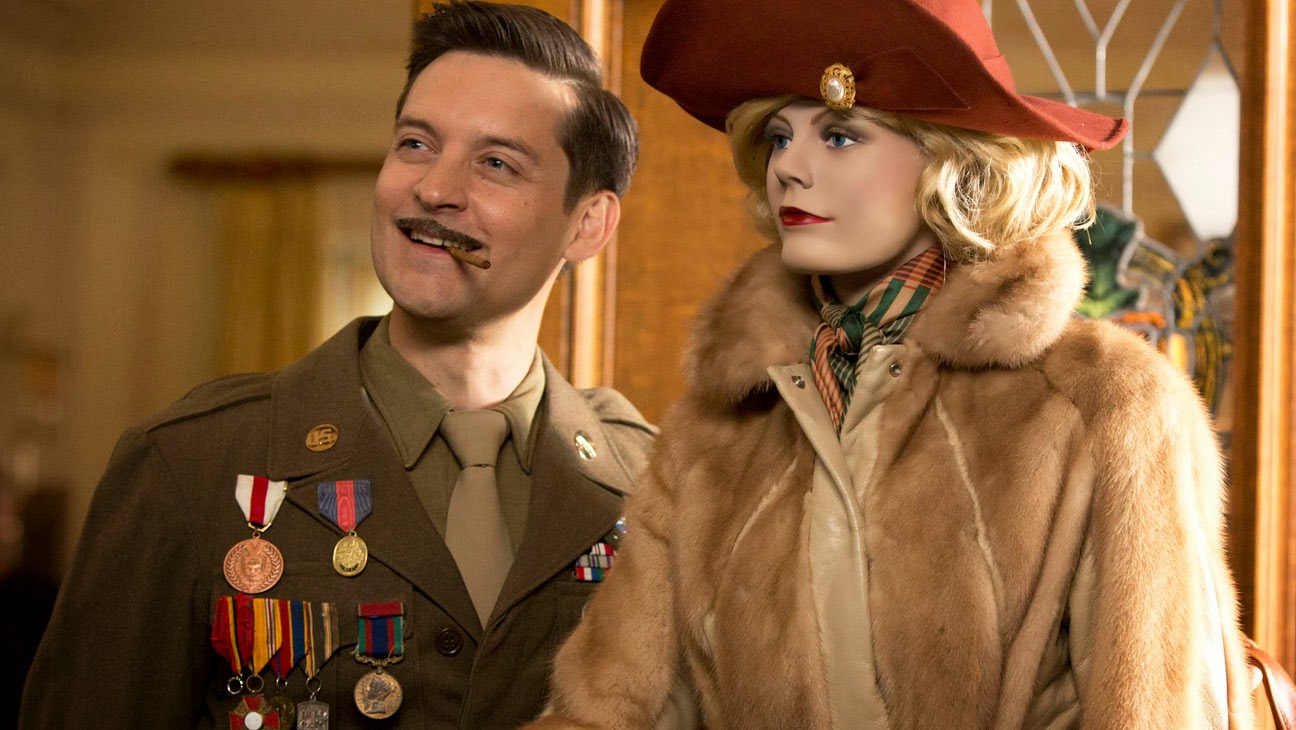

Spoils' story, for example, apes the 70s mini-series and 50s soap only for the first two episodes. By the end there's no longer a sense of being in any one generation (though probably it's meant to be the late 60s). The story of foundling adventurer Devon Morehouse (Tobey MacGuire), his capitalist amok sister Cynthia (Kristin Wiig), and their forbidden love stretching from Depression before rising up Rink-like in plumes of oil and blacking the sky of WW2, beatnik junkiedom, hipster underwater observatories and into a climactic shoot-out in front of a bemused Shah of Iran. The six-part series' deadpan humor comes less from jokes and more from inept direction, dialogue, framing, mismatched rear projection and adorable miniatures. Carey Mulligan's voice shows up inside a mannequin playing a British wife brought home by Devon when he the war from home comes a-marchin' - and that's the order they would use those words in France, and maybe under the sloshy pen of trash novelist Eric Jonrosh, played with windy Paul Masson-era Welles-ishness by Will Ferrell. The idea of a mannequin is a legit rival for Cynthia is both oddly foreboding - a Stepford wife moment - and funny, depicting the dehumanized interchangeability of characters when stripped to the bones of meaning. The iconography of the mini-series becomes in SPOILS as a tattered yard sale, or the way a red velvet smoking jacket might sell for $500,000. if it was owned by Errol Flynn, or tossed into a rummage pile for .50 cents if owned by Errol Flynn's stand-in, and yet be the exact same jacket - and in fact, it was the same jacket. Deal with it.

The idea of stand-ins and a deep ambiguity illuminating the arbitrariness of place, value, and ownership course through Antonioni's work constantly in both micro- and macrocosms, and in Spoils there is an arbitrary dividing line set up, a story as elusive in its ultimate unimportance as the disappearance in L'Aventura. The forbidden love of Cynthia and Devon is made so only in the sense of social propriety --they are not related by blood -- but soap opera cannot function without such refusals, such sacrifices of love in the name of propriety; this sense of sacrifice helped found the Italian film industry, stemming in part from floridly romantic opera and verse and the realities of the post-war post-class economy and censorship which also factors in Red Desert --man's willful exile from an Eden that exists only in the memory (being in Eden is impossible by definition, like bringing money to heaven); one can't be an impassioned sensualist and a 9-5 captain of industry. Operatic soapy romantic signifiers are cinema's way of mourning the loss of sensuality, the thing that is sacrificed, the sexuality sublimated in the name of victory --in war, commerce, and construction -- and the way the rise of provincial conservative censorship is intrinsically tied into that commerce, and how grand actress gestures of selfless sacrifice are the icing that sells the workers this bogus cake.

Blow out the candle and make a wish!
It's these gestures of sacrifice that Antonioni subverts, just as the Cinq au sept movies subvert the censor's limited imagination and inability to to comprehend the naughty bits in the center of a  quadruple entendre. Codes and the symbolic structure of language point towards specifics after all - did they or did they not have sex? Sexually frustrated moral ethics guardians insist on knowing! Whole presidencies have been endangered over these nagging questions, but the code can be skirted, the censors hypnotized by symbolic references that point back only to themselves, forcing the prurient and the narrow-minded literalists into a tizzy. On purpose! And creating modernism.. by accident!

In Spoils, Cynthia mirrors Giuliana in Red Desert in that they both need to to waken from the idealized Edenic fantasy they nurture, the objet petit a renouncement that sacrificing love on the alter of propriety entails. Each has an idealized Edenic space to retreat to (i.e. the riverside in Written on the Wind), but the difference is that Giuliana knows hers no longer exists, it's been cut-off by toxic sludge, and that even thinking some new man understands her is barely substantial enough to be a pipe dream. If we've been presuming the signs in the film point towards it being one of Italy's countless 'red telephone' dramas of forbidden extramarital affairs, we're as confused as she is. But the signifiers pointing in that direction don't add up, they're more like one of those Salvador Dali dream sequences from the late 40s, only using smokestacks instead of scissors. Similarly, Cynthia pursues Devon because forbidden love is sexy and befits the very rich, for whom the only thing they can't have is the only thing worth having. The signifiers don't add up in Spoils either, less out of seeing the world through the eyes of a crazy person and more seeing it through the eyes of an Ed Wood-meets-Harold Robbins-style windbag.


I think being American is a distinct disadvantage to getting the modernist alienation affect. Europeans and South Americans all sneer at us for not being into subtitles, or for learning languages other than our own and yet they admire our innocence, knowing it is born out of a single language system. But if we imagine seeing a German film in German class (hence without subtitles) and not being able to understand because we haven't paid attention ever in class, then we too can get the modern alienation effect so coveted by the Cahiers du Cinema set. And if, after 20 minutes or so, bored and restless, we start to notice how silly and strange the people onscreen seem when language isn't there to contextualize their behavior, then we can feel the spirit of Bazin rise within us. Antonioni helps us realize we're bound up in signifiers even without language: if we see in this unsubtitled German film a woman at a child's bed against a white wall, and the kid has what looks like a thermometer in his mouth, we would totally believe that the kid is sick and the mom is concerned. But then we pan back and the thermometer is revealed to be a candy cigarette and it's not a hospital room but a post-modern apartment. So who is the woman? Suddenly an orderly comes in to take her away and you think she's insane and this is a mental hospital, but how did we know it was an orderly? Did he have a white lab coat on? That was no orderly! Now. Now you get it.

The censors don't want this to ever happen. They already demand a certain kind of code of conduct and a secret code to imply sex has occurred if your adult enough to read it. From there it's a small step to leading that crazy Jack Torrance dirty-minded censor on a wild goose chase through the Overlook maze of contradictory signifiers while you laugh and laugh. To take Americans outside the prison walls of language takes a great deal of this laughing; it's important to realize that Antonioni arrives at his 'plain as the nose on a plane goes twirl' effect through serious artistry, while the three layers of intentional accidental post-modern intention in Spoils of Babylon occur through lack thereof. It's the difference between acting the role of a guy leaving a half-eaten doughnut on a park bench and realizing there is no audience, or camera, or script around you, and so you were really just a dude leaving a doughnut on a park bench. Did anyone in the park see you leave it? If no one saw you leave it, how do you know it was even yours? Maybe you should quick pick it up and eat it before they notice!


An example of a similarly dry refracted modernism in Spoils of Babylon is right there in the name of one of the characters: Seymour Lutz, a variation of course on the name 'Seymour Butz,' an old Bart Simpson prank phone call favorite ("Is there a Butz here? I wanna Seymour Butz!")

This joke in its unaltered form would be far too crass for Jonrosh--a great Falstaffian bargain of a man--so in Babylon the name is abstracted, mispronounced by Cynthia constantly, leaving him to finally shout "it's pronounced Lutz! LUTZ!"

Now of course any comedy lover reading this set up will presume Wiig's calling him Seymour Butz instead of Seymour Lutz, which is where the joke would be if it was only once refracted. But Cynthia keeps calling him "Seymour Lund." Quintessential Jonrosh. Also, in saying "Lutz! Lutz!" he's invoking the tone and delivery of W.C. Fields in 1933's International House saying "Nuts! Nuts!" while fixing a loosened nut on his autogyro. Coincidence? Never!


One similar favorite moment late in Red Desert made me finally understand why Paul recommended it: Feeling guilty about the affair brewing when she's alone with Corrado (Richard Harris) in his swanky bachelor quarters, Giuliana looks up from the bed, sees the door is open, worried neighbors or husband or the porter might barge in any minute and so she closes the door, but it's to the cabinet by his bedside! 

At an earlier point she runs off after him towards a ship that's been quarantined, to stop him from what she thinks is him risking his life by going aboard to help with the sick, but then she tuns around, separated from the group in the fog, Corrado at her side; the others look at her as if she's been caught red handed in an affair --but are they really feeling that, or is just another passing mood? Now she thinks she's the one who needs to go rescue the sick on the ship. Both impulses are forgotten by the next distraction, just like they would be for someone on strong acid. Everyone seems always about to start an orgy or come onto her, but are they? Is this what being a hot mess in sex-crazed Italy is like? Or are they just ghost Repulsion wall arms? The answer is she's not crazy, we are. Antonioni is revealing our tendency to seek romantic sparks and soapy betrayal everywhere.


Finally, let's examine the cart selling apples, all strangely painted silver-grayish, on the Ravenna street. Who would buy gray apples? Are they some kind of decoration? Are the apples poison? Then why the gray paint buckets, also so completely painted over as to challenge the idea they are paint buckets at all? Is this art or pollution? We can't tell but when Giuliana sits by the cart for a minute she becomes a neo-realist apple peddler. Still, we can't deduce what's up with this cart, or her relationship to it, anymore than we can deduce if an orgy happens later, or after that a cheap affair or a tortured unrequired bonding, or none of the above, and if we don't fight the surreal de-signification domino effect then not knowing is like waking up from a dream within the dream. The hidden puppeteer hand is clumsily pulled down onto the stage and the mind's tendency to lose itself in green smoke and booming voices finds itself challenged by the sudden sight of curtainless wizards in their underwear. But there's a reason we like that hand offstage, the wizards clothed and behind curtains hidden, because once we no longer fall for the illusion we have to face our own death, and she speaks to us, as always, through a collage of remembered movie lines, song lyrics, and poetry, and in Scarlett Johansen's voice, and with Veronica Lake's hair, and the way she looks at Alan Ladd like she's just rescued him from a bad orphanage.
Read More
Posted in abstraction, alienation, Antonioni, bi-polar, Brecht, ennui, environmentalism, Eric Jonrosh, IFC, Monica Vitti, Post-Modernism, Ravenna, Richard Harris, surrealism | No comments

вівторок, 21 січня 2014 р.

Let the Darionioni Nuovo entrain your Dissonance: AMER (2009)

Posted on 14:49 by jackichain

Stendahl syndrome is a real thing and now I know because it happened to me with this experimental-narrative post-modernist hybrid fairy tale-erotic awakening giallo bit of mind-melting genius, Amer (2009). I didn't pass out but I did get a full bore panic attack mind shatter moment of pure Vulcan mind meld between image and reality. I have fallen into this film like Alice into that K-rabbit hole down through the 'a female David Lynch twisted up with a giallo fan version of Maya Deren' Wonderland. Amer isn't just a film, it's a disintegration engine, sucking up the distance between the viewer's mind and the screen like lovers on either end of a twizzler, swallowing towards the middle and into the blackness.  What sets Amer apart from all other films is that it's written and directed by a couple - Hélène Cattet and Bruno Forzani - they come together like the reunification of the conscious mind and the unconscious. "It’s because we are a couple that we can work together," the couple noted in a 2010 desktop interview. "It would have been impossible to make the film with someone else. We trust in each other and we can speak honestly about intimate things. That’s why we can collaborate." They sure can. Their names represent Italian males and French femaleness which makes sense because there are certainly strains of Catherine Breillat as well as Argento, Antonioni as well as Claire Denis in them, but they're Belgian. They're Belgian and beautiful.

 If helps the process to have seen enough experimental cinema, Antonioni-ish ur-ambiguous 'intentionally signification resistant' art, and Argento-ish European erotic fairy tale horror films from the 60s-70s, so the analytical signifiers and references can cascade upon you, the way Un Chien Andalou cascaded horror upon rioting Parisian art critics in 1929, or the Basilica of Santa Croce cascaded upon poor Stendahl. Thanks to these two kids who made this wild film, Stendahl syndrome's not just for Florentine tourists, or Asia Argento, anymore. This time it's poison L. This time they came for me. I fell.

Until mon Amer there's always been a weird dissonance, a grinding disagreement, between the iconography of experimental film and narrative film, even in Europe, where art doesn't have to be framed and velvet roped the way it does here. A mirror to this twin dissonance might be found between the Jungian anima and the Mulveyan male gaze, between Jess Franco's 1967 Succubus, let's say, and Lucretia Martel's The Headless Woman. But Amer brings to this twin dissonance (experimental vs. narrative / male fantasies about what girls dream vs. female artist's impressions of girls dreaming about men) a twin serpent DNA lover's frequency that harmonizes all those dissonant tones, and the resulting unified field harmony expands wider and wider until it envelops and entrains other dissonances, widening its wave until even the most ideal sympathetic response to the film is swamped and carried off ever outward into space until the floor rises up to meet you like a wall.

And then forward into an outright panic attack as the construct of self within your mind shatters like Ellison's glass goblin.
Your head's shambling pedestal falls
to the museum's dirty marble Florence floor
Your back's against the couch still --watching
the shattered shards scatter off the diving board couch
and you swim

deep

deep down - the floor comes towards you like a mouth,
Betty Blue Boy delivers a candy colored poke
in the outcast cowboy burning constantly at stake

But what mouth?

And what is the difference between faking not having amnesia and not having it but secretly pretending to (secret as in pretending you know what's going on when you don't but not really, i.e. faking it even to yourslf? This is what we black-out drinkers are familiar with --easing our way into our lives each morning like we know all that happened the night before but we don't - it's an art).


Many have tried and a few have come close to harnessing the kind of alternating current a romantic male-female directing-writing team couple can generate: Debra Hill and John Carpenter came as close as anyone with Halloween (1978) but every film has to get up from the table and go pick a bathroom sooner or later, and Halloween eventually chooses the Men's, which means John Carpenter in the limelight, Hill to the side. No film has made it all the way past the border of gender and to the boundary of the split subject, avoiding picking the man as the director, woman as producer, or vice versa --no film makes it past nationality, temper and even age, smashing through the wall between the bathroom doors and finding its own special hidden alcove. Amer isn't male gaze or the female gaze but both gazes sliced up in long celluloid pupil Laura Mars strips and arranged in Sergio Leone eye close-up layers to form something as new as neither, as referential as Tarantino and transgressive without relying on anything so paltry as meaning, story, narrative, coherence or logic... or even cheap shocks. Would your dreams ever deign to use them? Why should Amer? Instead it resists even the fundamental hazard at a guess of meaning critics might find in something similarly post-structuralist like Antonioni's Red Desert. It's something as slick and enjoyable as any modern movie but deeply entrenched in the experimental and certain to confuse or irritate anyone expecting signifiers and the real to properly adhere.

The male-female creative interaction of Hélène Cattet and Bruno Forzani seems mirrored in the zig-zag rhythm of the shots - one step into giallo narrative, one step back along fractured dream abstracted surrealism, each refracting and reflecting the predecessor - move, countermove and so nothing is ever clear or unclear. Everything resists a concrete interpretation but beguiles us into wanting one, uses that want for its own purposes: it doesn't charge ahead like a boy with an uzi and climax or dissolve into curios like a girl with a flower, yet if you don't run away in disgust, or boredom and if you don't dismiss it all as girly stuff or misogynist or think you don't know what's going and and just ride with it, but remain alert and enthralled and ideally high on lack of sleep and Jung and art and Robitussin, then there it is, in its sublime perfection, the mind--both halves--inner and outer, conscious ego and unconscious animus locking into place while busting open at the same time, the unconscious's language signifiers become reshuffled, the normal narrative progression cracked open like a nut, the inside goodness free falling in slow motion and for a moment you and the unconscious and the images onscreen are all one - the barrier of screen and speaker between you has evaporated.


When dealing with the giallo genre in the scope of female fairy tale icongraphy it's important to stress that the collective as well as personal unconscious does not recognize the border between life and death, between the alive and dead version of you, the ego/soul/body/consciousness. Your dreams are the same whether or not you die outside of them - death in your bed doesn't wake you from the nightmare. The razor in the hand of the man chasing you is never just a phallus, penetration anxiety or even fear of death. It's a fear of dissolving, a loss of self, the split - you are afraid to turn around and face the demon chasing you in your nightmare for a very good reason - once you turn around and face it the demon will merge with the 'you' who stopped running, both will cease to exist and a new life will begin. Only through fear of change, or merging, of opening the self's border, does one hold onto the virginity of a tangible unchanging self. All else is transition. All of Amer is this transition - it is a coming attractions highlight reel of infinite length, the narrative arc of the 90 minute film split three ways, and from there three more.

The first such split occurs during childhood - the Freudian key that unlocks Bluebeard's secret dead bride storage: Bava's Black Sabbath, Suspiria, Alice in Wonderland, Wizard of Oz, Brothers Grimm, and Valerie and her Week of Wonders. The second turns sunny and erotic with the girl on the cusp of sexual maturity: Rohmer, Betty Blue, Emmanuelle, Fellini, Blow-Up and Chabrol, and even maybe Cocteau. The third and final turns to the dark again: Argento, later Bava plus Blood and Black Lace, Soavi, Fulci... but with the jittery bipolar modern 'twang' of Antonioni's Red Desert, the eternal dance of metatexual refraction never ends. The movie becomes a male-female duel in exquisite corpse fashion, not scene by scene but shot by shot, each image reinterpreting the one that came before, ever circling dark truths but resisting meaning and remaining the pinnacle of cinematic 'dream logic.'


The only way to describe what's going on is to give these kids a name, so I'm calling them the Darionioni Nuovo, a group of filmmakers who have melded the experimental and deeply psychoanalytical styles and substances of Argento and Antonioni into a modern new vision for cinema, one geared towards not just the moviegoer's eyeball but their pupil, not just their ear but their ossicles. This is a zone that we usually don't trust 'new' filmmakers with, especially not in America where everything has to be laid out with big yellow lines and breasts and 2.3 children and token minorities and police and moral lessons and zeitgeist-dictated products placed according to rating and market. But in Europe and places where socialized education and less hysterical reactions towards sex and cigarettes lets the youth get super intellectual for free here they are, in three films reachable via Netflix, Berberian Sound Studio, Only God Forgives, and Amer but mainly or totally in this instance, Amer. Maybe they can't be appreciated, or even endured, without familiarity with the 60s-70s European horror film canon, but if you haven't experienced any of it, then what are you, un poulet?


Now when a guy, a bro, a dude tries to make a female coming of age story, no matter artsy or 'feminist' it's still a male fantasy, in the end, am I right guys? And that's a shame, because on the one hand we're not allowed to get turned on by the Blue is the Warmest Color because it's still the leering male gaze, and on the other we can't enjoy Chris Lilley's HBO show Private School Girl because our anima gets jealous. And when a woman makes a coming of age film she either lets her animus, "her master's voice" lure her into a phallus-sacrificial circle in the forest, ala Thirteen, or she projects said voice clear out of the room with the cricket bat-like swipe of a musketeer's sword (Breillat's Bluebeard). Amer rolls elegantly along the straight razor length of the blade and into the 'win a free game' hole at the end. When it emerges it is, como si dice?, ready for the Lynchian eraser factory.

And what then? The lights come in corners of this massive eraser factory that have been dark for years! You forgot those lights were even there; forgot the corners were even there; forgot the machines that now start whirring and you forgot what they do or where they came from. People are applauding you, Nina! You didn't even know you were onstage. Who are those people? You've moved from being just another American whining for his climax to a European calmly engaging the sensual. Now, Nina, Now! Now you really are the Black Swan. And some trick velvet light choker snaps shut behind you, the concrete Basilica floor snaps up to greet you like a grounding lover. And on the count of three you are back to one true unified / split.

Read More
Posted in Ambiguity, Amnesia, Antonioni, Argento, Betty Blue, Breillat, Bruno Forzani, Dylan, experimental, Florence, French, giallo, Helene Cattet, horror, Maya Deren, sexual awakening, Stendahl, violence | No comments

вівторок, 20 серпня 2013 р.

Cinq au sept (5-7) vs. the Censors: LOVE IN THE AFTERNOON, CHLOE, LOLITA, BABY DOLL, ON THE TOWN, RED DESERT

Posted on 08:36 by jackichain

Censorship has been a constant bane of our great country, but the need to outwit dogmatic Christian 'morality' has inspired great writers and directors to new heights of sneaky double entendre. One of my favorite tricks of theirs is a common enough thing in Paris but unknown to the Christian right: the afternoon tryst. The censors of the 50s-60s never could grasp the idea of love in afternoons; sex to them was limited to one position (missionary), one place (bedroom), one time frame (night after everyone had gone to sleep). Having boys and girls even in the same room at night it was presumed someone would be pregnant by morning, but in the middle of the day these girls were safe as Fort Knox.

If anything this proves censors are both unimaginative and vile. The more you try to control something the more paranoid you get, and the more limited in thinking. Thus their misguided sexually repressed fear leads this warped idea that men change into monsters as soon as bedtime looms, as parodied in this hilarious 2008 SNL sketch:


If someone did sleep over in a post-code film, for example if there's a fade to black after a kiss between two lovers at night, we can never go right to the next day or morning, the scene must always end with him going home alone, or being interrupted by the terrified maid announcing some sinister distraction, OR you could cut away to something, like a clock tower (in CASABLANCA) and come back to the scene with the lovers still fully dressed, but now smoking, and later that night, and then you might presume (if you were over 18) that they were both just very fast dressers. But you had to show her leaving nonetheless, later that night, and leave room for reasonable doubt. If she or he does stay over, the butler might be shocked to see a girl lounging in his master's bed, but then find his employer not in bed beside her but in a knot of sheets on the living room couch.

In the days of the small town idyll of the soap opera 50s there was plenty of post-war modern sex colliding with pre-war small town moral hypocrisy, and movies and novels lolled in the horrific toll taken when a young free spirited girl and boy stifle their romantic impulses to please the shrewish old gossip next door. A kid hangs themselves to be free of all the slander in PEYTON PLACE (1957), and in A SUMMER PLACE (1959), Sandra Dee comes home from spending the night on the beach with her boyfriend to find her mother (Constance Ford) waiting with a doctor to examine her hymen. What the fuck is this, you think, Taliban rule?  No, just a reminder, perhaps, that the censorship boards are terrorist-affiliated, very very misogynist and backwards, prizing virginity, which is something only a very sexually insecure, small-dick punk would do with no idea of what's involved. There, I said it.

That's what that moron Sam Neill in Jane Campion's THE PIANO (1993) also doesn't understand. He'd be much happier if he just rolled with the sensual blowback from his new wife's affair with Harvey Keitel. But this baster Neill is so sweaty and repressed and easily led along by colonialism's backwards ideas of propriety that he thinks it's much saner to mutilate her hand instead. In short, he is a natural-born censor.

Censors even insisted husbands and wives had to sleep in separate beds, which makes no sense if you're trying to endorse marriage as desirable. No doubt sex was present, but censors suspected even husbands of turning into rapists once the lights were out, though of course the night table between the beds was considered be enough to repel them. Laymen will also bring up the rule of lovers having one foot on the floor on each side of the bed but I've never seen that. Still it's pretty damning evidence of the sexophobic Catholic censor board.

Thus it's natural that one of the most interesting ways the filmmakers sought to baffle the censors is through time (the way lovers in the 20s would fool the dozing chaperone by moving the clock back).

It took most of the later 30s (from when the code was implemented in the back half of 1934 through to the late 60s) for screenwriters to bamboozle the censors while providing what the code was all about -- enough doubt over what happened in the fade out to let innocents think nothing happened and sex maniacs to think something did. Two examples most film fans should be familiar with are CASABLANCA (1942) and THE MALTESE FALCON (1941). The former cuts from an embrace to an airport watchtower and back to the lovers, still dressed, smoking and looking out the window. Since it's only later that night, and the lovers are still formally dressed, they can smoke and look contented.


In FALCON, there's a fade-out with Bogart leaning down to kiss Mary Astor that moves away from them (we never see them kiss, just Bogart bending down past the window towards where she's sitting) and out the window, where a figure in a trench coat watches up at the window like a ghost wondering if a womb might be going up for rent. We move from this to the next morning but the censors couldn't stop it because a) we never see them even kissing before the fade out, and b) the assosication with danger (the gunsel) and sex is subtextually implied anyway, and c) they are very far from the bed at the fade out, and not even shown in any representational manner.

But the easiest way to baffle and flummox the censors was love in the afternoon, which is a common French practice, as I never get tired of mentioning, and which decadent directors and screenwriters (excuse the redundancy) use to their advantage, making fun of the censors' lack of earthly carnal experience. Here are some worthy examples:

BABY DOLL (1956)

Elia Kazan's masterpiece takes the “did they or didn’t they” aspect of production code censorship and makes it the focus of the story, something they could never forgive him for. As the censor / prurient viewer stand-in for whom all things must be clear and literal, hick cotton gin owner Karl Malden goes insane trying to figure out whether the hazy dissolve in the nursery where Vacaro takes a nap in baby doll’s bed late in the afternoon signifies sex.  And this was the way Hollywood dealt with the issue of “did they or didn’t they:" the narrative split. If you expect a yes or no answer and really try to find one, you will go insane. In the tree of sex, the cardinals can rest easy in one corner, and the horny bald-spotted Maldens can go nuts in the other... it must be so, or society cannot function. BABY DOLL calls attention to this split however, and ridicules those who would prefer one side over the other... if you feel the need to insist "they did it," you are a pervert, and if you insist they did not, you are a prude. As such, BABY DOLL poses an affront to the pious and phony moralizing of so-called "decent" citizens, which may account for the huge Catholic protest the film created.

After Vacaro and Baby Doll wake up from their nap, neither Archie Lee nor we in the audience know if they did or didn't have sex. Rather than confront them directly, Archie Lee hems and haws around the issue, and Baby Doll and Vacaro play up their flirtations... but is solely for Archie's benefit? Yes. What makes this scene so “dirty” is not the seductive play between Vacaro and Baby Doll, but its performative aspect. They exaggerate their seductive fire for each other in order to enflame the jealousy of Malden. Their kisses are passionate in direct relation to Malden’s proximity; the harder Malden tries to control things, the steamier their interaction gets.

The lesson to be learned is how to let go of control: Vacaro wins Baby Doll via a constant ebb and flow of masculine aggression, a flow that pushes her boundaries and then moves back a bit to let her catch her breath. He chases her but when she stops running, he stops chasing. When she chases him, he runs. Thus play is introduced into the mating ritual, letting Baby Doll assume a more pro-active role. Once he has her where he wants her (trapped on an attic beam) instead of demanding sex he forces her to sign the statement against her husband. Why this film outrages the Catholics may lie more in this area than in the idea of a man obsessed with an "underdeveloped" woman (Baker doesn't seem the least bit under-developed, merely inexperienced). There's an implicit notion in code-sanctioned romance that the sex must be dealt with quickly -- one dissolve between a kiss / fade-out and a cigarettes-in-full-dress afterwards. BABY DOLL lives in the twilight realm of that fade-out, stretching that black bar until it forces Malden into a corner.

LOLITA (1962)

A whisper, a fade, no mention of anything ever. But what did happen in that hotel room the next morning? We're still wondering... in removing anything remotely even double entendre, the film makes Debbie Reynolds movies look raunchy by comparison, yet the whole film fairly sizzles over because of our fascination, or censorial-prurient desire to look deeply into the did they/didn't they crevasse... (more here)

LOVE IN THE AFTERNOON (1957)

It's kind of weird to think that Billy Wilder's LOVE IN THE AFTERNOON came out a year after BABY DOLL. It's classy enough for the 30s. (Wilder was an unrepentant fucker-with of censors). Audrey Hepburn visits millionaire Yank stud Cooper at his killing floor hotel suite (which he keeps stocked with a band of serenadng gypsy troubadours) only in the afternoons, while her detective father Maurice Chevalier is at work (Chevalier gets a lot of cases trailing errant wives to Cooper's apartment), then splits in time to deal with her dull boyfriend, homework, etc.)


I really resonate with this film for a few reasons, and one of them perhaps hinges on my whole enamored feeling towards the French cinq au sept (5-7), a tradition whereby one visited one's mistress between work and meeting the wife for a 7:30 dinner. Notes Chevalier in Wilder's film, "In Paris people make love . . . well, perhaps not better . . . but certainly more often. They do it any place, any time," but the film didn't do well, and as Film Projector notes, a lot of that was maybe the age difference:
Hollywood has a long tradition of teaming older men with younger women (and also that there is psychobiological evidence to explain such mutual attraction: men tend to equate youth in women with fertility, while women tend to equate age in men with the stability and material resources necessary to maintain a family), and such a romantic pairing as Gary Cooper and Audrey Hepburn—although certainly not fashionable in today's more age-conscious world—doesn't seem entirely implausible. (more)
Damn straight, age-consciousness. May-December relationships are as stigmatized today as gay relationships used to be. But it goes deeper than an older man is in a much better position to benefit a younger woman, sharing wisdom and gallantry galore, while all a younger man can really share is surly petulance and vitality. I also think that goes both ways, and older women should take younger men lovers as often as they please. Why not? It's good all around, and might even save this fucked up country from its current quagmire of gender and age relations. And it's very French, n'cest pas?

But rest assured, these relationships exist, behind closed doors, denied in public, deep in the closet, and safe from the censors by making love mainly in the afternoons (by evening, the old man is usually too tired).

ON THE TOWN (1949)

The war was over but girls were still being nice to guys in the service, and a certain sexual leeway was perhaps implied, especially between the working girls of New York (or San Francisco as with Dorothy Malone and that cute cabbie in THE BIG SLEEP - 1946). Once she gets rid of her roommate, taxi driver Betty Garrett all but devours Sinatra during the afternoon while Gene Kelly chases Miss Turnstiles and fellow sailor Jules Munshin hooks up with sassy sketch artist Ann Miller. We don't see much of that hook-up but it sure is great watching Garrett devour Sinatra: "I like your face," she tells him. "It's empty, know what I mean?" At least she keeps her goals reasonable -- going for Frank. "I knew you'd come back. They all come back." And since they all meet later, 8 PM I think, up in the Empire States Building, the unchaperoned nooner between Frank and Brunhilde (as Garrett is named) goes off without a hitch. The censor dozes right on through it. It was the war after all, or had been. Girls could hook up with sailors before marriage as long as they didn't stay the night and made it to their wartime riveting job on time the next morning. (see also High Society Matrons of Frank).

 CHLOE IN THE AFTERNOON (1972)

Eric Rohmer is a quiet genius when dealing with sexual tension of first kisses and hook-ups, and that genius is on big display in this tale of a Parisian man who runs into an old friend-of-an-old-girlfriend and starts hanging out with her in his lunch hour, gradually leading closer and closer to cinq au sept territory while his pregnant wife waits at home. Sure it might be a mid-life crisis and sure I can't give away the ending, but it's a great example of that love in the afternoon...


In closing, sex in the afternoon is such a great loophole to the conventional mores of the life-choking censors that it's naturally Parisian in origin. Paris, where people have sex rather than obsessing about it (to paraphrase Marlene Dietrich). What a delight censors can be confounded so easily!  Here sex is displayed all over the place as the ultimate status symbol: the stakes are high, and every one is holding out for a perfection they'd only run away from (or would run away from them) if they ever actually found it. We put all this pressure on the third date sleepover to deliver a wonderful mythic poetry that we can spend the next week analyzing and/or bragging about in long phone conversations with our friends; is it any wonder we're so single and so eager to settle? Ladies and gentlemen, let our great country discover the cinq au sept, and stop expecting sex to deliver all the answers... only film can do that.

RED DESERT (1964)

It's Antonioni's big art joke --the modernist response -- writ fast to the frisson disconnect of censorship - Vitti, her husband, her maybe lover, and a few assorted wives, secretaries, managers and swinging bosses all rendezvous for lunch at a brokedown shack by the docks. A conversation about the aphrodisiac properties of fertilized bird eggs leads to one of Vitti's few outbursts of ease-in-the-skin, "I want to make love," and this big bedroom space in the shack, painted red, is gradually full of bodies all being drawn to each other, dancing and slowly acting on their lusty interlocked blase cool. Have they gathered for an orgy? Or is just one almost happening? Is it a matter of Italian censorship that Antonioni can't be specific or is this the modern art genius? Yes, of course it's both, as in all these 5-7 movies. If we demand to know what did happen in the fade-out then we are like Karl Malden in Baby Doll, and we will lose our mind! Ah... Modernité!


Anyway we have the dissolve to darkness and when we fade in it's clear some great energy has been expended, or they ran out of wine or there's just one of those momentary lulls that occur sometimes among people having a really good time and almost having an orgy, but then backing off and feeling their good mood turn on them, pissed they chickened out. We're not meant to know, and by accepting never knowing we realize that's the point and that's why Vitti is crazy because even she doesn't know yet there is no knowing. She's the 'awake' character beginning to realize that all these other people know stuff she doesn't, that they have lives between frames, scenes, before and after, which she lacks. But is there really anything to lack? Again, that's the genius - no questions - we must embrace ambiguity as a pre-requisite to waking from the dream of consensual linear time. The result of our collective slumber to our true reality is what is poisoning the world. We miss the beauty of the trees so lose them. We 'don't know what it's got til it's gone,' but even when it's gone we don't know - unless we first get enough perspective, enough distance from our beds. So wake up, sleeper! The nap is over, the mistress is sated and watching the clock. The censor will be getting home soon; time to feign dignity and dishwater dull decency, until tomorrow, same time, same brief candle. The best part of it all is, you can wait.
Read More
Posted in adultery, Ambiguity, Antonioni, Caroll Baker, Chloe, Cinq au sept, Eric Romer, five to seven, Lolita, Nabokov, orgy, Paris, sex, Sue Lyon, Wilder | No comments

середа, 6 січня 2010 р.

The Many Agelessnesses of AUSTIN POWERS: INTERNATIONAL MAN OF MYSTERY (1997)

Posted on 18:05 by jackichain

A lot of shit went down in 1997, the year AUSTIN POWERS came out: loungecore was the big vibe in downtown New York and my loungey clique was so 'hip' we made the cover of the New York Times style section; Faxy Brown was Thursdays, mainly at Lansky's; Weds was lounge night at Windows on the World (top floor of the World Trade Center); Friday was for tourists, man, so we stayed in and did ecstasy and watched Bond; feather boas, Pizzicato 5, cosmopolitans, manhattans, cigarettes, Lansky's, and tuxedo jackets over silk shirts; smoking everywhere but the elevator; Moby and Fancy and Molly who got rich as a dominatrix and moved right up to the big leagues... then... it all... changed. Ecstasy was no longer the drug of choice; cocaine was cheaper suddenly and widely available; swing dancing took over from the usual frug. To swing you needed to know how to dance, so interpretive moderns like me had to sit it out.

I judge, not just because I was too dyslexic to learn swing dancing, but because the scene was never about syncopation or following some actual rhythm, man. It was about lack of principles. The term metrosexual was about to be coined just for us; Sex and the City was still just a column in some magazine; straight men kissed each other hello; everyone's face was stubbly with Party of 5-o-clock shadow. Absolutely Fabulous was our message in a bottle from Swinging London, and then AUSTIN POWERS. Formidable! I had nearly all the music in that film in my DJ kit.

AUSTIN POWERS then, was a cultural zeitgeist/touchstone kind of hit. We felt it was about us. And that's too bad, because all the success went to Mike Myers' head, just as it did Molly's and mine and all the rest who jumped on the cheap-cocaine train that officially kicked loungedelicness to the curb . First, Giuliani banned dancing like he was goddamn John Lithgow in FOOTLOOSE, then 9/11 exploding of Windows on the World and the budding innocent free-spirit attitude we were building; then the first the smoking bans-at workplaces, then in restaurants, then bars, then everywhere. I almost died on a massive ten day bender, watching AUSTIN over and over; where have all the flowers gone? It wasn't about alcoholism, ecstasy, ennui, fabulousness, thrift couture, blase attitude and gallery hopping anymore. It was about whispers between certain people at the Saturday night parties, pooling money, calling someone's pager... in short, we'd become like L.A.


It's a labor of love, is our AUSTIN, innocent of all expectations of the status awaiting it, and Myers is most hilarious when he's operating low and off the cuff with no pressure to measure up to a previous hit (the bombing of I MARRIED AN AXE MURDERER in the wake of WAYNE'S WORLD, for example). Too much fame, pressure and money can do terrible things to one's sense of comic timing; all your friends are suddenly crowded out by sycophantic well-wishers and the elbowing entourages of second string celebrities all out for a bite of your zeitgeist. When it's gone, so are they, and all that's left is the sad jokes involving the accidental consumption of bodily fluids, focusing big budget laser beam attention on the slack-jawed 6-7 year old easy mark in all of us.

The original AUSTIN however was just another SNL comedy from a man who had rocketed to fame on the catch phrase-laden WAYNE'S WORLD and decent Scottish and Japanese fake accents.  WAYNE'S WORLD 2 only made us realize how old and overplayed the "party on, Wayne"-itude had become, so we were doubtful about AUSTIN being as good as it looked in the ads.

But it was.

Mike Myers' instantly legendary character was as anachronistic as Don Quixote and as "enduring" in its age as Cervantes in his; yet Myers' film barely bothered to mine the riches of the conceit, instead dealing with Austin's slow integration into the social order, and ditto Dr. Evil (also Myers), who gets almost as much screen time and has his own problems, like a now-grown-to-surly-adulthood test tube son (Seth Green) and untidy underlings like the tragically named Number 2 (a game Robert Wagner).


As the main bird, super sexy and attractively inhibited, Elizabeth Hurley never wastes a moment to get on Austin's case, just like a typical late 1990s girlfriend weaned on 90210 and CNN. In one tragic scene, Austin has just demolished a whole squad of fembots, using nothing but the power of his shirtless mojo. Hurley (and mind you they've not yet had it off by this point in the film) finds him covered in blonde hair and bikini parts. Instantly, the most important thing for him is that she believes he was being faithful! FAITHFUL!!!! TO WHAT??? If I was the bad guy in THE WARRIORS I'd throw a handful of candy at her. But Austin just squirms in guilt and she smiles the smile of the cat who knows it has its mouse. "I believe you, Austin," she says, never once doubting the rightness of her own moral position as cocktease supremis. She hasn't even slept with him but demands ultimate fidelity. 

It's a neat comment on the "unfun" 90s that Hurley's main job in life seems to be tampering down Austin's bon vivant playahood, raining on his parade, and making him like it by pure virtue of her inescapable hotness. This being the age of AIDS and ADD, it doesn't matter if he's just saved the entire freaking universe and danger is allegedly all around, it's only important that Hurley believes he's not had it off with a robot.  

Bill, your balls are in the mail.

In the interest of science, I've defrosted one of my very first film reviews (from my forcibly discontinued but now reposted 1997 AOL web site, "Dr. Twilite's Neighborhood") to compare and contrast:
Finally, a movie that satirizes our collective nostalgia for the sixties. Mike Myers gets the giddy deliria down pat as Austin Powers, a sly London "mod" photographer/super spy. He also plays the villain, Dr. Evil, a sort of composite of the Ernst Stavros Blofeld and Myer's old SNL guru, Lorne Michaels. After a cataclysmic battle at a London nightclub, Dr. Evil escapes Power's clutches and cybergenetically freezes himself. Austin does the same, and soon they are both thawing out in the chill, no-fun nineties. It's an ingenious premise, and Myers has hung a variety of assorted gags around it, in addition of course, to the now required scatalogical humor.

Therein lies the only major problem with the picture. Compared to the non-stop zing of the NAKED GUN movies, Myer's own WAYNE'S WORLD, or even the real BOND series, AUSTIN sometimes meanders and drags, less a spy movie than a series of related skits ala SNL. But the skits are funny, Myers is always dead-on, and as Powers' "Bond girl", Elizabeth Hurley proves herself to be a very good comedic sport. The film may come off as being a bit stretched out here and there, but you have to admire Mike Myer's off-the wall lunatic originality, as well as his subtle message to all the retro types out there who dress for a time they never knew. As Dr. Evil so succinctly puts it: "There's nothing more pathetic than an aging hipster." (1999) ***
What?? Bitch please...in 1986 when you started dressing like you were from 1967, and then in 1997 you dressed like you were in 20s. Erich of the past, be not smug (PS - I wrote this coda re-editing this post in 2012, so there you go, see you in the frozen HELL of the post-Mayan future!) 

ADDENDUM 6/14: Just watched it again, man it holds up well. It's been 20 years. So much has changed, yet relationships are stranger than ever. We watched the first CHARLIE'S ANGELS movie after and it has not aged nearly as well, like one long commercial for itself, all slow-mo walks to pop hits, ka-ching right down the the Shake'n'Bake product placement. We've become cynical, I personally have examined all facets of the lifestyle I used to endorse, and they all lead to dead ends. Hurley was right. Humans need conflict and challenges (as Kirk said in "This Side of Paradise" where a space poppy promotes total happiness and surrender and no one wants to go to back to work).
Read More
Posted in Antonioni, Bill Clinton, David Hemmings, Elizabeth Hurley, Evil, London, Lorne Michaels, Mike Myers, Monica Lewinsky, Robert Wagner, Swinging | No comments
Старіші публікації Головна сторінка
Підписатися на: Дописи (Atom)

Popular Posts

  • Happy Birthday Cheryl Ladd!
    Today, it's Cheryl Ladd's birthday. Happy birthday to an underrated actress, sparkling beauty, sultry singer, and first-class Angel!...
  • Taming the Tittering Tourists: 50 SHADES OF GREY, 9 1/2 WEEKS, EXIT TO EDEN, SECRETARY + SHE DEMONS, Franco, Bunuel, Josef von Sternberg, Alain Robbe-Grillet
    Most fans of 50 Shades of Grey-- the kinky BDSM bestseller by E.L. James -- were wincing (and not in a good way) at last week's debut of...
  • CinemArchetype #25: The Fisher King
    The cinema has done wrounght or rongt for the Fisher King. What are these two odd words? They wrong and right mixed inextricably together --...
  • Are You Lonesome, Automaton: Terminator and Halloween vs. Hugo
    I am a mechanical man And I do the best I can Because I have my Family    -- Charles Manson ("Mechanical Man") Was it chance I saw...
  • Best Erich Writing of 2012
    It was a strange year, not least because the apocalypse we were hoping for in our darkest heart of hearts never occurred. So now here we are...
  • Hex and Taxes
    Emancipation Day and The Income Tax Due Date bracketed this past weekend, making it the right time to rent a ghost story/steampunk Dirty Sou...
  • Great Women of Horror: An Acidemic Top Ten
    So many of the top horror film bloggers are women it's not even fair to just say 'it's your month, baby.' Because they rule!...
  • 22 Films that prove 1933 was the greatest year for classic movies.
    Everyone cites 1939, year of Oz , Wind , and Grapes, as the best year in the history of movies, but not Acidemic. Here we know the best year...
  • Bitches Be Trippin': TOAD ROAD, A FIELD IN ENGLAND
    I've always taken a hard line stance that idiots (and minors, of course) shouldn't use drugs. Drugs should only be taken by artists,...
  • Secrets of 2012, or the "The Day of a Million Relapses"
    Sorry to be so late to the party in loving/trashing Roland Emmerich's 2012, but I got so much to say, You HAVE TO LISTEN TO ME! We'r...

Categories

  • . Akim Tamiroff
  • 1930s
  • 1932
  • 1933
  • 1941
  • 1967
  • 1968
  • 1969
  • 1970s
  • 1970s dads
  • 1980s
  • 2001
  • 2012
  • 33.3
  • 70s
  • 70s Dads
  • 9 1/2 weeks
  • 9 monkeys
  • aa
  • Aaron Spelling
  • abbi jacobson
  • ABC
  • Abel Ferrara
  • abortion
  • abstraction
  • abuse
  • acid
  • acting
  • Action
  • actor's studio
  • actresses
  • Adam Roarke
  • Adam Sandler
  • Adam Wingard
  • Addiction
  • Adrian Pasdar
  • Adrienne Barbeau
  • adult
  • Adult Books
  • adultery
  • African
  • African American
  • After school special
  • Ahab
  • AIP
  • air-mail
  • airmen
  • airplanes
  • Akira
  • Akira Kurosawa
  • Al Jolson
  • Al Santos
  • alain robbe-grillet
  • Alan Arkush
  • Alan Ladd
  • albert finney
  • Albert Maysles
  • Alchemy
  • alcohol
  • Alcoholics Anonymous
  • Alcoholism
  • Alec Baldwin
  • Alexander Payne
  • Alexandra Breckenridge
  • Alexandra Hay
  • Alfred Hitchcock
  • Ali Larter
  • Alice in Wonderland
  • Alien
  • alien abduction
  • Alien conspiracy
  • alienation
  • aliens
  • Allegory
  • Allen Jenkins
  • Altamont
  • Amanda Warren
  • Ambiguity
  • America
  • American
  • American Horror Story
  • Amnesia
  • amok
  • amok animals
  • amos poe
  • amy allan
  • Anarchy
  • ancient rome
  • androids
  • Andrzej Zulawski
  • Andy Serkis
  • Angelina Jolie
  • Angelo Rossitto
  • Anima psychosis
  • animals
  • Animus
  • Anita Loos
  • Anita Pallenberg
  • Ann Revere
  • Anna Carlisle
  • Anna Christie
  • anna karina
  • Anna May Wong
  • Anna Paquin
  • Anna Sten
  • Anne Francis
  • Anne Hathaway
  • annet mahendru
  • Antichrist
  • Anton Grot
  • Antonioni
  • anxiety
  • apocalypse
  • April Fools
  • Aquarius
  • Arabs
  • Archetpyal
  • archetypal
  • Archetypal Psychology
  • archetype
  • Argentina
  • Argento
  • Armageddon
  • Arnold Schwarzenegger
  • Arous
  • art
  • art scene
  • Arthur Hunnicutt
  • asa butterfield
  • Asexuality
  • asherah
  • ashley cahill
  • Asia Argento
  • astronaut
  • audio mimesis
  • Aurora
  • Automaton
  • Ava Gardner
  • Avengers
  • aviation
  • awesome horror
  • Ayahuasca
  • ayuhuasca
  • Aziz Anzari
  • Baader-Meinhof
  • Baby Doll
  • Backwoods
  • Bad
  • bad faith
  • balls
  • ballyhoo
  • BAM
  • Barbara Crampton
  • Barbara Hershey
  • Barbara Stanwyck
  • Baroque
  • Barry Shear
  • bars
  • Barton Fink
  • Basil Rathbone
  • basquiat
  • Batman
  • Batman Returns
  • Baudrillard
  • bawdy
  • beaches
  • Beards
  • beatles
  • Beatrice Dalle
  • Beckett
  • Bela Lugosi
  • Bella
  • Ben Hecht
  • Benicio Del Toro
  • bergman
  • Bertolt Brecht
  • Best of decade
  • Bette Davis
  • Betty Blue
  • bi-polar
  • Big Liebowski
  • Big Red One
  • Big Sur
  • Bikers
  • Bill Clinton
  • Bill Gunn
  • billie piper
  • Bing Crosby
  • Biography
  • birth
  • bisexual
  • Black
  • Black Cat
  • black comedy
  • Black Dahlia
  • Black Metal
  • Black Star
  • blackface
  • Blacklist
  • blade runner
  • blank generation
  • blaxploitation
  • Bleeding Skull
  • Blind Dead
  • Bloggers
  • Blondes
  • blood
  • blue meanings
  • Blueberry
  • Bob Geldoff
  • bob guccione
  • Bob Hope
  • Bohemian Grove
  • Bombshell
  • Bon Rafelson
  • bondage
  • Bonnie Brown
  • boondoggle
  • bootleggers
  • bootlegging
  • Boris Karloff
  • bourgeois
  • bowery
  • Brad Pitt
  • Bradley Cooper
  • Brain
  • brain damage
  • brainwashing
  • Bramwell Fletcher
  • Brazil
  • Brecht
  • Breillat
  • Brenda Wiley
  • Bret Easton Ellis
  • Brian Cox
  • Brian De Palma
  • Brian Donlevy
  • Brian Glazer
  • Brian Wilson
  • Bright Lights
  • Brit Marling
  • British
  • broad city
  • Broderick Crawford
  • Brooke Shields
  • Bruce Lee
  • Bruce McCall
  • Bruce Willis
  • Bruno Forzani
  • Bruno Ve Sota
  • Buddha
  • Buddhalution
  • Buddhism
  • Bueno Aires
  • Buenos Aires
  • Bugs Bunny
  • Burl Ives
  • Burma
  • Burns and Allen
  • Burt Lancaster
  • burt reynolds
  • Busby Berkeley
  • Busby Berkley
  • Buster Crabbe
  • Cabin Fever
  • Caligula
  • camille paglia
  • camp
  • Camping
  • Canada
  • Canadian
  • Candace Hilligoss
  • Candice DeLong
  • Cannibalism
  • Cannibals
  • capital crime
  • Capitalism
  • Cappucine
  • Carey Mulligan
  • Carlos
  • Carmen Sternwood
  • Carmilla
  • Carol Channing
  • Carole Lombard
  • Caroll Baker
  • Carrie
  • carrie white burns in hell
  • Carroll Baker
  • Cartoons
  • Cary Grant
  • Casablanca
  • Casey Anthony
  • casinos
  • Cassavettes
  • castavet
  • castration
  • Cat Women
  • Cate Blanchett
  • catherine deneuve
  • Catherine Keener
  • Catherine Mary Stewart
  • Catherine Zeta Jones
  • Catholicism
  • Catholics
  • Cecil B. DeMille
  • Cesca
  • CGI
  • Channing Tatum
  • Charles Bickford
  • Charles Coburn
  • Charles Dickens
  • Charles Farrell
  • Charles Haid
  • Charles Kaufman
  • Charles Laughton
  • Charles MacArthur
  • Charles Manson
  • Charlie Bronson
  • Charlie McCarthy
  • Charlie Sheen
  • Charlies' Angels
  • Charlize Theron
  • Charlotte Gainsbourg
  • Charlotte Rampling
  • Cheap Trick
  • Cheech and Chong
  • Cher
  • Cherie Curie
  • Cheryl Ladd
  • chick flick
  • childhood
  • children
  • Children's Hospital
  • Children's liberation movement
  • Chile
  • Chloe
  • Chloe Grace Moretz
  • Chris Hemsworth
  • Chris Nolan
  • Chrisopher Lloyd
  • Chrisopher Walken
  • Christ
  • Christendom
  • Christian Bale
  • Christianity
  • Christina Rosetti
  • Christmas
  • Christophe Waltz
  • Christopher Jones
  • Christopher Lee
  • Christopher Nolan
  • chronicle
  • chthonic
  • Chuck Norris
  • cia
  • Cibo Matto
  • Cinematography
  • Cinq au sept
  • citizen kane
  • City Gardens
  • Civil War
  • Claire Denis
  • Clara Bow
  • Clarence Brown
  • Clarence Muse
  • Clark Gable
  • classic horror
  • Classism
  • Claude Raines
  • Claude Rains
  • Claudette Colbert
  • Cliff Robertson
  • Clint Eastwood
  • clitorectomy
  • cocaine
  • cockblocking
  • Cocoa Cola
  • Cocteau
  • Coen brothers
  • Coffy
  • Coke Ennyday
  • Cold War
  • Colin Farrell
  • Colin Firth
  • collagen
  • colonialism
  • Colorado
  • Columbia
  • Comedy
  • Comedy horror
  • Communism
  • computer games
  • Conan
  • conan barbarian
  • Confederacy
  • conflict diamonds
  • Conrad Veidt
  • conservativism
  • conspiracy
  • Constance Bennett
  • controversy
  • Coppola
  • Copyright issues
  • Cormac McCarthy
  • Cornell Woolrich
  • Corruption
  • Counterculture
  • Country Joe
  • Cpnspiracy
  • crack
  • Craig Robinson
  • crank
  • crazy
  • Creepshow
  • Crestwood
  • Crime
  • criterion
  • Critics
  • Cryogenics
  • Crypto-fascism
  • crystal skull
  • Cul-de-sac
  • cults
  • cultural theory
  • Curtis Harrington
  • Cyd Charise
  • Czech new wave
  • daimonic reality
  • Dakota Fanning
  • Dan Curtis
  • Dance
  • Dance marathon
  • dancing
  • Daniel Ekeroth
  • Daniel McBride
  • Daniel Plainview
  • Daniel Radcliffe
  • Danny Trejo
  • Dario Argento
  • Darionioni Nuovo
  • Dark Secret of Harvest Home
  • Dark Shadows
  • Darwin
  • Dashiell Hammett
  • Daughter Italian Ripp London Ralph Bates Susan Brodrick
  • Daughter of Horror
  • Dave Chapelle
  • David Brandon
  • David Cronenberg
  • David Cross
  • David Del Valle
  • David Fincher
  • David Hemmings
  • David Icke
  • David Letterman
  • David Lynch
  • David Niven
  • David O Russell
  • Dazed and Confused
  • DC Comics
  • Dead
  • dead files
  • Deadgirl
  • Deadly Women
  • Dean Martin
  • Dean Stockwell
  • death
  • death drive
  • death fetishist
  • Deborah Kerr
  • decadence
  • decapitation
  • Defection
  • Dellamorte Dellamore
  • Delphine Seyrig
  • Dementia
  • Demi Moore
  • Demons
  • denise richards
  • Denmark
  • dennis hopper
  • Depression
  • Desert
  • Detective Magazines
  • Detectives
  • detournement
  • Devil
  • Devil Commands
  • devouring other
  • Diablo Cody
  • Diane Keaton
  • diane selwyn
  • Diane Varsi
  • DIaspora
  • Dick Foran
  • Dick Powell
  • Dinah Shore
  • dinners
  • Dino De Laurentiis
  • Dino De Laurentis
  • dinosaurs
  • disaster
  • disillusionment
  • Disney
  • DMT
  • DNA
  • Dogme 95
  • dogs
  • Dogville
  • Dolores Del Rio
  • Dolores Fuller
  • Dolph Lundgren
  • Domestic violence
  • Dominique Strauss-Kahn
  • Dominique Swain
  • Domino Harvey
  • Don Coscarelli
  • Don Rickles
  • Donal Cammell
  • Donald Pleasance
  • Dopey
  • Dorothy Lamour
  • dostoyevsky
  • Douglas Fairbanks
  • Douglas Fairbanks Jr.
  • downtown
  • Dracula
  • dreams
  • Drew Barrymore
  • drinking
  • drinking games
  • Drug addiction
  • drugs
  • Drunken Monkey
  • Duane Jones
  • duff gardens
  • Duke Ellington
  • Dustin Hoffman
  • Dusting Hoffman
  • DW Griffith
  • dwarfs
  • Dyatlov Pass
  • Dylan
  • Dylan Baker
  • Dylan McDermott
  • dystopia
  • Eagles
  • East Germany
  • ecological horror
  • Ed Dorado
  • ed wood
  • eddie nugent
  • Edgar Allen Poe
  • Edgar Bergen
  • Edgar Ramirez
  • Edgar wright
  • Edmund Goulding
  • Edmund Lowe
  • education
  • Edward Arnold
  • Edward Dmytryk
  • Edward Everett Horton
  • Edwige Fenech
  • Ego
  • Egypt
  • Egyptology
  • eisa gonzalez
  • el rey
  • Eli Wallach
  • Eliza Dushku
  • Elizabeth Hurley
  • Elizabeth Taylor
  • Ellen Burstyn
  • Ellen Page
  • Elliot Gould
  • Elliot Nugent
  • Elm Street
  • Elvis
  • Elvis Presley
  • EMA
  • Emily Blunt
  • Emily Watson
  • Emir Kusturica
  • Emma Roberts
  • emperor
  • Endless Love
  • England
  • Enlightenment
  • Ennio Morricone
  • ennui
  • ensemble
  • environmentalism
  • Eric Jonrosh
  • Eric Romer
  • Erich Kuersten
  • Erich von Stroheim
  • Errol Flynn
  • escorts
  • Espionage
  • Eugene O'Neill
  • Europe
  • European
  • Eva Green
  • Eva Mendes
  • Evan Peters
  • Evil
  • evolution
  • excess
  • Existenitalism
  • existential
  • Existentialism
  • Exorcist
  • exotica
  • Experience
  • experimental
  • Exploitation
  • Eyes of Laura Mars
  • Facebook
  • Fairuza Balk
  • fairy tale
  • fairy tales
  • Fakery
  • family drama
  • family dynamics
  • fantasy
  • Fanu
  • farce
  • Farrah Fawcett
  • fascism
  • Fashion
  • Fassbinder
  • Fate
  • fatherhood
  • Fay Adler
  • Fay Wray
  • Faye Dunaway
  • Female Convict Scorpion
  • feminism
  • Fernando De Leo
  • Ferris Bueller
  • Fight Club
  • Film Critics
  • Film Forum
  • Film Noir
  • film preservation
  • Film Theory
  • films
  • Final Destination
  • first national
  • Five Stairsteps
  • five to seven
  • Florence
  • Florence and the Machines
  • Flower Power
  • Folk
  • folk music
  • fool
  • Ford Beebe
  • Forest
  • France
  • Frances Dee
  • Francis Ford Coppola
  • Franco Nero
  • Franco Zeffirelli
  • Francois Dorleac
  • Frank Morgan
  • Frank Sinatra
  • frankenstein
  • Frankenstenia
  • Franklin Pangborn
  • freaks
  • Fred Ward
  • Freddy Kruger
  • Frederic March
  • free love
  • freebase
  • French
  • french girls
  • French New Wave
  • french revolution
  • freud
  • Freudian
  • Fritz Lang
  • Fritz Lieber
  • frostbite
  • Fulci
  • Fundamentalism Christianity
  • fury
  • Fuzzy Night
  • gaby hoffmann
  • Gale Sondergaard
  • gambling
  • Gang violence
  • gangster
  • Gangsters
  • Gary Cooper
  • Gary Morris
  • Gary Oldman
  • Gaspar Noe
  • Gender
  • gender issues
  • gender reassignment surgery
  • Gene Evans
  • Gene Kelly
  • Gene Tierney
  • George Bernard Shaw
  • George C. Scott
  • George Chakris
  • George Clooney
  • george harrison
  • george lazenby
  • George Peppard
  • George Reed
  • George Romero
  • George Sanders
  • George Zucco
  • Georgina Reilly
  • German Expressionism
  • Germans
  • Germany
  • ghost america
  • ghosts
  • Ghoulardi
  • giallo
  • giant spider
  • Giant Spiders
  • Gig Young
  • gigolo
  • gillian robespierre
  • gin
  • Ginger Rogers
  • ginger snaps
  • giorgio moroder
  • Giovanni Lombardo Radice
  • girl power
  • Girls
  • Glasgow
  • Glenda Farrell
  • Glenda Jackson
  • Globalization
  • Gloria Stuart
  • Go Ask Alice
  • God
  • Godard
  • Godfather
  • Godzilla
  • Golden Turkey
  • Golem
  • Gone With the Wind
  • Gonzo
  • Goodfellas
  • Gore
  • Gore Vidal
  • Gort
  • Goth
  • Gothic
  • Government
  • Graveyard
  • gravity
  • Great Britain
  • great depression
  • greed
  • greenwich village
  • Gregory Peck
  • Gregory Ratoff
  • Greta Garbo
  • greys
  • Grindhouse
  • Grizzly Adams
  • Groucho Marx
  • Guggenheim
  • guide
  • gunfights
  • Guns
  • Guru
  • guy debord
  • Gwenyth Paltrow
  • Gwili Andre
  • H.G. Welles
  • habitat
  • Haight-Ashbury
  • HAL 9000
  • Hal Holbrook
  • Halloween
  • hallucinations
  • Hammer
  • handheld horror
  • Hanging Man
  • Happiness
  • Harlem
  • Harold Robbins
  • Harrison Ford
  • Harry Hamlin
  • Harry Nilsson
  • Harvey Keitel
  • haters
  • haunted house
  • hauntings
  • Hazel Court
  • Heather Graham
  • heaven
  • Heckler
  • Helen Hayes
  • Helena Bonham Carter
  • Helene Cattet
  • Hell
  • Hell's Angels
  • henri clouzot
  • Henry Fonda
  • Henry Hill
  • Herbert Marshall
  • Herk Harvey
  • heroin
  • Herschel Gordon Lewis
  • High School
  • highway safety
  • hillbillies
  • Hills Have Eyes
  • Hinduism
  • hippies
  • Hipster
  • hit girl
  • Hitler
  • holidays
  • Hollywood
  • Hollywood Haunted Babylon
  • hollywood sewing circle
  • Hollywood USA
  • Homophobia
  • homosexuality
  • hope lange
  • horror
  • Horror Demons Monsters Hippies Sex
  • Horror films
  • horror screenwriter
  • Horror terror
  • horses
  • hospitals
  • Howard Hawks
  • Howard Hughes
  • Hubris
  • Hugh Herbert
  • Hugh Jackman
  • Hugo Weang
  • Humphrey Bogart
  • Hundustani
  • Hunger
  • hungry charlie's
  • Hunter S. Thompson
  • Huntsman
  • Hurt Locker
  • Hypnotism
  • Hypocrisy
  • Hysteria
  • Ian McKellen
  • Ice Age
  • IFC
  • ilana glazer
  • Ilsa She-Wolf of the SS
  • imitators
  • immortality
  • imperialism
  • In Bruges
  • incest
  • incompetence
  • indecent
  • Indiana Jones
  • Indie
  • Inept
  • infringement
  • Ingrid Bergman
  • Inishmore
  • initiation
  • Insanity
  • Internet
  • intolerance
  • intoxication
  • Isabelle Adjani
  • Italian
  • Italian-American
  • Italy
  • J. Edgar Hoover
  • jack arnold
  • Jack Benny
  • Jack Hill
  • Jack Nicholson
  • Jack Nitzsche
  • Jack Torrance
  • Jackie Coogan
  • Jackie Earle Haley
  • Jackie Gleason
  • jacobean
  • Jacques Dutronc
  • jake gyllenhaal
  • james bond
  • James Caan
  • James Cagney
  • James Cameron
  • James Coburn
  • James Davidson
  • James Deen
  • James Fox
  • James Franco
  • james huberty
  • James Mason
  • James McHattie
  • James Taylor
  • James Toback
  • James Watkins
  • James Whale
  • jamie dornan
  • Jamie Lee Curtis
  • Jan De Bont
  • Jane Asher
  • Jane Birkin
  • Jane Campion
  • Jane Fonda
  • Janet Leigh
  • Janice Rule
  • janos
  • Japan
  • Japanese
  • Jaqueline MacInnes Wood
  • Jason Patric
  • Jason Reitman
  • Javier Bardem
  • Jay Baruchel
  • Jazz
  • Jean Claude Van Damme
  • Jean Harlow
  • Jean Luc Godard
  • Jean Michel Gondry
  • Jeff Bridges
  • Jeff Goldblum
  • Jeff Morrow
  • Jemima Kirke
  • Jennifer
  • jennifer connelly
  • Jennifer Jones
  • Jennifer Lawrence
  • Jennifer's Body
  • jenny slate
  • Jeremy Renner
  • Jerry Lewis
  • Jess Franco
  • Jesse Eisenberg
  • Jessica Alba
  • Jill Banner
  • Jim Breuer
  • Jim Crow
  • Jimi Hendrix
  • jimi page
  • Jimmy Page
  • Joan Blondell
  • Joan Collins
  • joan crawford
  • Joan Jett
  • Joan of Arc
  • Joanne Woodward
  • Joe Cocker
  • Joe E. Brown
  • Joe Kubert
  • joe massot
  • Joe Pesci
  • joel mccrea
  • Joel Schumacher
  • john agar
  • John Barrymore
  • John Bonham
  • John Carpenter
  • John Carradine
  • John Cusack
  • John Cusak
  • John Ford
  • John Garfield
  • John Gilbert
  • John Goodman
  • John Heard
  • John Huston
  • john lennon
  • john lurie
  • John Malkovich
  • john monk saunders
  • John Parker
  • John Phillip Law
  • John Sebastian
  • John Stahl
  • John Wayne
  • Johnny Depp
  • joint
  • Joker
  • Jon Beller
  • Jon Voight
  • Jonas Cord
  • Josef Von Sternberg
  • Joseph Campbell
  • Joseph McCarthy
  • Josh Brolin
  • josh hartnett
  • Joshn Brolin
  • Jude Law
  • Judi Bowker
  • judi dench
  • Judy Davis
  • Judy Garland
  • Julia Roberts
  • Julian Barett
  • Julianne Moor
  • Julie Bishop
  • Julie Harris
  • Juliette Lewis
  • Jung
  • Jungian
  • jungle
  • junk
  • Juno Temple
  • Jurgen Prochnow
  • Justin Timberlake
  • Juvenile Delnquency
  • kali
  • karate
  • Karen Morely
  • Karina Longworth
  • Karl Malden
  • Karyn Kusama
  • Kate Bosworth
  • Kate Jackson
  • Kate Valk
  • Kate Winslet
  • Kathryn Bigelow
  • katniss
  • Katrina Bowden
  • Kay Francis
  • Keira Knightley
  • Keith Richards
  • Kelli Maroney
  • Ken Russell
  • Kenneth Anger
  • Ketamine
  • Kevin Smith
  • KGB
  • kiefer sutherland
  • Kiele Sanchez
  • Kiera Knightley
  • Killer Whale
  • Kim Morgan
  • Kim Novak
  • Kimberly Linn
  • Kirsten Dunst
  • Klaus Kinski
  • Klute
  • Kristen Stewart
  • Kristen Wiig
  • Kristina Lokken
  • Kubrick
  • Kurt Russell
  • La Cava
  • la nouvelle justine
  • lacan
  • lacanian
  • Lake Bell
  • Lambda
  • Lana del Rey
  • Lana Turner
  • Lance Rock
  • language barriers
  • Lars Von Trier
  • Las Vegas
  • last year at marienbad
  • Laura La Plante
  • Lauren Bacall
  • Laurence Olivier
  • Le Tigre
  • Led Zeppelin
  • Lee Marvin
  • Lee Tracy
  • legalize it
  • Lena Dunham
  • Leni Riefenstahl
  • Leo Carrillo
  • Leo Di Caprio
  • Leonardo Dicaprio
  • Les Grossman
  • lesbian
  • Lesbian Sex
  • Lesbianism
  • Lesbians
  • Leslie Nielsen
  • Let's Scare Jessica to Death
  • lewd
  • Lewis Carroll
  • Liam Neeson
  • Lili Taylor
  • Lililan Gish
  • Lily Damita
  • limousines
  • Linda Fiorentino
  • lindsay lohan
  • Lionel Atwill
  • Lionel Barrymore
  • Lionel Stander
  • liquid karma
  • Lisa Houle
  • Liz
  • lizard queen
  • llewyn davis
  • Lohengrin
  • Lolita
  • Lon Chaney Jr.
  • Lon Chaney Sr.
  • London
  • Lord Lhus
  • Lord of the Rings
  • Loretta Yong
  • loretta young
  • Lorne Michaels
  • Lorraine Warren
  • Los Angeles
  • Lotte Lenya
  • louise fazenda
  • Love
  • lsd
  • Lubitsch
  • Luc Besson
  • Lucien Prival
  • Lucille Ball
  • Lucio Fulci
  • Lucretia Martel
  • luis bunuel
  • Luke Jordan
  • Lupe Velez
  • lycanthrope
  • lydia lunch
  • lynch mobs
  • Lynn Lowry
  • M. Night Shyamalan
  • Macbeth
  • Mad Men
  • Madge Evans
  • Madness
  • Mae West
  • Mafia
  • magic
  • Magnificent Ambersons
  • Mako
  • malcolm lowry
  • malcolm mcdowell
  • Mamas and the Papas
  • Mandy Moore
  • Manhattan
  • Manny Farber
  • Manson
  • mantis aliens
  • Marg Helgenberger
  • Maria Montez
  • Marian Marsh
  • Marianne Faithfull
  • Marie Antoinette
  • marijuana
  • Marilyn Monroe
  • Mario Bava
  • Mark Frost
  • Marki Bey
  • Marlene Clark
  • marlene dietrch
  • Marlene Dietrich
  • marlon brando
  • Marni Nixon
  • Marnie
  • Marquis de Sade
  • Martial Arts
  • Martin McDonagh
  • Martin Ransohoff
  • Martin Scorsese
  • Martine Beswick
  • martyrdom
  • Marvel
  • Marwencol
  • Mary Astor
  • Mary Shelly
  • Mary Woronov
  • masculinity
  • Masochism
  • masonic
  • masons
  • Matador
  • Matango
  • Materialism
  • matriarchy
  • Matt Dillon
  • Matthew Wilder
  • Maureen O'Hara
  • Max Ophuls
  • Max Rosenblum
  • Maya Deren
  • Maya Rudolph
  • McGowan
  • media studies
  • medical
  • Megan Fox
  • Meghan Wright
  • Meiko Kaji
  • Melies
  • Melissa Sue Anderson
  • melodrama
  • memoir
  • memory
  • Mercedes de Acosta
  • Mesa of Lost Women
  • mescaline
  • meta
  • metaphysics
  • metatextuality
  • meth
  • Mexican Mud Band
  • MGM
  • mia farrow
  • Michael Blodgett
  • Michael Caine
  • Michael Cera
  • Michael Corleone
  • michael fassbender
  • Michael Lang
  • Michael Madsen
  • Michael Mann
  • Michael Myers
  • Michael Remar
  • Michael Shannon
  • Michael Smiley
  • Michele Soavi
  • Mick Jagger
  • mick lasalle
  • mid-life crisis
  • Mike Hammer
  • Mike Myers
  • Military
  • Milla Jovovich
  • Milla Jovovitch
  • Mimsy Farmer
  • mind control
  • minnie castavet
  • Minotaur
  • miranda frost
  • Miriam Hopkins
  • Misandry
  • miscegenation
  • Mischa Auer
  • misogynist
  • misogyny
  • Mitt Romney
  • MK Ultra
  • Mobsters
  • Moby Dick
  • Moira Shearer
  • Monarch
  • Monica Lewinsky
  • Monica Vitti
  • Monkees
  • monkeys
  • Monogram
  • monster
  • monsters
  • Monte Hellman
  • Monterey Pop
  • Montgomery Clift
  • morality
  • morphine
  • Mortimer Snerd
  • Mothra
  • Muhammed Ali
  • Mummies
  • Murder
  • murder comedy
  • mushrooms
  • music video
  • Musical
  • musicals
  • Mutations
  • Myrna Loy
  • Mystery
  • mysticism
  • Myth
  • Nabokov
  • Naked
  • Naked Lunch
  • nancy allen
  • Nancy Grace
  • Nancy Loomis
  • Natalie Portman
  • Natasha Henstridge
  • Native Americans
  • nature
  • nautical
  • Nazis
  • Near Death Experiences
  • Neil La Bute
  • Neile Adams
  • nerve profiles
  • netflix
  • new earth army
  • New York City
  • Nic Cage
  • Nicholas Ray
  • Nicholas Roeg
  • Nick Gilder
  • Nick Redfern
  • Nicolas Cage
  • Nicolas Winding Refn
  • Nicole Kidman
  • Nietzsche
  • Nigeria
  • no girlfriends
  • Noel Francis
  • Nora von Waldstätten
  • Nordic
  • Nordics
  • Norma Shearer
  • Nostradamus
  • nouvelle vague
  • Novelists
  • Nude
  • Nudity
  • NYC
  • nymphomania
  • Obama
  • obelisk
  • obituary
  • obscenity
  • Obsession
  • occult
  • ocean
  • Oh Calcutta
  • Oliver Assayas
  • Oliver Stone
  • Olivier Assayas
  • olympiad
  • Omar Bradley
  • ona munsen
  • Ontario
  • opera
  • opium
  • Orca
  • orgy
  • orientalism
  • Orson Welles
  • Oscarbait
  • Otis Redding
  • Otto Preminger
  • overacting
  • overdose
  • Owen Wilson
  • ozone
  • Pacific Northwest
  • Paddy Chayefsky
  • Paganism
  • palpatine
  • Pam Grier
  • Paranoia
  • Parenting
  • Paris
  • Paris Hilton
  • Party
  • pastiche
  • Pastorale
  • Patriarchy
  • Patricia Arquette
  • Patricia Ellis
  • Patrick Harpur
  • Patriotism
  • Patton
  • Paul Garratt
  • Paul McCartney
  • Paul Newman
  • Paul Robeson
  • Paul Ryan
  • Paul Schrader
  • Paul Thomas Anderson
  • Paul Walker
  • Paula E. Shepherd
  • Paula Prentiss
  • Paulette Goddard
  • Paulina Porizkova
  • Pedophiles
  • Pedro Almodovar
  • Peggy Hopkins Joyce
  • Penelope Cruz
  • Penitentiary
  • penny dreadful
  • penthouse
  • People Next Door
  • Performance
  • permeability
  • Pert Kelton
  • perversion
  • Peter
  • Peter Bogdanovich
  • Peter Brandt
  • Peter Cushing
  • Peter Fernando
  • peter fonda
  • Peter Lorre
  • Peter O'Toole
  • Peter Sellers
  • Peter Weller
  • petit-bourgeois
  • Peyote
  • Phil Hartman
  • Phillip Baker Hall
  • Phillip Seymour Hoffman
  • picnic at hanging rock
  • Pink Floyd
  • Pirates
  • PJ Harvey
  • PJ Soles
  • plague
  • Platonic love affairs
  • poetry
  • Poison Gas
  • Poland
  • Police
  • Political Anal father
  • Political Analogy
  • Politicians
  • Politics
  • Popeye
  • Poppers
  • poppies
  • Population control
  • porn
  • pornography
  • Portia Doubleday
  • post-apocalyptic
  • Post-code
  • Post-Modernism
  • pot
  • power
  • PRC
  • pre-code
  • pregnancy
  • President
  • Preston Sturges
  • pretentiousness
  • preversion
  • Prince Prospero
  • Production Code
  • prohibition
  • prometheus
  • promiscuity
  • prostitution
  • protests
  • pscyhe
  • psychedelia
  • psychedelic
  • psychedelics
  • psychic twins
  • Psychology
  • Psychopaths
  • psychotronic
  • psycology
  • Public Domain
  • Punch-Drunk Love
  • quatermass
  • Quentin Tarantino
  • Race
  • Rachel Weisz
  • racism
  • Radley Metzger
  • Ralph Bellamy
  • Ralph Meeker
  • Ramones
  • randy moore
  • Randy Newman
  • Raoul Walsh
  • Rape
  • Rapture
  • Raquel Welch
  • Rare
  • Ravenna
  • Ravi Shankar
  • Ray Bolger
  • Ray Milland
  • Raymond Chandler
  • reality
  • Rebekah del Rio
  • recuperation
  • red cross
  • Redheads
  • Rednecks
  • Reece Shearmith
  • Regicide
  • Reincarnation
  • remake
  • remarriage
  • Renny Harlin
  • repression
  • reptile cortex
  • Reptilians
  • Republicans
  • Repulsion
  • retro
  • Revolt
  • Rhada Mitchell
  • Ricardo Cortez
  • richard barthelmess
  • Richard Basehart
  • Richard Burton
  • Richard Dix
  • Richard Gere
  • Richard Harris
  • richard hell
  • Richard Kelly
  • Richard Linklater
  • Richard Matheson
  • Richard Nixon
  • Richard Pryor
  • Richard Rush
  • ridley scott
  • riots
  • ritual
  • RKO
  • RNC
  • Rob Zombie
  • Rober De Niro
  • Robert Altman
  • Robert De Niro
  • Robert e. howard
  • Robert Evans
  • Robert Mitchum
  • Robert Montgomery
  • Robert Pattinson
  • Robert Plant
  • robert rodiguez
  • Robert Ryan
  • Robert Siodmak
  • Robert Wagner
  • Robert Wise
  • Robots
  • rock
  • rodeo
  • roger corman
  • Roger Ebert
  • Roger Vadim
  • Roger Waters
  • Roger Wnslet
  • Roland Emmerich
  • Rolling Stones
  • Roman Coppola
  • Roman Polanski
  • Romance
  • rome 78
  • Romero
  • Romy Schneider
  • roost
  • Rory Cochrane
  • Rosamund Pike
  • Rosemary
  • Roswell
  • roy abramsohn
  • roy batty
  • roy scheider
  • royalties
  • Rubber
  • Rudy Vallee
  • Rudyard Kipling
  • Runaways
  • Rural
  • Russ Meyer
  • Russia
  • Russian spies
  • Russians
  • Rutger Hauer
  • Ruth Chatterton
  • ruth gordon
  • rutledge
  • Ryan Gosling
  • sacrifice
  • sacrificial
  • sadcore
  • Sadism
  • sadomasochism
  • Saint Francis
  • Salem
  • salieri
  • Sam Fuller
  • Sam Neill
  • Sam Peckinpah
  • Samuel Fuller
  • San Pedro
  • sandahl bergman
  • Sandra Bullock
  • Sandra McCoy
  • Sarah Anne Jones
  • Sarah Michelle Gellar
  • Sarah Silverman
  • Sartre
  • Satan
  • Satanic Panic
  • Satanism
  • satire
  • satyriasis
  • sauron
  • Scarface
  • Scarlett Johansson
  • scary
  • Schizophrenia
  • schlock
  • Science
  • Science Fiction
  • scopophilia
  • Scotland
  • Scottie Schwartz
  • Scream Factory
  • Screwball
  • sean connery
  • Sebastián Silva
  • Seduction
  • self-reflexivity
  • Self-Styled Siren
  • serials
  • Seth Rogen
  • seventies
  • seventies dads
  • severin
  • severine
  • sex
  • sex comedy
  • sex crimes
  • sexism
  • sexual abuse
  • Sexual Assault
  • sexual awakening
  • sexual discrimination
  • sexual seduction
  • Sexuality
  • sexy 30s actresses
  • Shakespeare
  • Shaman
  • Shark Week
  • Sharknado
  • Sharks
  • Sharni Vinson
  • Sharon Stone
  • Sharon Tate
  • Sheep
  • Shelly Winters
  • Sherri Moon Zombie
  • Shining
  • Shirley Ross
  • Shout
  • Shrinks
  • Sick
  • Sig Rumann
  • Sigmund Freud
  • signal corps
  • Sil
  • silent
  • Simon and Garfunkel
  • Simon Callow
  • Simon Pegg Nick Frost
  • simpsons
  • Sin
  • sissy spacek
  • Situationists
  • sixties
  • sizzle
  • skeeviness
  • slacker
  • slam dancing
  • slasher
  • slavery
  • Sleaze
  • Sleepy
  • Slow Ride
  • smoking
  • snow
  • Snow White
  • sobriety
  • Social Message
  • social psychology
  • Society of Enjoyment
  • Sofia Coppola
  • soldier of fortune
  • Sonny Tufts
  • sophie marceau
  • soundwaves
  • South Ameri
  • South America
  • Southern Gothic
  • Southland Tales
  • Space
  • Species
  • spider baby
  • Spiderman
  • spirits
  • Spooky Behavior
  • sprituality
  • Stacey Nelkin
  • Stacie Ponder
  • Stacy Keach
  • Stagefright
  • Stanley Cavell
  • Stanley Kubrick
  • star wars
  • starship troopers
  • Starvation
  • steampunk
  • Stendahl
  • Stepford Wives
  • stephen king
  • steve de schavi
  • Steven Shaviro
  • Steven Soderbergh
  • Steven Spielberg
  • stock market
  • Stoner
  • Stoners
  • stop motion
  • Street Fighter
  • Strip Clubs
  • structuralism
  • submarines
  • Substitute
  • subtext
  • suburbia
  • Subversion
  • Succubus
  • Sue Lyon
  • suicide
  • Sunset Gun
  • Superheroes
  • supermodel
  • Supernatural
  • surfing
  • surrealism
  • Susan Doukas
  • susan foster kane
  • Susan Strasberg
  • Suspiria
  • Suzy Kendall
  • Svengali
  • Swedish
  • Swingers
  • Swinging
  • Sydney Pollack
  • Syfy
  • Sylvester Stallone
  • Sylvia Sidney
  • symbolism
  • syracuse
  • Syracuse University
  • tabs
  • Taissa Farmiga
  • Talia Shire
  • Talk Radio
  • tangerine dream
  • Tara Reid
  • tarantual
  • Targets
  • Tarzan
  • teachers
  • ted wilde
  • teenagers
  • telekinesis
  • Templars
  • Tenebrous Kate
  • Tennesse Williams
  • Terence Malick
  • Terence McKenna
  • Terminator
  • Termite Art
  • Terror
  • Terrorism
  • Terrorists
  • Terry Gilliam
  • Terry Southern
  • Texas
  • Thai
  • That's the Way it Is
  • THC
  • The Big Sleep
  • The Grey
  • the sentinel
  • the thing
  • Theater
  • Thelma Todd
  • theory
  • Theresa Russell
  • Third World
  • Thor
  • Ti West
  • Tibetan
  • Tiffany Bolling
  • Tim Burton
  • Time Dilation
  • Times Square
  • Timothy Carey
  • timothy dalton
  • Timothy Leary
  • titan
  • Titanic
  • Tokyo
  • Tom Atkins
  • Tom Cruise
  • Tom Fergus
  • Tom Hardy
  • Tommy Lee Wallace
  • Tony Clifton
  • Tony Montana
  • Tony Scott
  • Tor Johnson
  • Toshiro Mifune
  • totem
  • Tourists
  • Track 29
  • transgendered
  • Treasure Island
  • Trick R Treat
  • Trilby
  • trip
  • tripping
  • trippy
  • Tristana
  • tropics
  • trucks
  • true crime
  • trumpet
  • TV
  • TV Movie
  • Twilight
  • Udo Kier
  • UFOs
  • UHF
  • Ulysses
  • unborn
  • Uncle Tom's Cabin
  • unconscious
  • undead
  • unions
  • Universal
  • ursula andress
  • Uwe Boll
  • V for Vendetta
  • Vacation
  • Vagina Dentata
  • Val Lewton
  • Valerie and her week of wonders
  • Valerie Leon
  • values
  • vamipires
  • Vampira
  • vampire
  • vampires
  • Vanessa Howard
  • varney
  • Vegetarianism
  • Venice
  • Ventriloquism
  • venus flytrap
  • venus in furs
  • Vera Farmiga's sister
  • Veronica Lake
  • vertigo
  • VHS
  • vice
  • Victorian
  • Victory Jory
  • vietnam
  • Viggo Mortenson
  • Vince Gallo
  • Vincent Cassel
  • Vincent Price
  • Vincente Minnelli
  • Ving Rhames
  • vintage
  • vintage TV
  • violence
  • Violence cocaine
  • Violet
  • Virginia Bruce
  • Virginity
  • Voiceovers
  • voodoo
  • W. Somerset Maugham
  • W.C. Fields
  • W.S. Anderson
  • Wagner
  • Wall Street Protesters
  • Wallace Beery
  • Wallace Shawn
  • Walt Disney
  • walter barrymore
  • Walter Hill
  • Walter Houston
  • walter huston
  • Walter Pigeon
  • Waltons
  • War
  • Warner
  • Warren Beatty
  • Warren Oates
  • Warren William
  • warriors
  • Wartime
  • Wasps
  • Watergate
  • WC Fields
  • weed
  • Weimar
  • Weldon
  • werewolves
  • Werner Herzog
  • Wes Anderson
  • Wes Craven
  • westerns
  • white slavery
  • Whitney Cummings
  • Who
  • Wicker Man
  • Wilder
  • Wilderness
  • Willem Dafoe
  • William Beaudine
  • William Bendix
  • william castle
  • William Faulkner
  • William friedkin
  • William Girdler
  • William Hickey
  • William Hurt
  • William Peter Blatty
  • William Powell
  • William S. Burroughs
  • William Shatner
  • Willie Best
  • Winona Ryder
  • Winter
  • Witchcraft
  • Witches
  • Wizard of Oz
  • wonderwall
  • Woods
  • Woodstock
  • Woody Allen
  • Woody Harrelson
  • Woolf
  • world war I
  • World War One
  • World War Two
  • Worst Movie
  • Wrong Turn
  • wrongslayer
  • WW1
  • WW2
  • XXX
  • Youth
  • Yvonne Furneaux
  • Z-Man
  • Zach Galiafinakis
  • Zach Snyder
  • Zen
  • zeppelin
  • Zionists
  • Zizek
  • zombies
  • Zoolander

Blog Archive

  • ▼  2014 (37)
    • ▼  липня (5)
      • Taming the Tittering Tourists: 50 SHADES OF GREY, ...
      • OBVIOUS CHILD, GINGER SNAPS and Your Reproductive ...
      • Medusae of Asia: THE SHANGHAI GESTURE (1941), RAIN...
      • Two hearts stab as one: Brian De Palma + Dario Arg...
      • Dawn of the Dinkins: RANDOM ACTS OF VIOLENCE (2013...
    • ►  червня (4)
    • ►  травня (6)
    • ►  квітня (6)
    • ►  березня (5)
    • ►  лютого (6)
    • ►  січня (5)
  • ►  2013 (70)
    • ►  грудня (7)
    • ►  листопада (5)
    • ►  жовтня (6)
    • ►  вересня (7)
    • ►  серпня (4)
    • ►  липня (4)
    • ►  червня (4)
    • ►  травня (5)
    • ►  квітня (7)
    • ►  березня (7)
    • ►  лютого (3)
    • ►  січня (11)
  • ►  2012 (93)
    • ►  грудня (8)
    • ►  листопада (10)
    • ►  жовтня (9)
    • ►  вересня (6)
    • ►  серпня (6)
    • ►  липня (6)
    • ►  червня (6)
    • ►  травня (6)
    • ►  квітня (10)
    • ►  березня (7)
    • ►  лютого (9)
    • ►  січня (10)
  • ►  2011 (134)
    • ►  грудня (9)
    • ►  листопада (10)
    • ►  жовтня (8)
    • ►  вересня (11)
    • ►  серпня (9)
    • ►  липня (9)
    • ►  червня (13)
    • ►  травня (13)
    • ►  квітня (16)
    • ►  березня (16)
    • ►  лютого (12)
    • ►  січня (8)
  • ►  2010 (118)
    • ►  грудня (7)
    • ►  листопада (10)
    • ►  жовтня (10)
    • ►  вересня (11)
    • ►  серпня (16)
    • ►  липня (8)
    • ►  червня (11)
    • ►  травня (12)
    • ►  квітня (7)
    • ►  березня (10)
    • ►  лютого (9)
    • ►  січня (7)
  • ►  2009 (48)
    • ►  грудня (6)
    • ►  листопада (6)
    • ►  жовтня (9)
    • ►  вересня (5)
    • ►  серпня (13)
    • ►  липня (9)
На платформі Blogger.

Про мене

jackichain
Дивитися мій повний профіль