achyutktelang blogspot

  • Subscribe to our RSS feed.
  • Twitter
  • StumbleUpon
  • Reddit
  • Facebook
  • Digg
Показ дописів із міткою Howard Hawks. Показати всі дописи

середа, 2 квітня 2014 р.

Carpenter Carpet Capsules: HALLOWEEN III, YOU'RE NEXT, MACHETE KILLS, THE OCTAGON

Posted on 10:45 by jackichain
"For me it's simply an exercise in improvisation, since I can't read or write music - I just make it up as I go along. I think of the orchestral stuff as 'carpet' music - I lay a "carpet" under the scenes - it doesn't get in the way," -- John Carpenter (on scoring his own movies)
Horror has never been about moving forward, or being in the present, it's about the past reaching back up from the unclaimed freight basement to pull us back down, and so it's always the simple, insistent, slightly-off scores that wow us. A simple repeating riff can send chills down a nation's spine; a harmonica and single sustained twang of an electric guitar can blow our minds during a climactic western showdown. Alas, most filmmakers hire 'real musicians' for their scores, which means complicated strings micro-managing our emotional responses. As Carpenter's quote above makes clear, knowing too much about writing music and composing complex melodics can be a drawback. Less is more, a single crazy squiggling synth line or sustained Morricone guitar note is worth most full-bodied orchestral John Williams pomp. Showing off all the stuff you learned in Juliard doesn't make your work 'better' than self-taught savants like Carpenter. Let's look at these four films I've seen the last few days, united by badass music scores if nothing else.

HALLOWEEN III: SEASON OF THE WITCH
1982 - Written and Directed by Tommy Lee Wallace
**1/2
Halloween III: Season of the Witch's score is one of those great John Carpenter-Alan Howarth percolators, rich with the same kind of 303 cyclic rumblings and unease-producing synth drones that are so mind-blowing and ingeniously simple in Assault on Precinct 13, Halloween, The Fog, and Escape from New York. Thought there are some shrill notes here that are less fun and less carpet-like and more like nails on a blackboard, liable to aggravate your tooth fillings, including the diegetic TV commercial jingle for the Silver Shamrock mask collection (a "London Bridge is Falling Down" if remade by Raymond Scott in his "Music for Baby" phase). Writer-director Tommy Lee Wallace (Carpenter's Christian Nyby) makes some really misguided choices, including an unscary bouncy headache music plays over some otherwise superlatively unsettling trick-or-treating shots as the sun goes down in an array of Los Angeles suburbs (onscreen text declares they are other cities but they're clearly all the same L.A. neighborhood); elsewhere it sounds like a five year-old trying to duet with a car alarm on a triangle.

Supposedly Nigel Kneale, the British sci fi writer genius behind Quartermass and the Pit, started the script for this but wound up taking his name off. It's clear whomever came up with the concept didn't understand Halloween or how we in the USA consider a shamrock anachronistic in any month but March. Maybe Silver Shamrock could have sold Guy Fawkes masks and have this be set in Britain? That might make more sense (Britain doesn't have Halloween). The jingle could have been "always remember / the fifth of November / because you'll be dead / just five days earlier" --I just made that up.

A lot of this film's detractors glide over all that to focus on the lack of Michael Myers. I have no problem with it, but I do have a problem with being expected to believe anyone would want a giant shamrock button affixed on the back of their Halloween mask like they were just down at the St. Patrick's Day parade, and neither would they want to be one of only three mask options. "Don't you have any Halloween spirit?" a bar patron asks when the proprietor changes the channel from the awful commercial. What the hell does "London Bridges" with a bouncing shamrock have to do with goddamned Halloween spirit?


I hadn't deigned to see this since first hating on it back in the 80s when it premiered on TV, and even then, as a kid, the illogic of the plot made it hard to follow, but I've been reading good things on the internet --ooh you should give it a second chance blah blah ---well, I'm glad I did, for the most part BUT there's a lot of dumb decision-making involved with the central gimmick besides the shamrock and song: the villain's plans hinge on every kid in America sitting around the house at nine PM, wearing a stifling latex mask while watching TV to wait for the 'big giveaway' --there's no clear reason why or how the masks would help one get a prize for watching, and no kid is going to sweat it out in a hot latex mask watching TV for more than a minute at a time; and it gets worse, Silver Shamrock makes only three mask types for Halloween--skull, pumpkin, and a witch (for the girls)--and no kid is going to see a selection of three lame masks and think, gee- I'd love to look exactly like a third of my class. One of the frustrated buyers at the motel complains that her four year-old was playing with the mask and the shamrock design logo chip fell off -- who the freak cares? Will people not get scared if the label falls off your ghostly bed sheet?

Ho ho Ho! Merry Xmas! 
I wish there were more great early John Carpenter films; I wish this was one of them and parts are, such as the typically refreshing and Carptenter-ish no-nonsense hotel hook-up between mystified Dr. Tom Atkins and Stacey Nelkin, the daughter of an early victim of killer automaton-like agents of Silver Shamrock, and there's some good use of tick-tock momentum, the sense of the hotel room as a base of operations where the pair hook up and plan their attack but another demerit for the tiresome cliche of his ex-wife Linda, who we most often hear badgering him on the phone about missing junior's recital or whatever the hell- it's shrill and unneeded, generating the kind of rote bad vibes lesser directors feel they need, but Hawks and usually Carpenter avoid such nonsense; also the cheap shock of the penultimate robot attack that rolls against most all logic and whatever affection may have come over us for this cute, easygoing and Hawksian chick. And our respect for the way Atkins handles himself on the tour is lost when he thinks he should go use the Santa Mira hotel phone to call the cops, after learning from the bum he met that the Shamrock controls everything via cameras and bugged phones!  He seems surprised when the call doesn't go through. Come on, dude! You're throwing my good faith right out the window.


But if you can forget all the ridiculous nonsense, whole chunks of the film have the groovy Carpenter vibe, especially when it's just Atkins and Nelkin driving and hanging out in their room, bluffing their way into tours of the factory with the aplomb of a pair of Hitchcockian lovers-on-the-run. Even freaked out and scared as they might be, they're cool, rational, adult, and no drama. Atkins' shaggy Nick Nolte-ish charm in full effect, "It's getting late, I could go for a drink," how often do you hear a shaggy dog hero of a horror movie say that and have it not be a sign he's an alcoholic? I like that even after they shag he's going out late to score a bottle of booze, just like I would have done, and remembering the ice bucket on his way back too, too, --that's the kind of shit Carpenter probably added --and the cute hook-up where even the nudity and showering is emotionally grounding and nice rather than just merely exploitative and I love the cool dead isolation the Northern California town in the setting sun and utter stillness at night--a lowdown town recalling the wastelands of Assault on Precinct 13, They Live and Prince of Darkness, and near no interesting park or lake; I've driven through--as that awesome music plays, that shit's all primo gold. As the evil genius mastermind Cochran, Dan O'Herlihy exudes great Celtic charm that can oscillate to reptilian evil so that his whole countenance seems to shape-shift and the cheery paternal charm in his voice drops away to reveal a base line of unperturbed malevolence -- he does after all plan to kill almost all the children in the USA. "It's a joke, you see, on the children!" He even gets in a great creepy monologue about the 'real' Halloween and the last time such a large sacrifice occurred, and "the streets ran red with the blood of animals and children... In the end, we don't decide these things, you know..."


I suppose it's wishful thinking to hope for a 'producer's cut' that replaces the anachronistic elements and makes the penultimate anticlimax less dispiriting (by which I hope you understand I do NOT mean less apocalyptic and 'horrifying,' just nicer to the spirit of the Hawks-Carpenterian feminine and less a kind of last minute abandoning of originality to just homage in Invasion of the Body Snatchers and hope for the best). Alas - fans of the first Halloween--and even the second-- still hated it, even so. The problems run deep: a guy with a mask and kinfe chasing an unmasked kid with a knife is scary but kids wearing masks watching a demon TV signal is not --it's too abstract --we have to see their faces, know their names, see them scared but brave. The kids here are all pretty one-dimensional cliches, and once the masks are on, they more or less cease to matter. It could have been terrifying but the mask kills it.

Luckily, there's that carpet.

Dig the subliminal VHS box retro vibe (the carpet lip almost a spine crease)
YOU'RE NEXT (2011)
****
Getting back to the idea of the right, simple but strong carpet being so integral to horror, You're Next has one of the best in recent memory-- a vaguely retro synth 303 burbling, eerie drones that are unnerving but never annoying-- it's enough to give one hope for horror's future-past, not that You're Next is exactly horror as opposed to a 'thriller'--there's no repressed to return--but it's certainly creepy, not least for the way we don't know whom to trust or root for and everyone is characterized in a way that's both sympathetic and the reverse, like real people, a family who can devolve into shouting matches at the drop of a pin and be calm a minute later- like my family! The cast is great and I can't really tell you anything else without spoiling it. AJ Bowen, whom I did not care for in Ti West's otherwise nearly sublime House of the Devil, is pitch perfect here, and Ti West himself shows up as one of the heirs. Also appearing is Calvin Reeder who made the genuinely nightmarish and surreal near-sublime The Oregonian (review here), and Larry Fessenden, whom I did not care for as the smug hipster hotelier, chickenshit ghost-hunter, and lame wooer in West's The Innkeepers. But I hear good things about his horror film, Habit. As long as he combs and occasionally washes his hair in future outings, we should be fine.

My brother Fred had that same brass rubbing (far right)
I haven't seen any of Missouri filmmaker Adam Wingard's other films either, but they look like a grim lot. You're Next was completed in 2011 but wasn't released here 'til last year, which is a goddamned shame as this is a future classic. Scrappy Sharni Vinson is a great final-ish girl, full of wily Australian gumption and I love that none of the characters are entirely sympathetic or unsympathetic; it works because it recalls not just classics of the 70s and 80s, but classics of the 30s, i.e. the old dark house full of secret panels, greedy relatives gathered for the will, lightning storms, scary masks, strong female leads and a refreshing lack of any moral compass. What else can I tell you that wouldn't spoil what may be the best thriller-chiller since The Descent? Or at least, Cabin in the Woods? What a treat having 80s cult horror favorite Barbabara Campton as the mom - you may remember her as the badass dominatrix from From Beyond! She still looks damn good.

Barbrara Crampton - top - You're Next (2011), bottom: From Beyond (1986)
MACHETE KILLS!!
2013 - ***1/2
Hard to believe now, but there was a time I found Sofia Vargara shrill and grating --her deafening voice and exaggerated English enunciation brought back memories of my Argentine ex-wife making fun of Yankee accents -- but in Machete Kills! Vagara tones it down as a violent madame of a high end Mexican brothel, able modulating a playful dominatrix simmer into a vengeful cannibal trash cinema boil without ever waking the frog, as it were, or hurting my ears, thus earning my devotion now and forever. Even the sophomoric breastplate machine gun couldn't dampen my awe.

So hell yeah Roberto Rodriguez is still in the game. Getting younger as he ages, he's at the point now where Carpenter hasn't been since Ghosts of Mars. Planet Terror isn't only the better of the two Grindhouse films, it's up there with Spider Baby, Faster Pussycat, Kill! Kill!, and City of the Living Dead. I liked Machete, too, but Kills! is even ballsier; it has less to prove, throwing aside even the usual revenge boilerplate plot and going for a Machete in Space Part Part I angle (the second part being advertised in the opening trailer) having Machete recruited by the president (Emilio Estevez's brother Carlos); Amber Heard is tight like a noose as Miss San Antonio; Lady Gaga is top shelf as the assassin El Camaleón --with Cuba Gooding Jr., Antonio Banderas, and Walton Goggins some of her thousand faces. Perhaps the coolest and most original angle is that the premiero uno (Damien Bashiro) of the first batch of bad guys has a split personality, only one of which is a suicidal psychotic killer, and has a missile launch activator button attached to his heart, triggered to fire missiles at the White House and Russia if he should die or try to defuse it; so Machete ends up going to ludicrous extremes to keep him alive, which all leads to high hilarity and ballsy greatness culminating with Mel Gibson as a light saber-wielding hybrid of Steve Jobs and Drax from Moonraker.


Like the marvelous Planet Terror (which had a great 'carpet' score reminiscent of both the best Carpenter and Fabio Frizzi) there's a great score by Rodriguez and collaborator Carl Thiel here, and countless nods to great trash films old and new. I counted, among others: They Call Her One Eye, Skyfall, Live and Let Die, Rolling Thunder, High Risk, Escape from LA, The Professionals, Drive, Coffy, Switchblade Sisters, The Warriors, Enter the Dragon, The Five Deadly Venoms, and even Lucha Libre, Fantastic Four (the John Byrne-era comics, not the movies) and of course Star Wars, which Gibson's Drax-Jobs loves so much he even has a working X-34 Landspeeder. It's all here, all Mexicanized and, like Planet Terror, stacked with a hot girl cast rocking nice midriffs.

Hold up, you say, that sounds sexist. Yes, but the liberal arts-feminist squirmer like myself found nothing offensive, for Rodriguez loves strong women the way Jack Hill, or Hawks, or Russ Meyer does, i.e. free of corny John Ford sentiment, children, bossy buzzkill safety-first harridanism, sleazy objectification, or last minute bad faith dependence. I bet, for example, Pauline Kael would have loved Machete Kills, and Molly Haskell still might. Rodriguez's women get whole monologues to assert their power and independence and the actresses relish every syllable. Like the casts in Hawks, Hill, and Carpenter films, everyone seems to be having a grand time on set, and very little looks like CGI or Hollywood pasteurized. The great Tom Savini makes sure blood splatters the old fashioned way, and every head is on straight before it's sliced off. Explosions are often rendered through ye olde drive-in trailer superimposition variety, and RR leaves the blue outlines in, as the nature of non-digital superimposition demands, and that we fans love, and the color is rich and vivid like a restored Corbucci. It ends on a cliffhanger ala The Street Fighter, Kill Bill, or Nymphomaniac, but by then I felt pretty sated, bloodlust-wise. You should too. 'lessen you're a Commie. 'Cuz the film's only made back half it's budget so far --will the trilogy be unbroken? 

THE OCTAGON
(1980) - **1/2

There was a time when Chuck Norris was every kid's friend, instead of merely liberalism's enemy and a hipster objet d'curiosity. We'd all seen him jump up as a car is trying to run him down and kick the driver through the windshield on a TV commercial that played constantly during our cartoons in 1978 for Good Guys Wear Black. We all wanted to see it, and could -- it was PG. But it sucked - the cool parts were all in the commercial. So then came The Octagon, this time rate R and with more fights. It has a certain cedar sauna charm and is on Netflix streaming and looks reasonably remastered for HD - and it's dorky fun enough for a low key rainy Saturday afternoon or day off from work, while you clean your guns.


And best of all, it's deadpan funny-paranoid. The ominous lack of music, weird looks, close-ups of keys all portend some dire action is about to erupt any moment, but is it just that Norris is a terrible actor, unable to convey any emotion, or say anything of interest, and the car keys exchanged are the best he can do in his delicate fighting condition by way of Hawksian cigarettes and drinks with the Patty Hearst-ish composite heiress love interest, Justine (Karen Carlson, with more than a faint air of Ellen Burstyn)? The mercs working for Lee Van Cleef (hired as her bodyguards), an old buddy of Chuck's, are all great rugged cowboy character actors--they probably tied up Charlie's Angels and Starsky and Hutch a dozen times each, but I can't remember their names--and there's romance blooming as Norris looks out for Justine, too, but since Norris can't smoke or drink he pays for it in jumpiness: a mop handle looming into the foreground rattles him like it's a bo staff in some yet unseen assassins gloved hands; a car backfiring rattles Justine and therefore him. And he has a problem of stuttering echo within his inner thoughts. How do I know? Because we get to hear them-em-em-em. Here's a sample:
"A.J.-j-j-, Justine-ne-ne, you wouldn't even know each other-r-r-r if not for me-me-me- I'm the bridge-ge-ge..."

Dick Halligan's loping score, when it does show up, pilfers from Ennio Morricone but at least he's stealing from the best. Still, it's kind of a bummer watching Norris spending the bulk of the movie refusing to help various women who beseech his aid in killing a terrorist ninja trainer, just because said trainer just happens to be his own brother. It's cool that the mercs being trained by the ninjas finally get weary of the abuse on their own, and when they see their supposed leader being a coward in a one-on-one with Chuck, needing four ninjas on his side plus unfair weapon advantage, they turn on the guards and start kicking ass, led by the hot furry Palestinian trainee named Aura (Carol Bagdasarian). Damn right.


For all the hype, Norris is a slow fighter. We have to take his word, roundhouse kicks aside, that he's actually a black belt in anything, but that's okay. Maybe he doesn't want to accidentally hurt any of his stunt men, or is just way too used to demonstrating moves to classes of grasshoppers rather than fighting, and most of the fights take place on sand or in carpeted domiciles so no one seems to get hurt when they fall either, but it's diverting to see the ninjas pop up out of the torch-lit outer darkness from sandy holes under freshly laid corpses and so forth, compelling me to wonder if they just hang out in there all night in case a Chuck happens by. Sounds rather dull. The Octagon itself is just a space where ninjas are trained in some deleted scene; its sandy floor and wooden beams  are varnished by the time of the final fight, giving everything a dusky woodsy look like the clinic in Cronenberg's The Brood. If you like rustic wood finish and cozy exteriors, see them as a double feature, and spray some bleach and patchouli in the air, and you'll think you're soaking in it in a cedar sauna. And isn't that what good bad trash movies are all about-out-out?


Read More
Posted in Adam Wingard, awesome horror, Barbara Crampton, Chuck Norris, Fulci, Howard Hawks, John Carpenter, retro, Sharni Vinson, Stacey Nelkin, Tom Atkins, Tommy Lee Wallace, vintage | No comments

понеділок, 29 липня 2013 р.

Mater Testiculorum: SCARFACE, SUSPIRIA, CARRIE

Posted on 11:24 by jackichain
"Masculinity must fight off effeminacy day by day.
Woman and nature stand ever ready to reduce the male to boy and infant."
-Camille Paglia

"Son? I wish I had one! He's a bum!"
--Mama Mantana (Scarface)

 You can argue that gangster cinema began at Warners with Cagney and Robinson, but a few pre-code masterworks aside, the gangster never hit his grandiose peak until it became an Italian-American story was directed by an Italian-American. Robert Evans knew this, and so insisted on Coppola for The Godfather (1972). An Italian director for an Italian story. Defamatory? Maybe, but the Italian-American Anti-Defamation league was founded by one of the heads of the five families, Joe Colombo, so who can you truss? Me, 'ass who.

And an Italian-American director is going to ideally bring in a sense of Italian flair and artistry, the Scorsese drive and odd streaks of compassion, the Coppola darkness, and the De Palma operatics. And just the word opera should make you think of Argento, an Italian, straight-up, whose films have such elaborate beauty, brutal violence and strange rhythms (check out my 10/2009 companion to this piece, "Nightmare Drive-In Logic, Italian-style) they transform the work of everyone who sees them... whatever that work that is.


The Italian-Americans don't all love opera but it's emblematic of their artistic genes, along with the poetry of Dante, the art of Botticelli, Da Vinci, Michelangelo, and the masochism of Catholicism (each centurion lash upon the wrecked torso of Christ fantasized about in excruciating detail). All this and more pumps, drives, twists the flagellant Italian heart, consumed by "original sin," which stretches its exposed raw nerve beating-heart history back through Roman orgies, gladiators, court intrigues, brutal inquisitions, the plague, the Mafia, and so on. Thus the murders in Argento and De Palma and Scorsese and Coppola play out like operas of the damned, in which every emotion is heightened, and played out in full, wringing every last drop of blood. They present characters who are adults, who sometimes joke around but never about business and when violence occurs to or through them it's always painful business, always transmitted across the screen with time for the victim to scream, or scrawl a note on the tile steam, or be crucified by butcher knives, or crawl away or bravely stare into the eyes of their killer, shouting "Fack Yew!"


In the good Argento and De Palma films, death may be cinematic and beautiful at times but it also hurts and no one dies easy; characters get time to register the horror of realizing their whole life is about to end, suddenly and with no good reason, and so much left undone, like a cloud of screwdrivers twisting vainly to the sticky in their widened eyes. They see death coming, and if they live they make sure their opponents get the same luxury. There's a feeling of what's really involved with killing people. In normal gangster films people just get shot, blammo! Whammy! But when being true to Italian operatic rhythms, one needs time to die, a lot of time, while Ennio Morricone strings play a semi-mocking eulogy overhead and you look at your killer with a slow turn from pleading to fear to anger and oaths, to resignation and then downwards or up into the infinite abyss. And if you can't make the turn all the way, the way Lopez can't, for example, can't kill your own enemy but got to hire it done, then you don't even deserve the top shelf bullets.


It makes sense then that De Palma has no real interest in capturing Latin culture, filling the score instead with the boss Italian synths of Giorgio Moroder, and the gaudy pre-fab architectures of the Italian disco. Hawks' 1932 Scarface bounced around with merry good-cheer and a mock-Italian comedy-team rhythm that made a stunning counterpoint to the violence; Paul Muni showed that thing we all love about our one Italian-American friend: their positive life force always on, never wavering, comical even at their baseline. Even when breaking your thumbs for not paying your debts they can joke around and make you feel like a regular guy and ask you how's your mother. And if you dated one then you know how nurturing they are, cradling your head when you throw up, and only crying and freaking out when they realize you are never going to stop drinking long enough to be much of a take-home-to-the-parents-style boyfriend.


Scarface's ice princess blonde, played as a bundle of nerves snaking themselves through sheer brass will into the shape of a svelte cat-eyed bombshell (Michelle Pfeiffer, making the grade) is the opposite,  so trapped in the narcissist mirror she can't wait to clear the lines off it, the better to see herself with. But if you can get her to laugh, a woman like that? Ah Manolo, she break her contract for you. Plus, she's forbidden. That's the boss's lady, ogay? But Tony values only that which he cannot have because he's too dumb to know in advance that attaining it will bring him no satisfaction. Instead he has to look closer to home, towards Taboo 2. He falls for his sister the first time he sees her as a young woman and that he's been in jail for five years in Cuba excuses it somewhat at first but then he makes no effort to reign in his incestuous impulse.


As Tony, Pacino is filmed first in long shots, his musky tan face paint dripping off when he's hot which is all the time, or being bathed in Angel's blood with a gun to his head, the blood and brown make-up swirling together to form a muddy rust. In the early scenes where he's bluffing his way up into Lopez's good graces he seems to fold into himself, like a sullen teenager, all terrible bangs and loud shirts, short frame and hairy arms, a peasant trying to cover up his innocence with tough talk and bravado and big cigars (see below). De Palma's camera doesn't circle but rather observes him from on high. As Tony increases in stature and drive, De Palma's camera moves in for close-ups and low angle shots, such as the shakedown from the narcotics cop, and Pacino quickly but imperceptibly mutates as well, oscillating back and forth between tough guy killer and loyal clown, gradually losing the clown aspect along the way and replacing it with self-absorbed money-obsessed paranoiac.


We learn from books like The Devil's Playground that De Palma knew something about cocaine, and if you look at this movie and the bloated satire of Bonfire of the Vanities (1990) and The Untouchables (1987), as a trilogy, you get a saga of desire, loss, and how empires might be built on the underbelly of America's endless attempts to inflict the morals of senator's wives onto America, the importance of not getting high on one's supply is understood so deeply you can feel De Palma's good judgment slipping away as the film goes on. But that fits both the operatic paradigm I've drawn (especially La Traviata, which begins in a beautiful party and a rich paramour's baubles and ends with her broke, all her stuff being carted away as she dies in bed, alone but for a nurse who wonders if she'll ever be paid.


Despite all these problems, Tony lives on today, twenty years later, as a kind of living demi-god. As a character he has aged less well than the the emulators might think, however. If there's something heroic about his "say 'ell to my leedle fren!" last stand, it's tempered by his blindness to his monitors, his letting his security team get slaughtered, his own impulse killings of Manny and Alberto the Shadow. Mired in cocaine and confusion, he pulls the plug on his existence by blowing the hit, letting his coked-up ego and repressed love of kids and guilt over his mama--"sensitive weakness"--knock him into a winner-lose-all fugue state. His final shoot-out can be read academically as a zero point tantrum of grief and self-absorption. He doesn't know how to handle success, but blazing shoot-outs? This he knows. And like Tony, and Tom Hanks in Bonfire Capone's unlimited wealth doesn't compel him to hide his working class roots, such as the pic below where he's getting shaved by his old barber in a beautiful palatial space under twisted dark manly flooring. This is wealth spent by the man, to realize his aesthetic, not to placate some rich wife's drive for respectability. No flowers, white tiles and dinner parties with all the best snobs. This is instead the nouveau riche bachelor in full flower, wherein the dark sleek look of the Corleone compound, the Italian aesthetic, free of female meddling, allowed to flower in its own dark orchid fashion, and it is beautiful, because darkness is.

Fade to Black, from sun to setting sun image to dark marble death
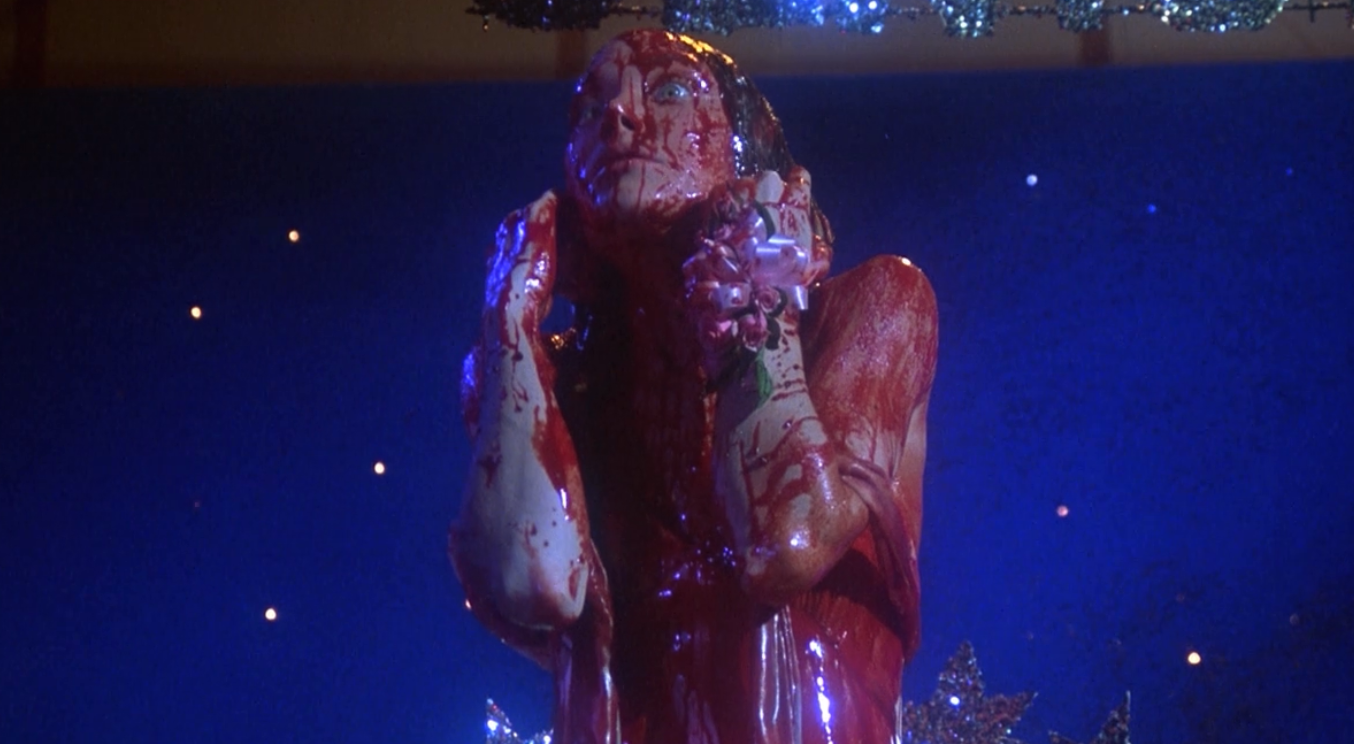
Looking back at it now on an anamoprphic DVD, Scarface looks shoddy in spots, badly blocked: sets seem to end a few feet from the side edges of the screen and the backdrops often look like freestanding drywall in the midst of waterlogged-curling. Loepz's BMW dealership back office with its tropical sunset (above, middle) cuts off into a blackness on every side, with the setting Miami sun wallpaper giving off that flat chintzy feel of a direct-to-video porn film or travel agency. We start the film sensing this will be a big budget panorama: Cuban refugee stock footage, crowded sweaty scenes under-highway encampments, dishwashing, stabbing, twilight phone booths, the wild Colombian chainsaw set piece, but then the gradual tightening noose of opportunity boils it all down to that La Traviata garrett. As Tony "makes his own moves" there are few places that are seen twice in the film, and fewer actors stick around as the scenes tighten up in a forward Apollonian arc that begins to wither into a fecund limpness: real Miami sunshine devolving to that car dealer image of a sunset, hot disco ladies devolving into some dorky dancer dressed like 'El Gordo' and more and more mirrors diluting Tony's vibrancy, as if the vast empire of Scarface merchandise was already draining his snarl of tragic meaning. The architecture eventually turns to gold trim and black marble (a symbol of death like the 'X' markings in the 1932 version) that Gina enters like a ghostly echo with her flimsy negligee open and gun, daring him to come over and make love to her, like the fish-eyed demoness at the climax of Suspiria. I'll go even further on a limb and say that Suspiria borrows quite a bit in color and nightmare logic pacing from De Palma's big break-out Carrie which came out the year before (1976 -though Carrie was still in theaters, and drive-ins by then, as it had become such a cultural landmark even parents were going to see it. It did for proms and telekinesis what Jaws had done for sharks and the ocean two years prior).


But this crazy "Fuck me Tony" scene with Mary Elizabeth Mastrantonio and her nightmare black halo and temple of Dionysus sacrificial dress is where De Palma truly comes to life: mixing that queasy, death-saturated Argento color scheme and slowed-down time (which he mastered with the nightmare pace of the prom queen stair climb in Carrie) and the queasy sense of post-modern sexual displacement of his idol Hitchcock (i.e., he can't realize he's in danger until it's 'on TV'). Not until this final bloody incestuous kiss-off does De Palma find the pitch black death rattle wide-eyed in the face of horror wit that Hecht and Hawks understood better than most, though for them the preparation for facing death was great, the actual death a bit of a joke, whereas with De Palma death comes before there's much time to fix a game face, but the actual process of dying stays as felt and faced as in the grimmest of Italian horror films.  

From top: Suspiria, Untouchables, Bonfire of the Vanities
To get back to the sister, Tony doesn't really understand the way desire for her as just another hot young stranger is all amped up by brotherly love, paternal instinct, and narcissism. I know the effect of seeing your relative whom you've only seen every five or six years suddenly showing up in your neighborhood as a bona fide hottie. It's so so wrong, and for the mentally aberrant, like Tony, it's the ultimate. Just as it was for Caligula, another crazy Italian powermonger, Tony sees all taboo as dares.
Carrie
The only real separation between Italian-American gangster films and Italian horror perhaps is that death is where the gangster film stops, but horror has a few more places to go. And the brutal circumstances of that trip, the violence of going out, is everything. If you look at non-Italian American horror of the same approximate time, death doesn't dawdle. Even most slasher films, the American ones, like Halloween, are really about the stalking and POV camera: when death comes it's almost a relief, since as I pointed out in "A Clockwork Darkness", we now know where the killer is so there's no more worrying from where and when he will strike, how the person will die or if they will escape. No onscreen death can match our dread of the potential for it. But Argento's murders, Depalma's or Scorsese's or Coppola's first two Godfathers, are the exceptions: the moment of the first bullet, stab, or slash doesn't necessarily end the escape chances of survival, or mean a close to the episode. Death throes might go on for a full reel of near escapes, feeble cries for help, and forlorn looks up at the uncaring sky or (as in Fulci's Don't Torture the Duckling) busy highway, pleading for someone to stop...


And architecture plays another part in prolonging the sense of helplessness. In the apartment building where the first murder goes down in Suspiria, the multiple reflective frosted windows, the bizarre wallpaper, strange vertical angles, unholy lighting, and the howling, strange music and create a sense of complete alienation, an inescapable interior 'Hotel Overlook'-style space (though far less recognizable) we feel we recognize it from our own nightmares. We're never sure what is a mirror and what a window; the smoked glass of the bathroom shower stall seems to look right out on the hallway elevator! While De Palma is more rooted in the concrete at least in Scarface, and his vision less baroque, De Palma has a natural tendency to use crane shots and the architecture itself to create a mood of unease. In the climax, it is Tony himself who is the Mater Suspiriorum, or rather Mater Testiculorum Fide and the Bolivian hit squad is Jessica Harper sneaking in with her sewing scissors. 


In the above quotes at the top of this article I wanted to exhume the roots of the Italian artistry as the constant need to escape from mama (or even kill her symbolically, as in Suspiria). In the end of Scarface, Tony realizes even a macho endeavor like criminal empire management can turn him matronly ("Got tits," he drunkenly laments to Manny, visualizing his future as another complacent Lopez, "need a bra"). I say unto thee, blessed is the filmmaker who can recognize his own mom-haunted apron-string slashing anger as art and not feel the need to apologize to both women and the social order in general for his venting. As long as he's conscious of it. And both Argento and De Palma revere strong women, but fear them as well. A strong woman can make a man feel outgunned at every step, emasculated (since nothing he can do--even killing--- will ever measure up to the raw violence of giving birth) but if he can stare death square in the face and say hello to his little friend --this is balls. And balls alone can deliver us into the sad twisting architecture of the last breath, the byzantine nightmare realm where reality and dreams switch place, and life disappears like you just woke up and forgot everything about it like we do so often with dreams.


Mom would pull you back from that void, she's afraid you'll fall. If you heed her, you no longer have your balls, just your word to be good. Being a safe distance from the void may please her, but bores the rest of us stiff. God bless the director who says mama, back off a me, and then dives right over the ledge with his camera

He who chooses hell over heaven, death over life, he is alone truly free of those apron string jelly fish stingers. He looks at the modern reverence for life, health, the family, and winces; knows these gym rats and granola moms are all just scaling heights to nowhere, preserving their mortal husk on entomology's display board in vain  or vanity (or that old excuse, 'for the kids'). We men are from birth trained to apologize for our own measly drives, even our desire for death, and to follow some vague plan of being 'good' or even 'true' -- yoking ourselves ever further beneath the plow to compensate for our inexcusable appendage. Missing the brass ring circle of light on the swim out of the merry-go-round abyss we may and probably will wind up permanently trapped in Lucifer's pool filter. All we can do when that happens is throw some of our magic seeds out onto the grass over our heads and hope it's enough to leave some kind of stain on the earth in our name. All we had in this world was balls and words, but this world didn't want either. Our writing is still ours, unless-a someone pays us for the rights, but our balls are yours, Cook's Tours! Take them around that womb globe. Sow their seed like Set sowed Osiris's chopped up body, or get stuffed, into the palatial tree coffin, the polluted womb. Marry well and often and love your chil--no, don't do either, just run! Run before she gets here she .../// Vito! Where are you going now, you silly boy! 


Read More
Posted in balls, Baroque, Brian De Palma, castration, Cesca, Coppola, Dario Argento, death, Evil, feminism, gangster, Gothic, Howard Hawks, Italian, Italian-American, monster, Scarface, Tony Montana | No comments

субота, 18 травня 2013 р.

Early Hawks: THE CRIMINAL CODE, TIGER SHARK, CEILING ZERO, BARBARY COAST, ROAD TO GLORY

Posted on 11:36 by jackichain

Much as I love Orson Welles, I've never quite forgiven him for his Cahiers du Cinema interview when he was asked to name the three greatest American directors and answered, "John Ford, John Ford, and John Ford." How dare he exclude our greatest director, Howard Hawks? Of course it should be: Howard Hawks, John Ford, and Preston Sturges. Ford was brilliant visually and emotionally but easily mired in his misty-eyed Irish sentiment. He wasn't American -- he was "Irish-American." Sturges is the most American, and Hawks is the most of what makes America great - the knowing the difference between being brave in the face of death and just being an imperialist swine. Of the three when it comes to comedies, only one made The Lady Eve, so earns his spot right there. When Ford tried to do comedy he got lost in children's choirs and rollicking brawls. There's never any religion, or children to get soft over with Hawks. What these men do instead is to face danger on a daily basis, not necessarily externally but internally, so when violence comes their way it's already after they've conquered themselves; and they sing and play music together, and drink and smoke. And when they die, they die like men, or they survive like men, either way without speeches. And if they meet a woman it's ten times faster and more disorienting than a Maginot line charge. There's no chaperone, no parson beaming, no dance, no time for blarney --they have to face that woman alone, and no amount of inner death-defying can prepare them. The whole fabric of the John Ford fort, the small town unity that extends in generations for centuries back, is sublimely pared down to a gummy old cripple, a drunk, and a limping sheriff, holed up in a jail and visited daily by attractive women who seem more modern and free of phony glamor than even Ford's wild Irish tomboys. There's no mutually consenting nonmarital sex in a Ford film, and nothing but nonmarital sex in a Hawks. No weddings, no stern cockblocking elders (only Walter Brennan), no kids (unless they're froggy-voiced old people in kid bodies, like in Gentlemen Prefer Blondes). Ideally, the heroine and hero are dead before they either become or produce either end of the generational spectrum.


Needless to say, John Ford John Ford John Ford has won the history, the legend's been printed; he's got dozens of boxed sets in his name, Hawks none (aside from R2 where he has but one), and part of that may be that Hawks films are still very modern. There are very few misses in his canon but also nothing of superficial (i.e. bourgeois) importance like GRAPES OF WRATH. The closest Hawks gets is maybe his most unHawkslike, SGT. YORK. Usually, instead of emotion, race, and historical accuracy, Hawks' films are fun, archetypal, witty, engaging, resonant more on a Jungian than Freudian level. In some ways it's as if Hawks films take place in the universe that Ford has set up, the same towns and valleys, but then the Hawks characters are never seen in Ford's films because they hide out from all the boring town functions, they'd never dream of going where Fords' camera would be waiting for them. While the Ford characters are off square dancing, speechifying, voting, learning to read and write, and eating big breakfasts, Hawks' characters quietly grab a bottle of whiskey off the table, sneak out back, roll cigarettes and shoot the shit. Fords films are about obeying the rules, worshipping tradition, joining the social order with a deep Catholic devotion, Hawks films are about breaking rules, sidestepping tradition, and letting Dean Martin suffer through the shakes and PTSD brought on by past films enduring Jerry Lewis. "In case you haven't figured it out yet," John Wayne explains to his prisoner; "the minute your brother starts somethin' you're liable to get accidentally shot." The way Wayne says 'shot' is a chilling reminder of death's finality. In some films, guns are just toys and marksmanship is almost irrelevant - the heroes never miss and the villains never hit- but in Hawks it's about being a dead shot even with a pistol fired from the hip, or else staying the hell out of the way of those who are. The rules in most westerns seem very arbitrary and inconsistent: good guys stand around like idiots and bad guys only rarely realize the good guys have been sitting ducks the entire time; in Hawks' films it's always perfectly clear how the sheriff and deputies handle even a walk around town, with hostages and cover fire and every last struck match out of line of fire. It's not that all good guys are great shots, in a Hawks' film, it's that only great shots are welcome. In Ford's, it's that only men good to their saintly old mom are welcome.

In the 30s, though, Hawks was still figuring himself out. He had some great writers, many of whom, like William Faulkner, had served with him in the escadrille signal corps (so had to deal with death daily) or gone hunting with him, BUT Hawks had yet to find his signature action movie style, the male bonding-in-isolation, the querencia mentality, wherein courageous, noble, chivalrous marksmen, pilots, or hunters band together against great odds in an enclosed space. He had some early masterpieces, like SCARFACE, but in some of these early films he's bound by love triangles and other structures odd for Hawks but ubiquitous at the time. Anyway, maybe examining these five early films (in order of release) will help. They're all rather obscure, so I mention how to locate each film, be it available only on VHS, DVD-R, or TCM--which is a crime considering nearly every John Ford movie ever made is remastered out there on disc--and my own ratings.

THE CRIMINAL CODE (1931)
Avail. on VHS and Region 2 DVD
***
Walter Huston is a tough but fair warden who, as DA, sends a naive kid (Phillip Holmes) up the river for ten years. The kid whacked a masher with a bottle in a notorious speakeasy, and the masher died. It's a bad break, but as Huston tersely snaps, "an eye for an eye - that's the foundation of the criminal code!" Waving a black book like a blackjack, Huston has no choice eventually (once he becomes warden) to realize there's a different criminal code, which means don't rat out your fellow inmates. And there's a climax wherein if Holmes rats out a killer of a squealer he'll walk out a free man, but he won't violate the code. He won't! He won't he won't! he won't! Huston gets in some intense acting, grabbing the boy by the lapels and demanding to know who did it. WHO DID IT!??


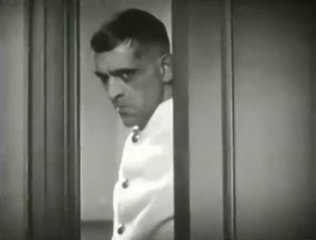
There's some good press room overlapping dialogue introducing the action, but this doesn't feel particularly like a real Hawks film. Once he becomes warden, Huston gets some chances to be super tough, like walking unarmed into a throng of hateful prisoners, or getting a shave from a lifer who cuts another man's throat, and there's a great silent build-up to the whacking of a squealer, with Karloff looming around like a white tunic-sporting Frankenstein, but otherwise characters are trapped in situations clearly contrived for the demonstration of Big Moral Issues, and an air of existential gloom hangs heavy uber alles. There's not much room for Hawksian heroics in such a clamped-down situation (like if the whole of RIO BRAVO was told from the point of view of the imprisoned Joe Burdett).  In TARGETS (discussed here) it's the film Peter Bogdanovich and Karloff watch on TV while getting drunk in Karloff's hotel suite. The VHS I have is pretty solid, made back in the day when they built them to last.

TIGER SHARK (1932)
Occasional TCM airings, Warner Archive DVD
**1/2
When Hawks focuses documentary-style on a tuna fishing off the coast of a Steinbeckain California, going into the heart of tuna schools and pulling them up one after the other, throwing them all into a big trough around the boat, where they flip and flop trying to escape, slicing each other up with their razor fins, you get an idea this was what John Huston was trying for with his mustang hunt in THE MISFITS. When one man fishes for himself, it's the natural order; when a crew fishes for half a state, it's mortifying. The good part here is that man's not strictly the sole apex predator, because where there's fish there's tiger sharks, and they love the spicy tang of a Portuguese-a commercial a-fisherman for-a the nice-a dinner. Edward G. Robinson's jovial capatin loses his hand to one, and so wears a shiny hook (he gets it polished on his wedding day). Another guy loses his legs, dies, and leaves his daughter (Zita Johann) powerless against Eddie's boastful charms. Johann's weird pallor worked in THE MUMMY but she doesn't have the inner fortitude of, say, Greta Garbo's Anna Christie, and so when she falls for Eddie's partner (two-handed hunk Richard Arlen) there's only the sense that he might have access to some benzos that would make the overacting of Robinson's angler bearable. Wrote Andrew Sarris, "Hawks remorselessly applies the laws of nature to sex.The man who is flawed by age, mutilation, or unpleasing appearance to even the slightest degree invariably loses the woman to his flawless rival." There's some good scenes and no bad ones in TIGER SHARK, but Robinson seems miscast. His constant chatter and Portuguese accent seem unduly weak for such a great actor. When he shoots at sharks from the safety of the crow's nest it only makes a sensitive viewer sick, rthough it's when the illicit couple are making out and the bullet fire off camera suddenly stops--that the film's sole moment of 'whoa!' occurs, as how often does a cease fire signal the start of real danger?
 
CEILING ZERO (1936)
VHS
****
Here's the first film where Hawks shows the rapidfireoverlapping dialogue style that would become his trademark. A chronicle of the early days of Newark airport, wherein stray pilots are nursed through heavy fogs by hungover radio operators and ex-daredevil-turned air traffic warden Pat O'Brien deals with overlapping crises via radar and radio while old friends and a snoopy aviation bureau rep (Barton MacLane) try to interfere and/or say hello. We come to admire the way O'Brien can refrain from snapping people's heads off while engaged in life-or-death radio contact and some oblivious person walks in with an oblivious joke and a pat on the back.

Then, enter (tumbling) James Cagney, who served with O'Brien in the Signal Corp (where Howard Hawks served with William Faulkner). It's a bit similar to DAWN PATROL in that O'Brien doesn't fly the planes, and has to send men up in bad conditions (ceiling zero means the fog is so high even the sea gulls are grounded) and he doesn't like it.


A highlight is when they're all trying to help a lost Stu Erwin after his honing beam goes out, and he can't get their radio signal but they can all hear him shouting in panic and rage, him presuming everyone on the ground is off playing poker and they're all shouting into different phone lines all along the flight plan to various listening posts and police stations, and the one girl in the room cries and shouts "Why don't you do something?" and they all bark at once "SHADDUP!!!!" Awesome. We see a slight demerit in Hawks here, not misogynist per se, but his Hawksian woman was still being formed and while the girls are of varying degrees of toughness, they crack up in a crisis, throwing little tantrums when things get terse. There's also some surprising sexual frankness: June Travis offers herself to Cagney for succor after the death of the pilot who took the doomed flight so Cagney could have a date with her -- a shadowy prefiguring of Joe's death in the early section of ONLY ANGELS HAVE WINGS two years later.

The ending is one of those trite bits where everyone's noble self-sacrifice has to constantly trump one another's, but it's almost beside the point; Hawks has found the zippy overlapping dialogue of a bunch of professional men united against the weather, and the (notably Irish blarney-free) velocity of the Pat and Jimmy chemistry is at full manly throttle, setting a benchmark for all the two man hetero bromances to come.

The VHS I got is blurry, not built to last. There is no DVD. It is a crime.

BARBARY COAST (1935)
(DVD)
**1/2
Miriam Hopkins is the first white woman in San Francisco, back in the 19th century gold rush boomtown days, when a pre-Panama Canal ship had to travel all the way around South America to get there and took the better part of a year. Arrivers found a city of unpaved mud roads so nasty they could suck a pedestrian under like quicksand, a dense fog filled with scammers, pickpockets, and ruffians, and inside thenothing but crooked roulette wheels, murderous bouncers, and that pint-sized unlucky-in-love big shot Eddie G. Robinson controlling the works.


There's a few elements that let you know Hawks isn't fully himself here. COAST is one of the films he made as a hired gun of Goldwyn's and he's not particularly enamored with his leading man, Joel McCrea, a foolish poet-type who loses his hard-earned sacks of gold in one turn of Hopkins' fixed roulette wheel, a "cheap price for such an education." This after they fell in love as strangers both seeking shelter from a rainstorm at an old deserted cabin, the period equivalent of running out of gas, myeah. Notes Cinephile:
"There’s little sexual tension, chemistry, or even the vaguest hint of innuendo between the two leads, it would seem a sign attached to one of the gambling tables in Robinson’s casino which reads “No vulgarity allowed at this table” is a rule disappointingly applied to the rest of the film as well. It has little visual identity beyond Ray June’s atmospherically foggy night-time photography (which does some fine work with shadows towards the end) and little of the cynicism or edge which marked out other collaborations with screenwriter Ben Hecht, instead opting for flowery, pretentious dialogue many of the cast clearly struggle with."

Gambling is a hard trick to do right cinematically speaking and Hawks isn't a great one for making money seem important. Lugging sacks of gold through throngs of thieves seems foolhardy, unrealistic, i.e. you can't show a guy getting his pocket picked one second then another one lugging overflowing sacks of gold around by himself and not getting his corpse picked clean insider of six seconds. This inconsistent financial environment takes us as far from the usually clear-cut Hawksian sense of group solidarity and danger pinpointing as you can get. As Old Atrocity, Walter Brennan alone seems to achieve some sort of noble 3-D savagery. His survival in this place, his disheveled, foul-smelling self being welcome even in the glossy casino (where he lures strangers for a cut of the trimmings) makes him one of those rare figures (like C3PO or John Holmes in WONDERLAND) who can wander back and forth between classes, enemy camps, nature and civilization at will.  Add some throw-away lines like "it's hard rowing when I'm so emotional" and it still adds up to a formulaic but well-detailed socio-historic romantic thriller that's no SAN FRANCISCO (1936), nor even--when all is said and done--a TIGER SHARK.

THE ROAD TO GLORY (1936)
(Portugese DVD - Region 1)
***1/4
William Faulkner co-wrote this name-only remake of one of Hawks' silent films. It's hard to imagine it was made a year after BARBARY COAST as it looks straight from 1930, which is a compliment. As as a dreamy WWI Parisian combat nurse with a beautiful black velvet choker-wrapped neck, pale skin, bangs, sexy Red Cross on her cape, and a low-registered speaking voice, Hope Lange has the air of Lauren Bacall on the cover of the March 1943 Harper's Bazaar --which first won Hawks' notice.  You can see the same prematurely world-weary petulance in Lang's face, her moment of self-reflexion (thinking about a dead soldier lover?) a prelude to walking through selfless sacrifice's vampiric portal.


The plot to ROAD is an uneasy mixture of inter-generational jealousy and the same old love triangle and how both are bad for victory: new officer Frederic March meets Lang when they take shelter together from a bombing raid in a blasted-out basement saloon. He plays some tunes on the dusty piano, and puts his coat over her as the rafters rattle. Next day he's bothering her at the hospital while she tries to bandage the wounded, unaware she's the mistress of shaky drunk Warner Baxter, his new C.O. Once Baxter finds out, of course, it's suicide mission time for March, a bit like the situation in Kubrick's PATHS OF GLORY or Von Sternberg's MOROCCO, or any of a dozen other films (or FRIENDS AND LOVERS, reviewed a few posts ago). Adding to the trouble is Baxter's father (Lionel Barrymore) wanting to get into the young man's game of soldiering to prove his worth. He ends up hogging screen time before grenading his own team, Lionel-style. March puts up with it all stoically, and there's never a guess how it ends, DAWN PATROL-style.


A memorable segment of the film involves Germans digging underneath the allied lines while the allies can do nothing but wait it out, rolling cigarettes with their shaky hands as the Germans scrape away below, knowing that as soon as the scraping stops the bombs are likely to go off. That's where the true courage is tested, that painful, prolonged waiting... and smoking. There's a rousing charge across no-man's land and a sneaky night time flank maneuver, but there's still the same auld love triangle, sermons on the ignominy of war, the sense of being pawns in the grip of a writer with a theme and message rather than a director with the guts to let that highlighter pen fall to the floor and trust his own shoot-from-the-gut sense of comedy, overlapping dialogue, cigarettes, whiskey, coffee, and one damned good looking girl.

See also, the 1932 Hawks film THE CROWD ROARS, which I capsuled earlier. 
Read More
Posted in Boris Karloff, Frederic March, hope lange, Howard Hawks, James Cagney, joel mccrea, Lauren Bacall, Lionel Barrymore, Miriam Hopkins, red cross, walter barrymore | No comments
Старіші публікації Головна сторінка
Підписатися на: Дописи (Atom)

Popular Posts

  • Hex and Taxes
    Emancipation Day and The Income Tax Due Date bracketed this past weekend, making it the right time to rent a ghost story/steampunk Dirty Sou...
  • Great Women of Horror: An Acidemic Top Ten
    So many of the top horror film bloggers are women it's not even fair to just say 'it's your month, baby.' Because they rule!...
  • Are You Lonesome, Automaton: Terminator and Halloween vs. Hugo
    I am a mechanical man And I do the best I can Because I have my Family    -- Charles Manson ("Mechanical Man") Was it chance I saw...
  • CinemArchetype #25: The Fisher King
    The cinema has done wrounght or rongt for the Fisher King. What are these two odd words? They wrong and right mixed inextricably together --...
  • Happy Birthday Cheryl Ladd!
    Today, it's Cheryl Ladd's birthday. Happy birthday to an underrated actress, sparkling beauty, sultry singer, and first-class Angel!...
  • 22 Films that prove 1933 was the greatest year for classic movies.
    Everyone cites 1939, year of Oz , Wind , and Grapes, as the best year in the history of movies, but not Acidemic. Here we know the best year...
  • Bitches Be Trippin': TOAD ROAD, A FIELD IN ENGLAND
    I've always taken a hard line stance that idiots (and minors, of course) shouldn't use drugs. Drugs should only be taken by artists,...
  • Independence Daze Streampunk Pick: IRON SKY (2011)
    It all starts rather predictably: blackstronaut James Washington (Christopher Kirby - way cooler than Will Smith) is the first man on the ...
  • Touch by a Locust: EXORCIST II, MANHATTAN BABY
    The riddle of the locust is that the locust is strong, but steel is stronger, so says (I wish) African locust shaman James Earle Jones in E...
  • Secrets of 2012, or the "The Day of a Million Relapses"
    Sorry to be so late to the party in loving/trashing Roland Emmerich's 2012, but I got so much to say, You HAVE TO LISTEN TO ME! We'r...

Categories

  • . Akim Tamiroff
  • 1930s
  • 1932
  • 1933
  • 1941
  • 1967
  • 1968
  • 1969
  • 1970s
  • 1970s dads
  • 1980s
  • 2001
  • 2012
  • 33.3
  • 70s
  • 70s Dads
  • 9 1/2 weeks
  • 9 monkeys
  • aa
  • Aaron Spelling
  • abbi jacobson
  • ABC
  • Abel Ferrara
  • abortion
  • abstraction
  • abuse
  • acid
  • acting
  • Action
  • actor's studio
  • actresses
  • Adam Roarke
  • Adam Sandler
  • Adam Wingard
  • Addiction
  • Adrian Pasdar
  • Adrienne Barbeau
  • adult
  • Adult Books
  • adultery
  • African
  • African American
  • After school special
  • Ahab
  • AIP
  • air-mail
  • airmen
  • airplanes
  • Akira
  • Akira Kurosawa
  • Al Jolson
  • Al Santos
  • alain robbe-grillet
  • Alan Arkush
  • Alan Ladd
  • albert finney
  • Albert Maysles
  • Alchemy
  • alcohol
  • Alcoholics Anonymous
  • Alcoholism
  • Alec Baldwin
  • Alexander Payne
  • Alexandra Breckenridge
  • Alexandra Hay
  • Alfred Hitchcock
  • Ali Larter
  • Alice in Wonderland
  • Alien
  • alien abduction
  • Alien conspiracy
  • alienation
  • aliens
  • Allegory
  • Allen Jenkins
  • Altamont
  • Amanda Warren
  • Ambiguity
  • America
  • American
  • American Horror Story
  • Amnesia
  • amok
  • amok animals
  • amos poe
  • amy allan
  • Anarchy
  • ancient rome
  • androids
  • Andrzej Zulawski
  • Andy Serkis
  • Angelina Jolie
  • Angelo Rossitto
  • Anima psychosis
  • animals
  • Animus
  • Anita Loos
  • Anita Pallenberg
  • Ann Revere
  • Anna Carlisle
  • Anna Christie
  • anna karina
  • Anna May Wong
  • Anna Paquin
  • Anna Sten
  • Anne Francis
  • Anne Hathaway
  • annet mahendru
  • Antichrist
  • Anton Grot
  • Antonioni
  • anxiety
  • apocalypse
  • April Fools
  • Aquarius
  • Arabs
  • Archetpyal
  • archetypal
  • Archetypal Psychology
  • archetype
  • Argentina
  • Argento
  • Armageddon
  • Arnold Schwarzenegger
  • Arous
  • art
  • art scene
  • Arthur Hunnicutt
  • asa butterfield
  • Asexuality
  • asherah
  • ashley cahill
  • Asia Argento
  • astronaut
  • audio mimesis
  • Aurora
  • Automaton
  • Ava Gardner
  • Avengers
  • aviation
  • awesome horror
  • Ayahuasca
  • ayuhuasca
  • Aziz Anzari
  • Baader-Meinhof
  • Baby Doll
  • Backwoods
  • Bad
  • bad faith
  • balls
  • ballyhoo
  • BAM
  • Barbara Crampton
  • Barbara Hershey
  • Barbara Stanwyck
  • Baroque
  • Barry Shear
  • bars
  • Barton Fink
  • Basil Rathbone
  • basquiat
  • Batman
  • Batman Returns
  • Baudrillard
  • bawdy
  • beaches
  • Beards
  • beatles
  • Beatrice Dalle
  • Beckett
  • Bela Lugosi
  • Bella
  • Ben Hecht
  • Benicio Del Toro
  • bergman
  • Bertolt Brecht
  • Best of decade
  • Bette Davis
  • Betty Blue
  • bi-polar
  • Big Liebowski
  • Big Red One
  • Big Sur
  • Bikers
  • Bill Clinton
  • Bill Gunn
  • billie piper
  • Bing Crosby
  • Biography
  • birth
  • bisexual
  • Black
  • Black Cat
  • black comedy
  • Black Dahlia
  • Black Metal
  • Black Star
  • blackface
  • Blacklist
  • blade runner
  • blank generation
  • blaxploitation
  • Bleeding Skull
  • Blind Dead
  • Bloggers
  • Blondes
  • blood
  • blue meanings
  • Blueberry
  • Bob Geldoff
  • bob guccione
  • Bob Hope
  • Bohemian Grove
  • Bombshell
  • Bon Rafelson
  • bondage
  • Bonnie Brown
  • boondoggle
  • bootleggers
  • bootlegging
  • Boris Karloff
  • bourgeois
  • bowery
  • Brad Pitt
  • Bradley Cooper
  • Brain
  • brain damage
  • brainwashing
  • Bramwell Fletcher
  • Brazil
  • Brecht
  • Breillat
  • Brenda Wiley
  • Bret Easton Ellis
  • Brian Cox
  • Brian De Palma
  • Brian Donlevy
  • Brian Glazer
  • Brian Wilson
  • Bright Lights
  • Brit Marling
  • British
  • broad city
  • Broderick Crawford
  • Brooke Shields
  • Bruce Lee
  • Bruce McCall
  • Bruce Willis
  • Bruno Forzani
  • Bruno Ve Sota
  • Buddha
  • Buddhalution
  • Buddhism
  • Bueno Aires
  • Buenos Aires
  • Bugs Bunny
  • Burl Ives
  • Burma
  • Burns and Allen
  • Burt Lancaster
  • burt reynolds
  • Busby Berkeley
  • Busby Berkley
  • Buster Crabbe
  • Cabin Fever
  • Caligula
  • camille paglia
  • camp
  • Camping
  • Canada
  • Canadian
  • Candace Hilligoss
  • Candice DeLong
  • Cannibalism
  • Cannibals
  • capital crime
  • Capitalism
  • Cappucine
  • Carey Mulligan
  • Carlos
  • Carmen Sternwood
  • Carmilla
  • Carol Channing
  • Carole Lombard
  • Caroll Baker
  • Carrie
  • carrie white burns in hell
  • Carroll Baker
  • Cartoons
  • Cary Grant
  • Casablanca
  • Casey Anthony
  • casinos
  • Cassavettes
  • castavet
  • castration
  • Cat Women
  • Cate Blanchett
  • catherine deneuve
  • Catherine Keener
  • Catherine Mary Stewart
  • Catherine Zeta Jones
  • Catholicism
  • Catholics
  • Cecil B. DeMille
  • Cesca
  • CGI
  • Channing Tatum
  • Charles Bickford
  • Charles Coburn
  • Charles Dickens
  • Charles Farrell
  • Charles Haid
  • Charles Kaufman
  • Charles Laughton
  • Charles MacArthur
  • Charles Manson
  • Charlie Bronson
  • Charlie McCarthy
  • Charlie Sheen
  • Charlies' Angels
  • Charlize Theron
  • Charlotte Gainsbourg
  • Charlotte Rampling
  • Cheap Trick
  • Cheech and Chong
  • Cher
  • Cherie Curie
  • Cheryl Ladd
  • chick flick
  • childhood
  • children
  • Children's Hospital
  • Children's liberation movement
  • Chile
  • Chloe
  • Chloe Grace Moretz
  • Chris Hemsworth
  • Chris Nolan
  • Chrisopher Lloyd
  • Chrisopher Walken
  • Christ
  • Christendom
  • Christian Bale
  • Christianity
  • Christina Rosetti
  • Christmas
  • Christophe Waltz
  • Christopher Jones
  • Christopher Lee
  • Christopher Nolan
  • chronicle
  • chthonic
  • Chuck Norris
  • cia
  • Cibo Matto
  • Cinematography
  • Cinq au sept
  • citizen kane
  • City Gardens
  • Civil War
  • Claire Denis
  • Clara Bow
  • Clarence Brown
  • Clarence Muse
  • Clark Gable
  • classic horror
  • Classism
  • Claude Raines
  • Claude Rains
  • Claudette Colbert
  • Cliff Robertson
  • Clint Eastwood
  • clitorectomy
  • cocaine
  • cockblocking
  • Cocoa Cola
  • Cocteau
  • Coen brothers
  • Coffy
  • Coke Ennyday
  • Cold War
  • Colin Farrell
  • Colin Firth
  • collagen
  • colonialism
  • Colorado
  • Columbia
  • Comedy
  • Comedy horror
  • Communism
  • computer games
  • Conan
  • conan barbarian
  • Confederacy
  • conflict diamonds
  • Conrad Veidt
  • conservativism
  • conspiracy
  • Constance Bennett
  • controversy
  • Coppola
  • Copyright issues
  • Cormac McCarthy
  • Cornell Woolrich
  • Corruption
  • Counterculture
  • Country Joe
  • Cpnspiracy
  • crack
  • Craig Robinson
  • crank
  • crazy
  • Creepshow
  • Crestwood
  • Crime
  • criterion
  • Critics
  • Cryogenics
  • Crypto-fascism
  • crystal skull
  • Cul-de-sac
  • cults
  • cultural theory
  • Curtis Harrington
  • Cyd Charise
  • Czech new wave
  • daimonic reality
  • Dakota Fanning
  • Dan Curtis
  • Dance
  • Dance marathon
  • dancing
  • Daniel Ekeroth
  • Daniel McBride
  • Daniel Plainview
  • Daniel Radcliffe
  • Danny Trejo
  • Dario Argento
  • Darionioni Nuovo
  • Dark Secret of Harvest Home
  • Dark Shadows
  • Darwin
  • Dashiell Hammett
  • Daughter Italian Ripp London Ralph Bates Susan Brodrick
  • Daughter of Horror
  • Dave Chapelle
  • David Brandon
  • David Cronenberg
  • David Cross
  • David Del Valle
  • David Fincher
  • David Hemmings
  • David Icke
  • David Letterman
  • David Lynch
  • David Niven
  • David O Russell
  • Dazed and Confused
  • DC Comics
  • Dead
  • dead files
  • Deadgirl
  • Deadly Women
  • Dean Martin
  • Dean Stockwell
  • death
  • death drive
  • death fetishist
  • Deborah Kerr
  • decadence
  • decapitation
  • Defection
  • Dellamorte Dellamore
  • Delphine Seyrig
  • Dementia
  • Demi Moore
  • Demons
  • denise richards
  • Denmark
  • dennis hopper
  • Depression
  • Desert
  • Detective Magazines
  • Detectives
  • detournement
  • Devil
  • Devil Commands
  • devouring other
  • Diablo Cody
  • Diane Keaton
  • diane selwyn
  • Diane Varsi
  • DIaspora
  • Dick Foran
  • Dick Powell
  • Dinah Shore
  • dinners
  • Dino De Laurentiis
  • Dino De Laurentis
  • dinosaurs
  • disaster
  • disillusionment
  • Disney
  • DMT
  • DNA
  • Dogme 95
  • dogs
  • Dogville
  • Dolores Del Rio
  • Dolores Fuller
  • Dolph Lundgren
  • Domestic violence
  • Dominique Strauss-Kahn
  • Dominique Swain
  • Domino Harvey
  • Don Coscarelli
  • Don Rickles
  • Donal Cammell
  • Donald Pleasance
  • Dopey
  • Dorothy Lamour
  • dostoyevsky
  • Douglas Fairbanks
  • Douglas Fairbanks Jr.
  • downtown
  • Dracula
  • dreams
  • Drew Barrymore
  • drinking
  • drinking games
  • Drug addiction
  • drugs
  • Drunken Monkey
  • Duane Jones
  • duff gardens
  • Duke Ellington
  • Dustin Hoffman
  • Dusting Hoffman
  • DW Griffith
  • dwarfs
  • Dyatlov Pass
  • Dylan
  • Dylan Baker
  • Dylan McDermott
  • dystopia
  • Eagles
  • East Germany
  • ecological horror
  • Ed Dorado
  • ed wood
  • eddie nugent
  • Edgar Allen Poe
  • Edgar Bergen
  • Edgar Ramirez
  • Edgar wright
  • Edmund Goulding
  • Edmund Lowe
  • education
  • Edward Arnold
  • Edward Dmytryk
  • Edward Everett Horton
  • Edwige Fenech
  • Ego
  • Egypt
  • Egyptology
  • eisa gonzalez
  • el rey
  • Eli Wallach
  • Eliza Dushku
  • Elizabeth Hurley
  • Elizabeth Taylor
  • Ellen Burstyn
  • Ellen Page
  • Elliot Gould
  • Elliot Nugent
  • Elm Street
  • Elvis
  • Elvis Presley
  • EMA
  • Emily Blunt
  • Emily Watson
  • Emir Kusturica
  • Emma Roberts
  • emperor
  • Endless Love
  • England
  • Enlightenment
  • Ennio Morricone
  • ennui
  • ensemble
  • environmentalism
  • Eric Jonrosh
  • Eric Romer
  • Erich Kuersten
  • Erich von Stroheim
  • Errol Flynn
  • escorts
  • Espionage
  • Eugene O'Neill
  • Europe
  • European
  • Eva Green
  • Eva Mendes
  • Evan Peters
  • Evil
  • evolution
  • excess
  • Existenitalism
  • existential
  • Existentialism
  • Exorcist
  • exotica
  • Experience
  • experimental
  • Exploitation
  • Eyes of Laura Mars
  • Facebook
  • Fairuza Balk
  • fairy tale
  • fairy tales
  • Fakery
  • family drama
  • family dynamics
  • fantasy
  • Fanu
  • farce
  • Farrah Fawcett
  • fascism
  • Fashion
  • Fassbinder
  • Fate
  • fatherhood
  • Fay Adler
  • Fay Wray
  • Faye Dunaway
  • Female Convict Scorpion
  • feminism
  • Fernando De Leo
  • Ferris Bueller
  • Fight Club
  • Film Critics
  • Film Forum
  • Film Noir
  • film preservation
  • Film Theory
  • films
  • Final Destination
  • first national
  • Five Stairsteps
  • five to seven
  • Florence
  • Florence and the Machines
  • Flower Power
  • Folk
  • folk music
  • fool
  • Ford Beebe
  • Forest
  • France
  • Frances Dee
  • Francis Ford Coppola
  • Franco Nero
  • Franco Zeffirelli
  • Francois Dorleac
  • Frank Morgan
  • Frank Sinatra
  • frankenstein
  • Frankenstenia
  • Franklin Pangborn
  • freaks
  • Fred Ward
  • Freddy Kruger
  • Frederic March
  • free love
  • freebase
  • French
  • french girls
  • French New Wave
  • french revolution
  • freud
  • Freudian
  • Fritz Lang
  • Fritz Lieber
  • frostbite
  • Fulci
  • Fundamentalism Christianity
  • fury
  • Fuzzy Night
  • gaby hoffmann
  • Gale Sondergaard
  • gambling
  • Gang violence
  • gangster
  • Gangsters
  • Gary Cooper
  • Gary Morris
  • Gary Oldman
  • Gaspar Noe
  • Gender
  • gender issues
  • gender reassignment surgery
  • Gene Evans
  • Gene Kelly
  • Gene Tierney
  • George Bernard Shaw
  • George C. Scott
  • George Chakris
  • George Clooney
  • george harrison
  • george lazenby
  • George Peppard
  • George Reed
  • George Romero
  • George Sanders
  • George Zucco
  • Georgina Reilly
  • German Expressionism
  • Germans
  • Germany
  • ghost america
  • ghosts
  • Ghoulardi
  • giallo
  • giant spider
  • Giant Spiders
  • Gig Young
  • gigolo
  • gillian robespierre
  • gin
  • Ginger Rogers
  • ginger snaps
  • giorgio moroder
  • Giovanni Lombardo Radice
  • girl power
  • Girls
  • Glasgow
  • Glenda Farrell
  • Glenda Jackson
  • Globalization
  • Gloria Stuart
  • Go Ask Alice
  • God
  • Godard
  • Godfather
  • Godzilla
  • Golden Turkey
  • Golem
  • Gone With the Wind
  • Gonzo
  • Goodfellas
  • Gore
  • Gore Vidal
  • Gort
  • Goth
  • Gothic
  • Government
  • Graveyard
  • gravity
  • Great Britain
  • great depression
  • greed
  • greenwich village
  • Gregory Peck
  • Gregory Ratoff
  • Greta Garbo
  • greys
  • Grindhouse
  • Grizzly Adams
  • Groucho Marx
  • Guggenheim
  • guide
  • gunfights
  • Guns
  • Guru
  • guy debord
  • Gwenyth Paltrow
  • Gwili Andre
  • H.G. Welles
  • habitat
  • Haight-Ashbury
  • HAL 9000
  • Hal Holbrook
  • Halloween
  • hallucinations
  • Hammer
  • handheld horror
  • Hanging Man
  • Happiness
  • Harlem
  • Harold Robbins
  • Harrison Ford
  • Harry Hamlin
  • Harry Nilsson
  • Harvey Keitel
  • haters
  • haunted house
  • hauntings
  • Hazel Court
  • Heather Graham
  • heaven
  • Heckler
  • Helen Hayes
  • Helena Bonham Carter
  • Helene Cattet
  • Hell
  • Hell's Angels
  • henri clouzot
  • Henry Fonda
  • Henry Hill
  • Herbert Marshall
  • Herk Harvey
  • heroin
  • Herschel Gordon Lewis
  • High School
  • highway safety
  • hillbillies
  • Hills Have Eyes
  • Hinduism
  • hippies
  • Hipster
  • hit girl
  • Hitler
  • holidays
  • Hollywood
  • Hollywood Haunted Babylon
  • hollywood sewing circle
  • Hollywood USA
  • Homophobia
  • homosexuality
  • hope lange
  • horror
  • Horror Demons Monsters Hippies Sex
  • Horror films
  • horror screenwriter
  • Horror terror
  • horses
  • hospitals
  • Howard Hawks
  • Howard Hughes
  • Hubris
  • Hugh Herbert
  • Hugh Jackman
  • Hugo Weang
  • Humphrey Bogart
  • Hundustani
  • Hunger
  • hungry charlie's
  • Hunter S. Thompson
  • Huntsman
  • Hurt Locker
  • Hypnotism
  • Hypocrisy
  • Hysteria
  • Ian McKellen
  • Ice Age
  • IFC
  • ilana glazer
  • Ilsa She-Wolf of the SS
  • imitators
  • immortality
  • imperialism
  • In Bruges
  • incest
  • incompetence
  • indecent
  • Indiana Jones
  • Indie
  • Inept
  • infringement
  • Ingrid Bergman
  • Inishmore
  • initiation
  • Insanity
  • Internet
  • intolerance
  • intoxication
  • Isabelle Adjani
  • Italian
  • Italian-American
  • Italy
  • J. Edgar Hoover
  • jack arnold
  • Jack Benny
  • Jack Hill
  • Jack Nicholson
  • Jack Nitzsche
  • Jack Torrance
  • Jackie Coogan
  • Jackie Earle Haley
  • Jackie Gleason
  • jacobean
  • Jacques Dutronc
  • jake gyllenhaal
  • james bond
  • James Caan
  • James Cagney
  • James Cameron
  • James Coburn
  • James Davidson
  • James Deen
  • James Fox
  • James Franco
  • james huberty
  • James Mason
  • James McHattie
  • James Taylor
  • James Toback
  • James Watkins
  • James Whale
  • jamie dornan
  • Jamie Lee Curtis
  • Jan De Bont
  • Jane Asher
  • Jane Birkin
  • Jane Campion
  • Jane Fonda
  • Janet Leigh
  • Janice Rule
  • janos
  • Japan
  • Japanese
  • Jaqueline MacInnes Wood
  • Jason Patric
  • Jason Reitman
  • Javier Bardem
  • Jay Baruchel
  • Jazz
  • Jean Claude Van Damme
  • Jean Harlow
  • Jean Luc Godard
  • Jean Michel Gondry
  • Jeff Bridges
  • Jeff Goldblum
  • Jeff Morrow
  • Jemima Kirke
  • Jennifer
  • jennifer connelly
  • Jennifer Jones
  • Jennifer Lawrence
  • Jennifer's Body
  • jenny slate
  • Jeremy Renner
  • Jerry Lewis
  • Jess Franco
  • Jesse Eisenberg
  • Jessica Alba
  • Jill Banner
  • Jim Breuer
  • Jim Crow
  • Jimi Hendrix
  • jimi page
  • Jimmy Page
  • Joan Blondell
  • Joan Collins
  • joan crawford
  • Joan Jett
  • Joan of Arc
  • Joanne Woodward
  • Joe Cocker
  • Joe E. Brown
  • Joe Kubert
  • joe massot
  • Joe Pesci
  • joel mccrea
  • Joel Schumacher
  • john agar
  • John Barrymore
  • John Bonham
  • John Carpenter
  • John Carradine
  • John Cusack
  • John Cusak
  • John Ford
  • John Garfield
  • John Gilbert
  • John Goodman
  • John Heard
  • John Huston
  • john lennon
  • john lurie
  • John Malkovich
  • john monk saunders
  • John Parker
  • John Phillip Law
  • John Sebastian
  • John Stahl
  • John Wayne
  • Johnny Depp
  • joint
  • Joker
  • Jon Beller
  • Jon Voight
  • Jonas Cord
  • Josef Von Sternberg
  • Joseph Campbell
  • Joseph McCarthy
  • Josh Brolin
  • josh hartnett
  • Joshn Brolin
  • Jude Law
  • Judi Bowker
  • judi dench
  • Judy Davis
  • Judy Garland
  • Julia Roberts
  • Julian Barett
  • Julianne Moor
  • Julie Bishop
  • Julie Harris
  • Juliette Lewis
  • Jung
  • Jungian
  • jungle
  • junk
  • Juno Temple
  • Jurgen Prochnow
  • Justin Timberlake
  • Juvenile Delnquency
  • kali
  • karate
  • Karen Morely
  • Karina Longworth
  • Karl Malden
  • Karyn Kusama
  • Kate Bosworth
  • Kate Jackson
  • Kate Valk
  • Kate Winslet
  • Kathryn Bigelow
  • katniss
  • Katrina Bowden
  • Kay Francis
  • Keira Knightley
  • Keith Richards
  • Kelli Maroney
  • Ken Russell
  • Kenneth Anger
  • Ketamine
  • Kevin Smith
  • KGB
  • kiefer sutherland
  • Kiele Sanchez
  • Kiera Knightley
  • Killer Whale
  • Kim Morgan
  • Kim Novak
  • Kimberly Linn
  • Kirsten Dunst
  • Klaus Kinski
  • Klute
  • Kristen Stewart
  • Kristen Wiig
  • Kristina Lokken
  • Kubrick
  • Kurt Russell
  • La Cava
  • la nouvelle justine
  • lacan
  • lacanian
  • Lake Bell
  • Lambda
  • Lana del Rey
  • Lana Turner
  • Lance Rock
  • language barriers
  • Lars Von Trier
  • Las Vegas
  • last year at marienbad
  • Laura La Plante
  • Lauren Bacall
  • Laurence Olivier
  • Le Tigre
  • Led Zeppelin
  • Lee Marvin
  • Lee Tracy
  • legalize it
  • Lena Dunham
  • Leni Riefenstahl
  • Leo Carrillo
  • Leo Di Caprio
  • Leonardo Dicaprio
  • Les Grossman
  • lesbian
  • Lesbian Sex
  • Lesbianism
  • Lesbians
  • Leslie Nielsen
  • Let's Scare Jessica to Death
  • lewd
  • Lewis Carroll
  • Liam Neeson
  • Lili Taylor
  • Lililan Gish
  • Lily Damita
  • limousines
  • Linda Fiorentino
  • lindsay lohan
  • Lionel Atwill
  • Lionel Barrymore
  • Lionel Stander
  • liquid karma
  • Lisa Houle
  • Liz
  • lizard queen
  • llewyn davis
  • Lohengrin
  • Lolita
  • Lon Chaney Jr.
  • Lon Chaney Sr.
  • London
  • Lord Lhus
  • Lord of the Rings
  • Loretta Yong
  • loretta young
  • Lorne Michaels
  • Lorraine Warren
  • Los Angeles
  • Lotte Lenya
  • louise fazenda
  • Love
  • lsd
  • Lubitsch
  • Luc Besson
  • Lucien Prival
  • Lucille Ball
  • Lucio Fulci
  • Lucretia Martel
  • luis bunuel
  • Luke Jordan
  • Lupe Velez
  • lycanthrope
  • lydia lunch
  • lynch mobs
  • Lynn Lowry
  • M. Night Shyamalan
  • Macbeth
  • Mad Men
  • Madge Evans
  • Madness
  • Mae West
  • Mafia
  • magic
  • Magnificent Ambersons
  • Mako
  • malcolm lowry
  • malcolm mcdowell
  • Mamas and the Papas
  • Mandy Moore
  • Manhattan
  • Manny Farber
  • Manson
  • mantis aliens
  • Marg Helgenberger
  • Maria Montez
  • Marian Marsh
  • Marianne Faithfull
  • Marie Antoinette
  • marijuana
  • Marilyn Monroe
  • Mario Bava
  • Mark Frost
  • Marki Bey
  • Marlene Clark
  • marlene dietrch
  • Marlene Dietrich
  • marlon brando
  • Marni Nixon
  • Marnie
  • Marquis de Sade
  • Martial Arts
  • Martin McDonagh
  • Martin Ransohoff
  • Martin Scorsese
  • Martine Beswick
  • martyrdom
  • Marvel
  • Marwencol
  • Mary Astor
  • Mary Shelly
  • Mary Woronov
  • masculinity
  • Masochism
  • masonic
  • masons
  • Matador
  • Matango
  • Materialism
  • matriarchy
  • Matt Dillon
  • Matthew Wilder
  • Maureen O'Hara
  • Max Ophuls
  • Max Rosenblum
  • Maya Deren
  • Maya Rudolph
  • McGowan
  • media studies
  • medical
  • Megan Fox
  • Meghan Wright
  • Meiko Kaji
  • Melies
  • Melissa Sue Anderson
  • melodrama
  • memoir
  • memory
  • Mercedes de Acosta
  • Mesa of Lost Women
  • mescaline
  • meta
  • metaphysics
  • metatextuality
  • meth
  • Mexican Mud Band
  • MGM
  • mia farrow
  • Michael Blodgett
  • Michael Caine
  • Michael Cera
  • Michael Corleone
  • michael fassbender
  • Michael Lang
  • Michael Madsen
  • Michael Mann
  • Michael Myers
  • Michael Remar
  • Michael Shannon
  • Michael Smiley
  • Michele Soavi
  • Mick Jagger
  • mick lasalle
  • mid-life crisis
  • Mike Hammer
  • Mike Myers
  • Military
  • Milla Jovovich
  • Milla Jovovitch
  • Mimsy Farmer
  • mind control
  • minnie castavet
  • Minotaur
  • miranda frost
  • Miriam Hopkins
  • Misandry
  • miscegenation
  • Mischa Auer
  • misogynist
  • misogyny
  • Mitt Romney
  • MK Ultra
  • Mobsters
  • Moby Dick
  • Moira Shearer
  • Monarch
  • Monica Lewinsky
  • Monica Vitti
  • Monkees
  • monkeys
  • Monogram
  • monster
  • monsters
  • Monte Hellman
  • Monterey Pop
  • Montgomery Clift
  • morality
  • morphine
  • Mortimer Snerd
  • Mothra
  • Muhammed Ali
  • Mummies
  • Murder
  • murder comedy
  • mushrooms
  • music video
  • Musical
  • musicals
  • Mutations
  • Myrna Loy
  • Mystery
  • mysticism
  • Myth
  • Nabokov
  • Naked
  • Naked Lunch
  • nancy allen
  • Nancy Grace
  • Nancy Loomis
  • Natalie Portman
  • Natasha Henstridge
  • Native Americans
  • nature
  • nautical
  • Nazis
  • Near Death Experiences
  • Neil La Bute
  • Neile Adams
  • nerve profiles
  • netflix
  • new earth army
  • New York City
  • Nic Cage
  • Nicholas Ray
  • Nicholas Roeg
  • Nick Gilder
  • Nick Redfern
  • Nicolas Cage
  • Nicolas Winding Refn
  • Nicole Kidman
  • Nietzsche
  • Nigeria
  • no girlfriends
  • Noel Francis
  • Nora von Waldstätten
  • Nordic
  • Nordics
  • Norma Shearer
  • Nostradamus
  • nouvelle vague
  • Novelists
  • Nude
  • Nudity
  • NYC
  • nymphomania
  • Obama
  • obelisk
  • obituary
  • obscenity
  • Obsession
  • occult
  • ocean
  • Oh Calcutta
  • Oliver Assayas
  • Oliver Stone
  • Olivier Assayas
  • olympiad
  • Omar Bradley
  • ona munsen
  • Ontario
  • opera
  • opium
  • Orca
  • orgy
  • orientalism
  • Orson Welles
  • Oscarbait
  • Otis Redding
  • Otto Preminger
  • overacting
  • overdose
  • Owen Wilson
  • ozone
  • Pacific Northwest
  • Paddy Chayefsky
  • Paganism
  • palpatine
  • Pam Grier
  • Paranoia
  • Parenting
  • Paris
  • Paris Hilton
  • Party
  • pastiche
  • Pastorale
  • Patriarchy
  • Patricia Arquette
  • Patricia Ellis
  • Patrick Harpur
  • Patriotism
  • Patton
  • Paul Garratt
  • Paul McCartney
  • Paul Newman
  • Paul Robeson
  • Paul Ryan
  • Paul Schrader
  • Paul Thomas Anderson
  • Paul Walker
  • Paula E. Shepherd
  • Paula Prentiss
  • Paulette Goddard
  • Paulina Porizkova
  • Pedophiles
  • Pedro Almodovar
  • Peggy Hopkins Joyce
  • Penelope Cruz
  • Penitentiary
  • penny dreadful
  • penthouse
  • People Next Door
  • Performance
  • permeability
  • Pert Kelton
  • perversion
  • Peter
  • Peter Bogdanovich
  • Peter Brandt
  • Peter Cushing
  • Peter Fernando
  • peter fonda
  • Peter Lorre
  • Peter O'Toole
  • Peter Sellers
  • Peter Weller
  • petit-bourgeois
  • Peyote
  • Phil Hartman
  • Phillip Baker Hall
  • Phillip Seymour Hoffman
  • picnic at hanging rock
  • Pink Floyd
  • Pirates
  • PJ Harvey
  • PJ Soles
  • plague
  • Platonic love affairs
  • poetry
  • Poison Gas
  • Poland
  • Police
  • Political Anal father
  • Political Analogy
  • Politicians
  • Politics
  • Popeye
  • Poppers
  • poppies
  • Population control
  • porn
  • pornography
  • Portia Doubleday
  • post-apocalyptic
  • Post-code
  • Post-Modernism
  • pot
  • power
  • PRC
  • pre-code
  • pregnancy
  • President
  • Preston Sturges
  • pretentiousness
  • preversion
  • Prince Prospero
  • Production Code
  • prohibition
  • prometheus
  • promiscuity
  • prostitution
  • protests
  • pscyhe
  • psychedelia
  • psychedelic
  • psychedelics
  • psychic twins
  • Psychology
  • Psychopaths
  • psychotronic
  • psycology
  • Public Domain
  • Punch-Drunk Love
  • quatermass
  • Quentin Tarantino
  • Race
  • Rachel Weisz
  • racism
  • Radley Metzger
  • Ralph Bellamy
  • Ralph Meeker
  • Ramones
  • randy moore
  • Randy Newman
  • Raoul Walsh
  • Rape
  • Rapture
  • Raquel Welch
  • Rare
  • Ravenna
  • Ravi Shankar
  • Ray Bolger
  • Ray Milland
  • Raymond Chandler
  • reality
  • Rebekah del Rio
  • recuperation
  • red cross
  • Redheads
  • Rednecks
  • Reece Shearmith
  • Regicide
  • Reincarnation
  • remake
  • remarriage
  • Renny Harlin
  • repression
  • reptile cortex
  • Reptilians
  • Republicans
  • Repulsion
  • retro
  • Revolt
  • Rhada Mitchell
  • Ricardo Cortez
  • richard barthelmess
  • Richard Basehart
  • Richard Burton
  • Richard Dix
  • Richard Gere
  • Richard Harris
  • richard hell
  • Richard Kelly
  • Richard Linklater
  • Richard Matheson
  • Richard Nixon
  • Richard Pryor
  • Richard Rush
  • ridley scott
  • riots
  • ritual
  • RKO
  • RNC
  • Rob Zombie
  • Rober De Niro
  • Robert Altman
  • Robert De Niro
  • Robert e. howard
  • Robert Evans
  • Robert Mitchum
  • Robert Montgomery
  • Robert Pattinson
  • Robert Plant
  • robert rodiguez
  • Robert Ryan
  • Robert Siodmak
  • Robert Wagner
  • Robert Wise
  • Robots
  • rock
  • rodeo
  • roger corman
  • Roger Ebert
  • Roger Vadim
  • Roger Waters
  • Roger Wnslet
  • Roland Emmerich
  • Rolling Stones
  • Roman Coppola
  • Roman Polanski
  • Romance
  • rome 78
  • Romero
  • Romy Schneider
  • roost
  • Rory Cochrane
  • Rosamund Pike
  • Rosemary
  • Roswell
  • roy abramsohn
  • roy batty
  • roy scheider
  • royalties
  • Rubber
  • Rudy Vallee
  • Rudyard Kipling
  • Runaways
  • Rural
  • Russ Meyer
  • Russia
  • Russian spies
  • Russians
  • Rutger Hauer
  • Ruth Chatterton
  • ruth gordon
  • rutledge
  • Ryan Gosling
  • sacrifice
  • sacrificial
  • sadcore
  • Sadism
  • sadomasochism
  • Saint Francis
  • Salem
  • salieri
  • Sam Fuller
  • Sam Neill
  • Sam Peckinpah
  • Samuel Fuller
  • San Pedro
  • sandahl bergman
  • Sandra Bullock
  • Sandra McCoy
  • Sarah Anne Jones
  • Sarah Michelle Gellar
  • Sarah Silverman
  • Sartre
  • Satan
  • Satanic Panic
  • Satanism
  • satire
  • satyriasis
  • sauron
  • Scarface
  • Scarlett Johansson
  • scary
  • Schizophrenia
  • schlock
  • Science
  • Science Fiction
  • scopophilia
  • Scotland
  • Scottie Schwartz
  • Scream Factory
  • Screwball
  • sean connery
  • Sebastián Silva
  • Seduction
  • self-reflexivity
  • Self-Styled Siren
  • serials
  • Seth Rogen
  • seventies
  • seventies dads
  • severin
  • severine
  • sex
  • sex comedy
  • sex crimes
  • sexism
  • sexual abuse
  • Sexual Assault
  • sexual awakening
  • sexual discrimination
  • sexual seduction
  • Sexuality
  • sexy 30s actresses
  • Shakespeare
  • Shaman
  • Shark Week
  • Sharknado
  • Sharks
  • Sharni Vinson
  • Sharon Stone
  • Sharon Tate
  • Sheep
  • Shelly Winters
  • Sherri Moon Zombie
  • Shining
  • Shirley Ross
  • Shout
  • Shrinks
  • Sick
  • Sig Rumann
  • Sigmund Freud
  • signal corps
  • Sil
  • silent
  • Simon and Garfunkel
  • Simon Callow
  • Simon Pegg Nick Frost
  • simpsons
  • Sin
  • sissy spacek
  • Situationists
  • sixties
  • sizzle
  • skeeviness
  • slacker
  • slam dancing
  • slasher
  • slavery
  • Sleaze
  • Sleepy
  • Slow Ride
  • smoking
  • snow
  • Snow White
  • sobriety
  • Social Message
  • social psychology
  • Society of Enjoyment
  • Sofia Coppola
  • soldier of fortune
  • Sonny Tufts
  • sophie marceau
  • soundwaves
  • South Ameri
  • South America
  • Southern Gothic
  • Southland Tales
  • Space
  • Species
  • spider baby
  • Spiderman
  • spirits
  • Spooky Behavior
  • sprituality
  • Stacey Nelkin
  • Stacie Ponder
  • Stacy Keach
  • Stagefright
  • Stanley Cavell
  • Stanley Kubrick
  • star wars
  • starship troopers
  • Starvation
  • steampunk
  • Stendahl
  • Stepford Wives
  • stephen king
  • steve de schavi
  • Steven Shaviro
  • Steven Soderbergh
  • Steven Spielberg
  • stock market
  • Stoner
  • Stoners
  • stop motion
  • Street Fighter
  • Strip Clubs
  • structuralism
  • submarines
  • Substitute
  • subtext
  • suburbia
  • Subversion
  • Succubus
  • Sue Lyon
  • suicide
  • Sunset Gun
  • Superheroes
  • supermodel
  • Supernatural
  • surfing
  • surrealism
  • Susan Doukas
  • susan foster kane
  • Susan Strasberg
  • Suspiria
  • Suzy Kendall
  • Svengali
  • Swedish
  • Swingers
  • Swinging
  • Sydney Pollack
  • Syfy
  • Sylvester Stallone
  • Sylvia Sidney
  • symbolism
  • syracuse
  • Syracuse University
  • tabs
  • Taissa Farmiga
  • Talia Shire
  • Talk Radio
  • tangerine dream
  • Tara Reid
  • tarantual
  • Targets
  • Tarzan
  • teachers
  • ted wilde
  • teenagers
  • telekinesis
  • Templars
  • Tenebrous Kate
  • Tennesse Williams
  • Terence Malick
  • Terence McKenna
  • Terminator
  • Termite Art
  • Terror
  • Terrorism
  • Terrorists
  • Terry Gilliam
  • Terry Southern
  • Texas
  • Thai
  • That's the Way it Is
  • THC
  • The Big Sleep
  • The Grey
  • the sentinel
  • the thing
  • Theater
  • Thelma Todd
  • theory
  • Theresa Russell
  • Third World
  • Thor
  • Ti West
  • Tibetan
  • Tiffany Bolling
  • Tim Burton
  • Time Dilation
  • Times Square
  • Timothy Carey
  • timothy dalton
  • Timothy Leary
  • titan
  • Titanic
  • Tokyo
  • Tom Atkins
  • Tom Cruise
  • Tom Fergus
  • Tom Hardy
  • Tommy Lee Wallace
  • Tony Clifton
  • Tony Montana
  • Tony Scott
  • Tor Johnson
  • Toshiro Mifune
  • totem
  • Tourists
  • Track 29
  • transgendered
  • Treasure Island
  • Trick R Treat
  • Trilby
  • trip
  • tripping
  • trippy
  • Tristana
  • tropics
  • trucks
  • true crime
  • trumpet
  • TV
  • TV Movie
  • Twilight
  • Udo Kier
  • UFOs
  • UHF
  • Ulysses
  • unborn
  • Uncle Tom's Cabin
  • unconscious
  • undead
  • unions
  • Universal
  • ursula andress
  • Uwe Boll
  • V for Vendetta
  • Vacation
  • Vagina Dentata
  • Val Lewton
  • Valerie and her week of wonders
  • Valerie Leon
  • values
  • vamipires
  • Vampira
  • vampire
  • vampires
  • Vanessa Howard
  • varney
  • Vegetarianism
  • Venice
  • Ventriloquism
  • venus flytrap
  • venus in furs
  • Vera Farmiga's sister
  • Veronica Lake
  • vertigo
  • VHS
  • vice
  • Victorian
  • Victory Jory
  • vietnam
  • Viggo Mortenson
  • Vince Gallo
  • Vincent Cassel
  • Vincent Price
  • Vincente Minnelli
  • Ving Rhames
  • vintage
  • vintage TV
  • violence
  • Violence cocaine
  • Violet
  • Virginia Bruce
  • Virginity
  • Voiceovers
  • voodoo
  • W. Somerset Maugham
  • W.C. Fields
  • W.S. Anderson
  • Wagner
  • Wall Street Protesters
  • Wallace Beery
  • Wallace Shawn
  • Walt Disney
  • walter barrymore
  • Walter Hill
  • Walter Houston
  • walter huston
  • Walter Pigeon
  • Waltons
  • War
  • Warner
  • Warren Beatty
  • Warren Oates
  • Warren William
  • warriors
  • Wartime
  • Wasps
  • Watergate
  • WC Fields
  • weed
  • Weimar
  • Weldon
  • werewolves
  • Werner Herzog
  • Wes Anderson
  • Wes Craven
  • westerns
  • white slavery
  • Whitney Cummings
  • Who
  • Wicker Man
  • Wilder
  • Wilderness
  • Willem Dafoe
  • William Beaudine
  • William Bendix
  • william castle
  • William Faulkner
  • William friedkin
  • William Girdler
  • William Hickey
  • William Hurt
  • William Peter Blatty
  • William Powell
  • William S. Burroughs
  • William Shatner
  • Willie Best
  • Winona Ryder
  • Winter
  • Witchcraft
  • Witches
  • Wizard of Oz
  • wonderwall
  • Woods
  • Woodstock
  • Woody Allen
  • Woody Harrelson
  • Woolf
  • world war I
  • World War One
  • World War Two
  • Worst Movie
  • Wrong Turn
  • wrongslayer
  • WW1
  • WW2
  • XXX
  • Youth
  • Yvonne Furneaux
  • Z-Man
  • Zach Galiafinakis
  • Zach Snyder
  • Zen
  • zeppelin
  • Zionists
  • Zizek
  • zombies
  • Zoolander

Blog Archive

  • ▼  2014 (37)
    • ▼  липня (5)
      • Taming the Tittering Tourists: 50 SHADES OF GREY, ...
      • OBVIOUS CHILD, GINGER SNAPS and Your Reproductive ...
      • Medusae of Asia: THE SHANGHAI GESTURE (1941), RAIN...
      • Two hearts stab as one: Brian De Palma + Dario Arg...
      • Dawn of the Dinkins: RANDOM ACTS OF VIOLENCE (2013...
    • ►  червня (4)
    • ►  травня (6)
    • ►  квітня (6)
    • ►  березня (5)
    • ►  лютого (6)
    • ►  січня (5)
  • ►  2013 (70)
    • ►  грудня (7)
    • ►  листопада (5)
    • ►  жовтня (6)
    • ►  вересня (7)
    • ►  серпня (4)
    • ►  липня (4)
    • ►  червня (4)
    • ►  травня (5)
    • ►  квітня (7)
    • ►  березня (7)
    • ►  лютого (3)
    • ►  січня (11)
  • ►  2012 (93)
    • ►  грудня (8)
    • ►  листопада (10)
    • ►  жовтня (9)
    • ►  вересня (6)
    • ►  серпня (6)
    • ►  липня (6)
    • ►  червня (6)
    • ►  травня (6)
    • ►  квітня (10)
    • ►  березня (7)
    • ►  лютого (9)
    • ►  січня (10)
  • ►  2011 (134)
    • ►  грудня (9)
    • ►  листопада (10)
    • ►  жовтня (8)
    • ►  вересня (11)
    • ►  серпня (9)
    • ►  липня (9)
    • ►  червня (13)
    • ►  травня (13)
    • ►  квітня (16)
    • ►  березня (16)
    • ►  лютого (12)
    • ►  січня (8)
  • ►  2010 (118)
    • ►  грудня (7)
    • ►  листопада (10)
    • ►  жовтня (10)
    • ►  вересня (11)
    • ►  серпня (16)
    • ►  липня (8)
    • ►  червня (11)
    • ►  травня (12)
    • ►  квітня (7)
    • ►  березня (10)
    • ►  лютого (9)
    • ►  січня (7)
  • ►  2009 (48)
    • ►  грудня (6)
    • ►  листопада (6)
    • ►  жовтня (9)
    • ►  вересня (5)
    • ►  серпня (13)
    • ►  липня (9)
На платформі Blogger.

Про мене

jackichain
Дивитися мій повний профіль